Almost everyone who makes the trip out to Kadamattom Church goes for the sorcerer. Kadamattathu Kathanar — the priest who bound a yakshi — is the best-known supernatural story in Malayalam, and we have told the whole cycle elsewhere. This piece is about the other thing in the building, the one that can be checked.
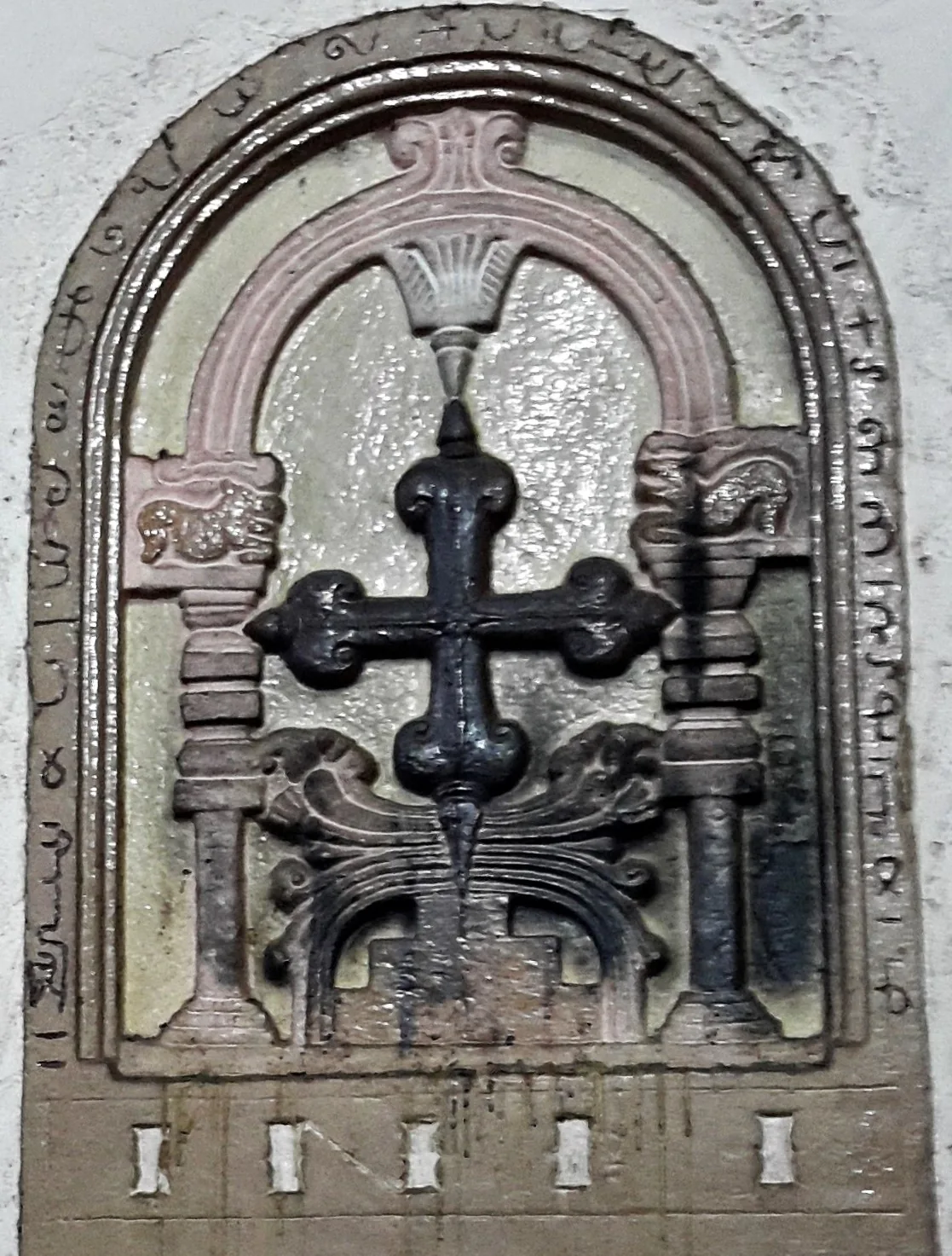
Set into the wall of the madbaha, the altar room, is a carved granite slab: a cross with floral-tipped arms standing on a stepped base, framed by an arch on two columns, with a line of script running round the arch. The script is Pahlavi, the language of Sasanian Persia. It is one of a small family of such stones in South India, and it is the reason this church matters to historians who have never heard the ghost story.
Who put it there
The church traces itself to Mar Abo, better known as Mar Sabor. He and a colleague, Mar Proth, were bishops of the Church of the East who arrived on the Malabar coast around 825 with a party of Persian Christian settlers, landing at the port of Kollam — then part of the Venad kingdom.
They founded, by tradition, a string of churches: Kadamattom, Akaparambu, Niranam, foundations at Kollam and Kayamkulam, and finally Thevalakkara, where they are said to have died and been buried. Here the ground was granted by the Kartha, the local chieftain, which makes the founding story a joint one — a Persian bishop and a Hindu ruler, six centuries before any European reached this coast.
- Mar Sabor and Mar Proth: Persian bishops, arrival dated to about 825, multiple foundations along the coast. Historical.
- The Pahlavi cross: a genuine medieval artefact with a legible, published inscription. Historical.
- Kadamattathu Kathanar: no contemporary record of any kind. Legend, and worth knowing as legend.
What the inscription actually says
This is usually left vague, as though the text were undeciphered. It is not. Professor F. C. Burkitt and C. P. T. Winckworth, then reader in Assyriology at Cambridge, produced a reading that was presented at the International Congress of Orientalists at Oxford in 1925, and it has never been seriously overturned.
It reads: “My Lord Christ, have mercy upon Afras, son of Chaharbukht, the Syrian, who cut this.” Winckworth later revised the final phrase to “who preserved this.”
That is worth sitting with. It is not a creed or a dedication. It is a prayer for one named man — Afras, son of Chaharbukht — and it survives in a working parish thirty kilometres inland from Kochi eleven hundred years later. Two Persian names, cut into Kerala granite, still on the wall of a church where Mass is said this morning.
The awkward part: this one is a copy
The Pahlavi crosses of South India form a small set — Kadamattom, two at Kottayam Valiapally, Muttuchira, Alangad, Kothanalloor, and the Mount cross at St Thomas Mount in Chennai. They are close enough to each other that Winckworth concluded the inscriptions all descend from a single original text, copied from stone to stone.
The Kadamattom carving is specifically assessed as a copy of one of the others, most probably the larger Kottayam cross — and not a careful one. The judgement is that whoever cut it was reproducing shapes rather than reading words. One epigraphic argument, made by B. T. Anklesaria on the letter forms, puts the Alangad cross closest to the original.
We flag this because our own page on the church treated the cross as the unambiguously solid half against the unprovable legend, and that was three-quarters right rather than wholly right. The stone is old, real and important. It is not a Mar Abo original, and the tradition that he carved it himself does not survive scrutiny.
Why the copying is the interesting part
It would be easy to read all this as deflation. It is the opposite. An original tells you one Persian Christian community was here. A chain of copies tells you something harder to get at: that the object went on mattering after the language stopped being understood.
Somebody, generations after Afras, wanted this cross in their own church badly enough to have it cut again — arch, columns, floral arms, and a border of characters they could not read, reproduced as faithfully as an illiterate hand could manage. That is what devotion to an inherited form looks like in stone. The Saint Thomas Christians were not preserving a Persian text; they were preserving a Persian “church”, in a country where nobody around them was going to do it for them.
What happened to Mar Sabor afterwards
One more thing, because it explains the feast. At the Synod of Diamper in 1599, convened under Portuguese authority to bring the Malabar church under Rome, Mar Sabor and Mar Proth were declared heretics and their veneration was to be suppressed.
It did not work. The parishes went on keeping their days, and the principal feast at Kadamattom, on the 24th and 25th of Makaram, is still the death anniversary of Mar Abo. Four hundred and twenty-odd years after a European synod struck him off, a Kerala hill church fills up for him every January or February. Whatever else the Portuguese changed here, they did not manage that.
Seeing it
The cross is on the right-hand wall of the madbaha. Access to the altar area is restricted during and around services, footwear comes off at the door, and you should ask before photographing it. The relief has been picked out in paint at some stage, which makes the design far easier to read from a few feet away and makes epigraphers wince.
Go on an ordinary weekday if you want to look at it properly. The Makaram feast is a fine thing to witness, but you will not be getting near the altar wall.
Frequently asked questions
How old is the Persian cross at Kadamattom?
The family of Pahlavi-inscribed crosses in South India is generally dated between about the seventh and tenth centuries, and Kadamattom is conventionally placed in the ninth, consistent with the church's traditional founding around 825. Precise dating is contested, partly because the inscriptions copy one another, so treat any single confident date with caution.
What language is the inscription in?
Pahlavi — Middle Persian, the language of the Sasanian empire — which is itself the historical point. It places the church inside the world of the Church of the East in Persia rather than anything European, and long before any European arrival on this coast.
What does it say?
On the reading by Burkitt and Winckworth presented at Oxford in 1925: “My Lord Christ, have mercy upon Afras, son of Chaharbukht, the Syrian, who cut this.” Winckworth later preferred “who preserved this” for the last phrase. It is a memorial prayer for a named individual.
Where are the other Persian crosses?
Kottayam Valiapally has two, and there are crosses at Muttuchira, Alangad and Kothanalloor, plus the Mount cross at St Thomas Mount in Chennai. They belong to different churches and different denominations today, which is itself a reminder that they predate the divisions.
Is the Kadamattom cross original or a copy?
A copy, on the scholarly reading — most likely of the larger Kottayam cross, cut by someone who could not read the script he was reproducing. That does not make it fake or modern; it is a genuine medieval object. It makes it a witness to how the Saint Thomas Christians kept reproducing an inherited Persian form long after the language behind it had gone.
Can I see it?
Yes, outside service times. It is set into the right-hand wall of the madbaha, the altar room, so access is restricted during and around services. Take your footwear off at the door, dress modestly, and ask before you photograph it.