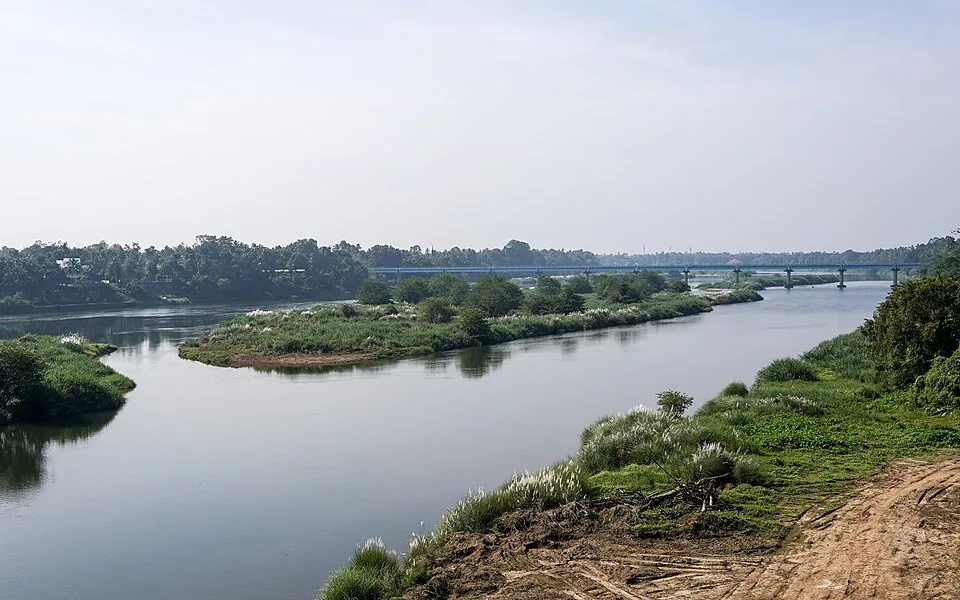
Two stories are told at the Kalady ghats, and both of them happen in the Periyar rather than in any of the temples. They are told as tradition, we report them as tradition, and they are the reason the riverbank here is worth standing on for longer than the buildings take.
One point of vocabulary first. The Periyar was known in older usage as the Purna or Poorna, and the Kalady stories are usually told with that name.
The crocodile
The best-known story concerns how Shankara became a monk, and it turns on a piece of negotiation rather than on a miracle.
As a boy he wanted to renounce the world and take sannyasa. His widowed mother, Aryamba, refused — he was her only son, and a son who becomes a renunciate is, socially and ritually, lost to his family. The matter was unresolved when, bathing in the river, a crocodile seized his leg.
From the water, the boy called to his mother that the crocodile would not release him unless she gave her permission for him to take sannyasa. Faced with losing him either way, she consented. The crocodile let go, and Shankara left to find a teacher.
- It is not primarily a story about an animal. It is a story about consent extracted under duress, and it knows it.
- The tradition preserves the mother’s refusal rather than smoothing it away, which is unusual for a hagiography.
- Most tellings add that Shankara promised to return to her at the end of her life — a promise the tradition says he kept.
The river that moved
The second story explains the village’s name. Aryamba, the telling goes, had to walk some distance — often given as around three kilometres — to reach the Purna for her daily bath, and one day she collapsed on the way. The boy prayed to Krishna, the family deity, and the river changed its course, moving to follow the path his feet had traced so that it would run close to their home.
The name is then explained from that: kal-adi, foot-mark, the village of the footprints. It is a satisfying etymology and it is the one you will be told locally. We have not found a source that settles it independently of the legend it explains, which is a familiar shape — a place name and a story that each justify the other.
Why Krishna, and not Shiva
Visitors sometimes find it odd that the philosopher most associated with Shiva devotion has a Krishna temple at his birthplace. The tradition’s answer is simply that Krishna was the kuladevata, the family deity of his household, and that the image at the Sree Krishna Temple was installed by Shankara himself. That is a claim of tradition rather than of record, and we pass it on as such.
The nearby Karthyayani Devi Temple is the other family-linked shrine at Kalady. Do not confuse it with the far better known Karthyayani Devi Temple at Cherthala in Alappuzha, which is a separate temple and will dominate any search you run.
Standing where the stories are set
The practical value of knowing all this is that it changes what you look at. Most visitors give the ghats five minutes and the Keerthi Sthambha half an hour, which is the wrong way round for anyone who came for the stories. Both of them are set at the water.
Treat the river with the care it deserves rather than the reverence alone. The Periyar is a managed river with dams upstream, the ghat steps are slippery when wet, levels can rise without local rain, and there are no lifeguards. Watch children closely.
Frequently asked questions
What is the crocodile story of Adi Shankara?
Tradition holds that while bathing in the river at Kalady, the boy Shankara was seized by a crocodile, and that he told his mother from the water that it would only release him if she permitted him to take sannyasa. She consented, the crocodile let go, and he left to become a renunciate. It is told as legend.
Why is Kalady called Kalady?
The local explanation is kal-adi, foot-mark — from the story that the river changed its course to follow the path traced by the child Shankara’s feet, so that his mother would not have to walk far to bathe. We have not found a source that establishes the etymology independently of the legend it explains.
Which river is associated with Adi Shankara at Kalady?
The Periyar, Kerala’s longest river, known in older usage as the Purna or Poorna. Both of the best-known Kalady legends — the crocodile and the change of course — are set in it.
Who was Aryamba?
Adi Shankara’s mother, a widow raising an only son. She appears in both the main Kalady legends: refusing him permission to take sannyasa until the crocodile forced the matter, and collapsing on the long walk to the river in the story that explains the village name.
Why is there a Krishna temple rather than a Shiva temple at Kalady?
Because Krishna was the kuladevata, the family deity of Shankara’s household. Tradition also holds that the image at the Kalady Sree Krishna Temple was installed by Shankara himself — a claim of tradition, not of record.
Can you bathe in the Periyar at the Kalady ghats?
People do, but treat it with care rather than only reverence. The Periyar is dam-regulated, so levels can rise from upstream rain or a release with no warning locally, the ghat steps are slippery when wet, and there are no lifeguards. Watch children closely.