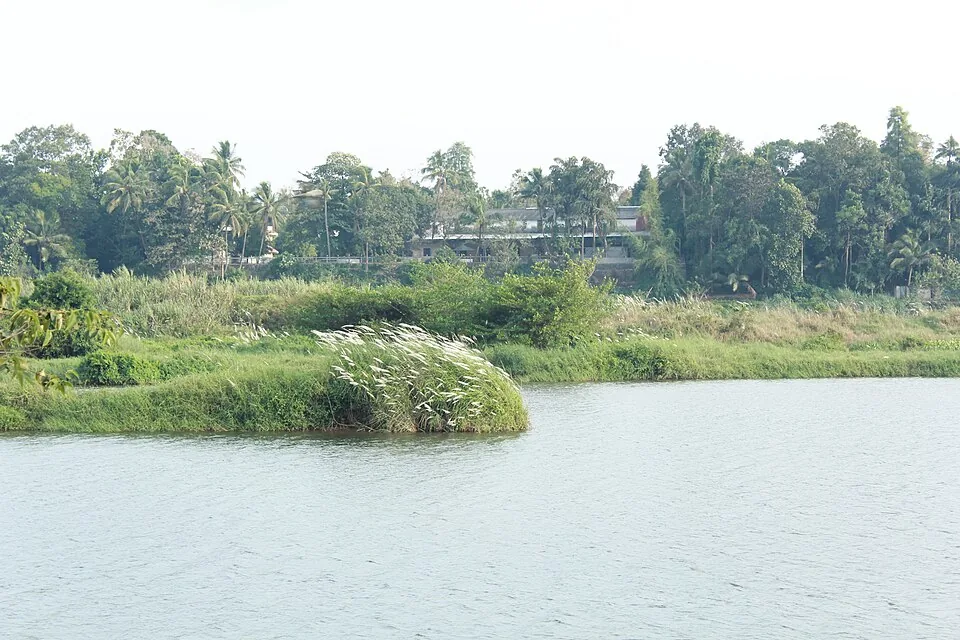
Everyone at Kalady is told the footprint story. Aryamba, Adi Shankara’s ageing mother, had to walk some distance each day to bathe in the Purna — the older name for the Periyar — and one day she fainted on the way. Her son prayed to Krishna. Krishna answered that the river would flow wherever the boy’s feet marked. Shankara walked; the river followed his footprints to the family’s door; the village has been called Kalady, the footprint, ever since.
It is told as a story about filial devotion, and it is. Now follow the water.
A river that reaches a house also reaches a temple
If the Purna moved to run past the family home, it moved across the ground the family’s temple was standing on. The Devaswom’s own account says exactly that: the original temple was submerged in the new riverbed.
The tradition then has Shankara reinstall the deity at the site the temple occupies today. And the detail preserved about that reinstallation is not devotional at all — it is technical, and slightly awkward. It was done on the Thiruvonam star in the month of Tulam, during Dakshinayana: the southward half of the year, not the Uttarayana period conventionally preferred for installing a deity. He is said to have marked the occasion by composing the Achyuta Ashtakam.
That is the shape of a real event showing through a miracle. Nobody invents an inauspicious date for a founding. You record an inauspicious date because it is what happened, and because the alternative was leaving the deity under water until the calendar improved.
They still worship the site that drowned
The part that stops you is what the temple does about it now. Puja is still performed at the original site, down at the Kalady ghat — the ground the river took. Not commemorated, not marked with a plaque. Worshipped, on its own account, as a place.
The annual aarattu, the concluding river procession of the festival, is held at that same ghat. So the temple’s calendar returns every year to the spot it was driven off, which is a considerably stranger and better fact than the footprint.
Whose temple this is
The tradition makes a specific claim about the deity, and it points to Shankara’s own words to support it. Krishna, here called Yadupathy and locally Kalady Appan, is held to be his kuladevata — his household’s ancestral deity — and the tradition cites verse 243 of the Prabodha Sudhakaram, in which Shankara praises Krishna as the family god.
The custody matches. The temple is under Kalady Devaswom in the trusteeship of two Namboothiri families connected to his life: the paternal Kappilly, also called Edanana, and the maternal Thalayattumpilly, also called Moothedam. It is a family arrangement, not an institutional one — and it is described as the only surviving structure from Shankara’s own time.
That last claim deserves the caution everything about Shankara deserves. His century is argued over by more than a thousand years between the maths that descend from him, so a building is not going to be easier. But it is worth knowing what is being asserted, because it sets this temple apart from the rest of Kalady in a specific way.
Why that matters at Kalady in particular
Because the rest of Kalady is young — not as tradition, but as marked ground. Sri Sacchidananda Shivabhinava Narasimha Bharati, the thirty-third Jagadguru of the Sringeri Sharada Peetham and its head from 1879 to 1912, is credited with identifying Kalady as the birthplace, fixing the specific sites and consecrating temples there to Adi Shankara and Sharadamba. That consecration is dated to 21 February 1910; the centenary was kept on 23 May 2010.
So the pilgrimage town you walk through is, as a set of monuments, a little over a century old. This temple claims to precede all of it — and to have been moved once already, by the river the whole story turns on.
What to look for
The calendar, more than the building. The Achyuta Ashtakam is recited here as an offering to Kalady Appan. During the Sankara Jayanti season a Kanakadhara Yajnam is performed with thirty-two Brahmins, one for each of the thirty-two years tradition allows him. On Akshaya Tritiya there is a golden-gooseberry abhisheka on the Lakshmi-Narayana idol — a direct reference to the Kanakadhara story, in which the boy’s hymn brought a shower of golden gooseberries to a household too poor to give him alms.
And walk down to the ghat. It is five minutes, it is where the aarattu ends, and it is the only place at Kalady where you are standing over the story rather than beside it.
Frequently asked questions
Is this temple in its original location?
No, by its own tradition. The Devaswom’s account holds that when the Purna changed course to reach Aryamba’s door it submerged the original temple, and that Shankara reinstalled the deity at the present site — on the Thiruvonam star in Tulam, during Dakshinayana rather than the customary Uttarayana, marking it with the Achyuta Ashtakam.
Is the drowned site still used?
Yes. Puja is still performed at the original site at the Kalady ghat, and the temple’s annual aarattu — the concluding river procession of the festival — is held there.
Why is Krishna the deity at a place associated with Advaita?
Because he is held to be the family deity. Krishna, here Yadupathy or Kalady Appan, is described as Shankara’s kuladevata, and the tradition points to verse 243 of the Prabodha Sudhakaram, where Shankara praises Krishna as the ancestral deity. A philosopher’s household deity and a philosopher’s doctrine are different things.
Who owns and runs the temple?
Kalady Devaswom, in the trusteeship of two Namboothiri families associated with Shankara’s life — the paternal Kappilly (Edanana) and the maternal Thalayattumpilly (Moothedam).
What is the Kanakadhara connection?
The Kanakadhara Stotram is the hymn the boy Shankara is said to have composed at the door of a household too poor to give him alms, bringing down a shower of golden gooseberries. The temple performs a Kanakadhara Yajnam with thirty-two Brahmins during the Sankara Jayanti season — one for each of the thirty-two years tradition allows him — and a golden-gooseberry abhisheka on the Lakshmi-Narayana idol on Akshaya Tritiya.
How old is Kalady as a pilgrimage town?
As marked ground, a little over a century. The thirty-third Jagadguru of Sringeri, Sri Sacchidananda Shivabhinava Narasimha Bharati (head 1879–1912), is credited with identifying the birthplace, fixing the sites and consecrating temples to Adi Shankara and Sharadamba, with the consecration dated 21 February 1910. This temple claims to be older than that identification.