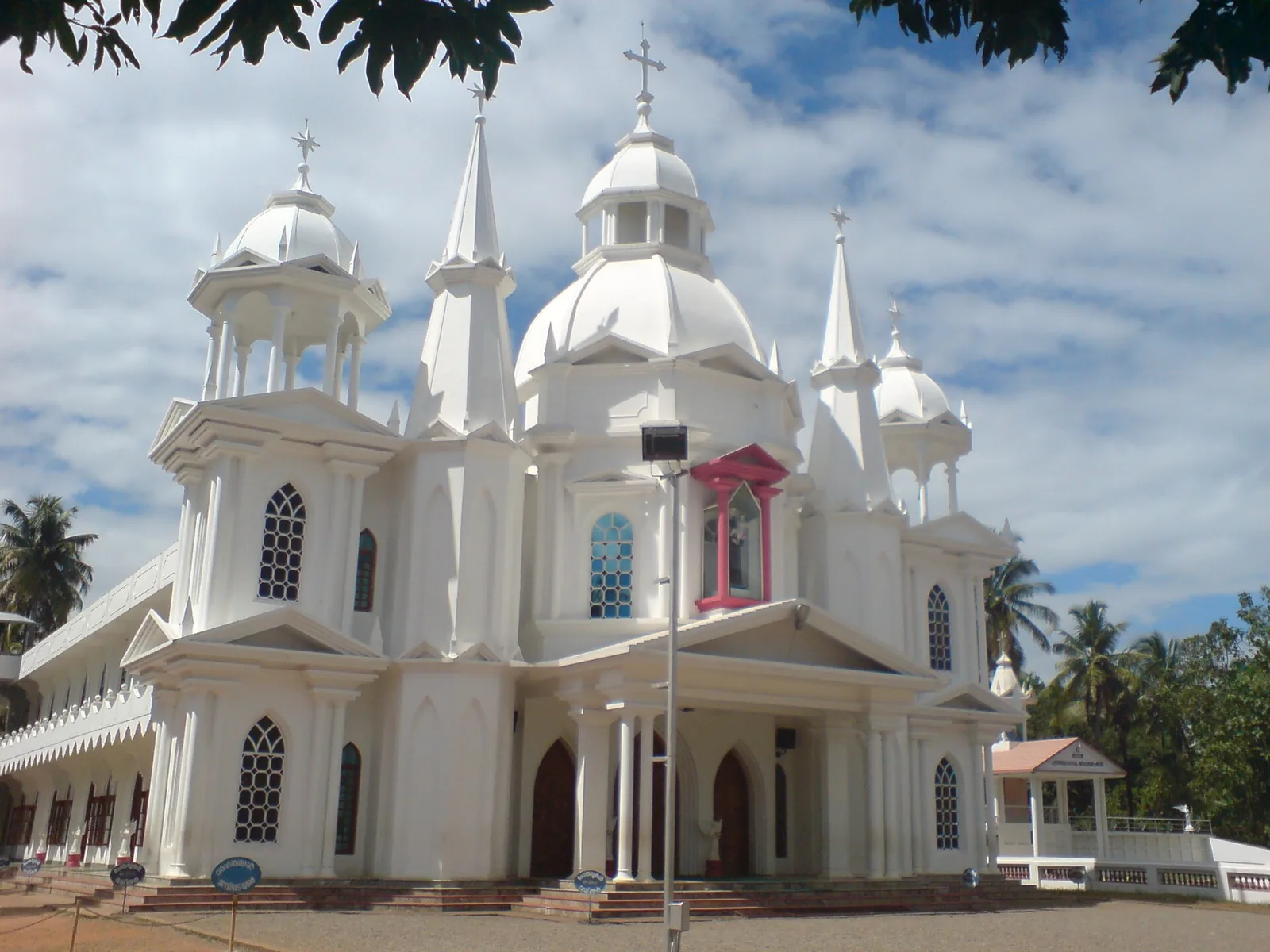
Ask how old a Kerala pilgrim hill is and the usual honest answer is that nobody knows. The tradition runs back past the first written record, the founding is a story rather than a document, and the best a careful page can do is say so. Kanakamala is the rare exception, and the exception is the interesting thing about it.
A priest, a year, a dream
In 1940 Fr Anthappan Valiyaveettil was vicar of St Antony’s Church at Perambra — the large white church in the photograph above, with its central dome, flanking towers and the red-framed niche on the façade, about 2.85 km west of Kanakamala hill and in the neighbouring ward of the same panchayat. In that year he is said to have seen a place in a dream. He went looking for it, concluded that Kanakamala was the hill he had been shown, and began taking people up it.
That is the founding act, and everything else at Kanakamala follows from it. The parish church at the foot of the hill was established three years later, in 1943. It was dedicated to St Anthony of Padua — the patron of the priest’s own parish, carried the two and a half kilometres east to the new place. The pilgrimage is older than the church it now begins from, which is not the order these things usually happen in.
The argument behind the vision
What raises this above a pious anecdote is that the priest is credited with a reason, and the reason is a piece of reasoning rather than a second vision. In the tradition of the Kerala Christians, St Thomas the Apostle came ashore in AD 52 at Azhikode, near Kodungallur. Kanakamala, the account runs, is the nearest hill to that landfall. And praying on high ground was characteristic of Jesus and of his disciples. Therefore the apostle would plausibly have come this way, and therefore the hill was already holy before anyone got round to marking it.
It is a deduction built from a map and a habit of scripture. It is also why the place answers to two saints: the church at the foot honours St Anthony of Padua, while the shrine on the summit is recorded — by the Malayalam Wikipedia and by OpenStreetMap alike — under the name of St Thomas. Two buildings, two patrons, one hill, and a perfectly clear reason for the split once you know the story.
What it is not
It is worth being exact about the size of the claim, because a bigger one is available 25.7 km to the south-east and it would be very easy to borrow. Malayattoor has the great St Thomas story of this coast: the apostle fleeing up the hill from hostile locals, drawing a cross on the summit rock and praying there, a golden cross afterwards seen at the spot, and a venerated rock said to carry his footprint. Those are Malayattoor’s, and we tell them on Malayattoor’s pages.
Nothing attaches a footprint, an apparition or an apostolic visit as an event to Kanakamala. What attaches to Kanakamala is a twentieth-century priest’s inference that the apostle would plausibly have passed nearby. That is a smaller and more fragile claim, and the devotion built on it is not one bit less real for it. Saying which is which is simply what an encyclopedia is for.
A village that grew around it
1940 was a busy year here in more ways than one: the primary aided school in the village is dated to it too. Over the following decades the settlement acquired the rest of its institutions — a government homoeopathy hospital established in the 1980s and inaugurated by the then Chief Minister of Kerala, an adoration convent, and an ashram called Akasaparavakal, the birds of the sky, a charitable institution for orphans. The post office and the hospital now stand within a few dozen metres of the church door, all on the same short road.
The parish became one of seventeen under St Joseph’s Forane Church at Kodakara, in the Syro-Malabar Diocese of Irinjalakuda. In October 2013 the diocesan website recorded its population as 2,250 people. In 2014 the pilgrimage was marked as reaching seventy-five years — its platinum jubilee — although that sits a year out from a 1940 start, and one of those two figures has been rounded somewhere along the way.
A note on the sources
Everything above rests on a thinner base than its confidence suggests, and you should know that. The founding account, the 1943 dedication and the parish population all trace to a single page on the Diocese of Irinjalakuda website, cited through the English Wikipedia article on the village. That page is dead. It survives as an archived copy taken in March 2016, which we were unable to open from here. The parish’s own website, stthomaskanakamala.com, is also gone; its domain no longer resolves.
So this is a well-attested story with a vanished citation, which in Kerala is an extremely common condition and one worth naming rather than papering over. If you hold a parish history, a jubilee souvenir or a photograph of the diocesan page, it would settle several small things at once — starting with which Chief Minister opened the hospital, and whether the jubilee counted from 1939 or 1940.
For the hill itself, the climb and the practicalities, see Kanakamala Kurishumudi.
Frequently asked questions
Who started the Kanakamala pilgrimage?
Fr Anthappan Valiyaveettil, then vicar of St Antony’s Church at Perambra, about 2.85 km west of the hill. He began it in 1940 after identifying Kanakamala as a place he had seen in a dream.
Why is the hill associated with St Thomas?
Because of the founding argument: that Kanakamala is the nearest hill to Azhikode, where tradition holds the apostle landed in AD 52, and that praying on hills was characteristic of Jesus and his disciples. It is a deduction, not a recorded visit.
When was the church built?
The parish church at the foot of the hill was established in 1943 and dedicated to St Anthony of Padua — three years after the pilgrimage began. The summit shrine is recorded under the name of St Thomas.
Which diocese does the parish belong to?
It is a Syro-Malabar parish, one of seventeen under St Joseph’s Forane Church at Kodakara, in the Diocese of Irinjalakuda, within the Thrissur metropolitan province.
Is the founding story documented?
It is recorded, but on a single source: the Diocese of Irinjalakuda parish page, now offline and surviving only as a 2016 archive copy, cited through Wikipedia. The parish’s own website has also gone. We print the account and we print its fragility.