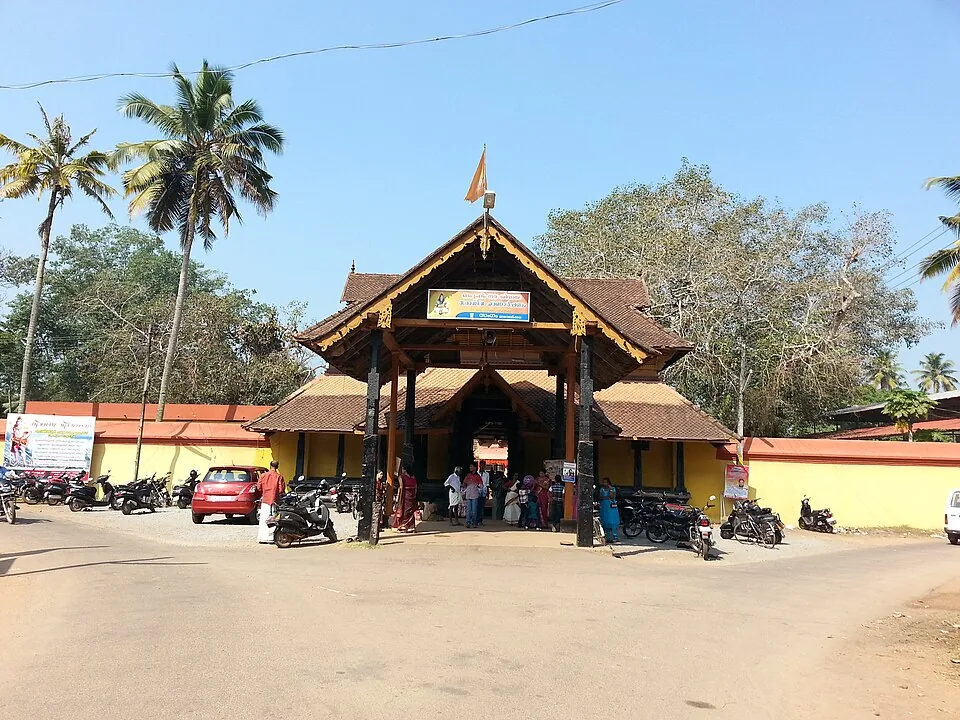
Kandiyoor Sree Mahadeva Temple is walled on four sides with a gateway on each. Walk round it and you will find that one of them does not open.
Capital of a kingdom
Kandiyoor was once the capital of Odanad, the medieval principality of this stretch of the Kerala coast, and this was its state shrine. That is the context for the 1218 restoration, which was carried out under Rama Kotha Varma of Odanad, and for the Sanskrit inscription before the srikovil commemorating a Kothavarman of the same house.
Odanad was later absorbed by Kayamkulam. Kayamkulam in turn was annexed by Marthanda Varma, in the eighteenth-century expansion that made Travancore. Each step left this temple a little further from the centre of things.
The sword
The tradition attached to the closed door is this: during the war between Odanad and Kayamkulam the defeated Kayamkulam Raja came to the temple, surrendered his sword at the deity’s feet, and went out by the western nada. It has stayed shut ever since.
It is worth separating the two halves of that. The closed western door is a fact you can verify by walking to it. The reason given for it is the temple’s own tradition, told about an event several centuries old, and this page prints it as that rather than as documented history.
What ended up here instead
A temple that loses its kingdom does not necessarily shrink. Kandiyoor accumulated: eleven subsidiary shrines around the central one, built in different periods, so that between them the site covers essentially every major strand of Hindu practice — Vishnu, Annapurneshwari, Gosala Krishna, Sastha, Subrahmanya, Nagaraja and Nagayakshi, Ganapathy twice over, Brahmarakshas. Five of them are Shiva himself, brought in from other Shiva temples and re-installed under their home names.
By the count of subsidiary deities the Malayalam account places Kandiyoor second in India, behind only Thiruvanchikulam. The kingdom went; the shrines kept arriving.