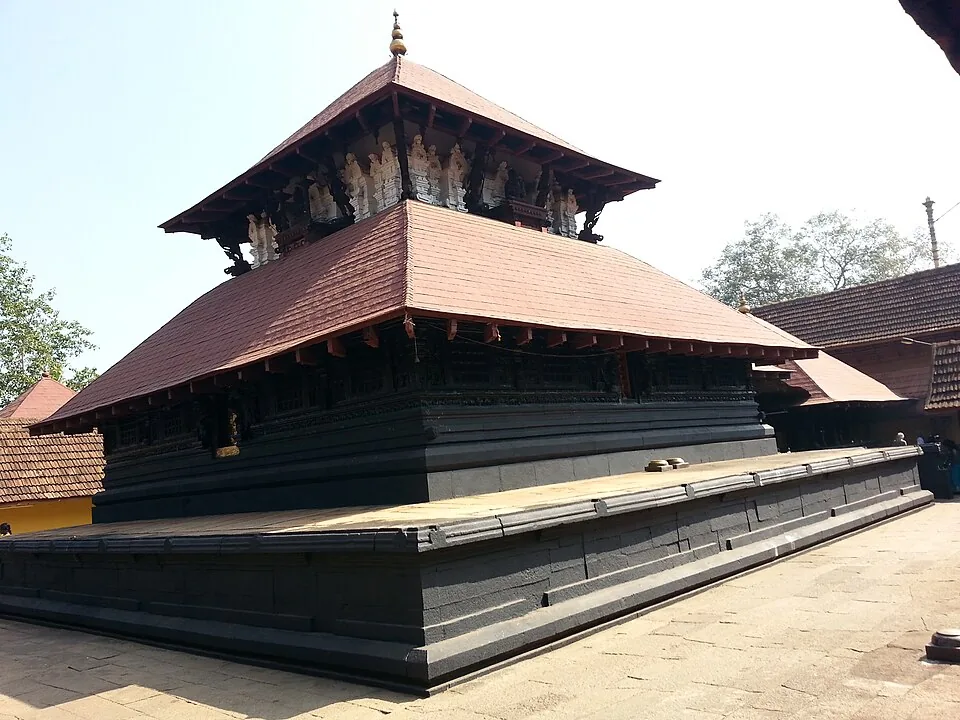
The most interesting thing at Kandiyoor Sree Mahadeva Temple is not a building. It is a sentence about a woman.
What the stone says
The inscription of 1218 records a restoration of the temple: when it started, when it finished, who paid. It records that the temple was a centre of Natyasastra study, with dance and music taught and performed, and with tevadichi — devadasi — performances.
And it names her. She appears as Unni in one account, Unniyachi in another, Unnunili in a third. She was a devadasi of this temple. She was the wife of Ravi Kerala Varma, the king of Venad. The restoration was sponsored at her instance, and when the work was done she took part in the kalasam ceremony that consecrated it.
- Unni — as given in the CC0 description of the temple photo set.
- Unniyachi — as given in the English Wikipedia article.
- Unnunili — as given in the Malayalam article.
- They are variants of the same name for the same person. We report the variation rather than picking one and pretending it is settled.
Not an anomaly, but the clearest case
A queen who is also a temple dancer sounds like a contradiction to modern ears, and it was not one. More than ten historic inscriptions record devadasis in Kerala temples, so the institution is well attested. What makes Kandiyoor exceptional is the density of the record here.
The Malayalam account carries a line of devadasi heirs by name: Cherukara Kuttathi, whom the Kandiyoor Mattam Raja of the day married, and after her Cherukara Unniyadi, Muttur Ilayachi, Unniyachaki and Karungade Unnulikkal. A fourteenth-century Sanskrit work, the Shivavilasam of Damodara Chakyar, is cited for the temple standing under devadasi control.
Put together, that is women holding institutional authority over a major temple, named individually, across generations, in writing. In most of medieval South India this is something scholars have to argue for from indirect evidence. Here somebody wrote it down.
Why it is worth saying plainly
The devadasi system as it ended in the nineteenth and twentieth centuries was something else entirely, and nothing here is an argument about that. But a page about a temple should say what its own stones say. Kandiyoor’s say that its restoration happened because a woman wanted it to, and that she stood in the ceremony when it was finished.