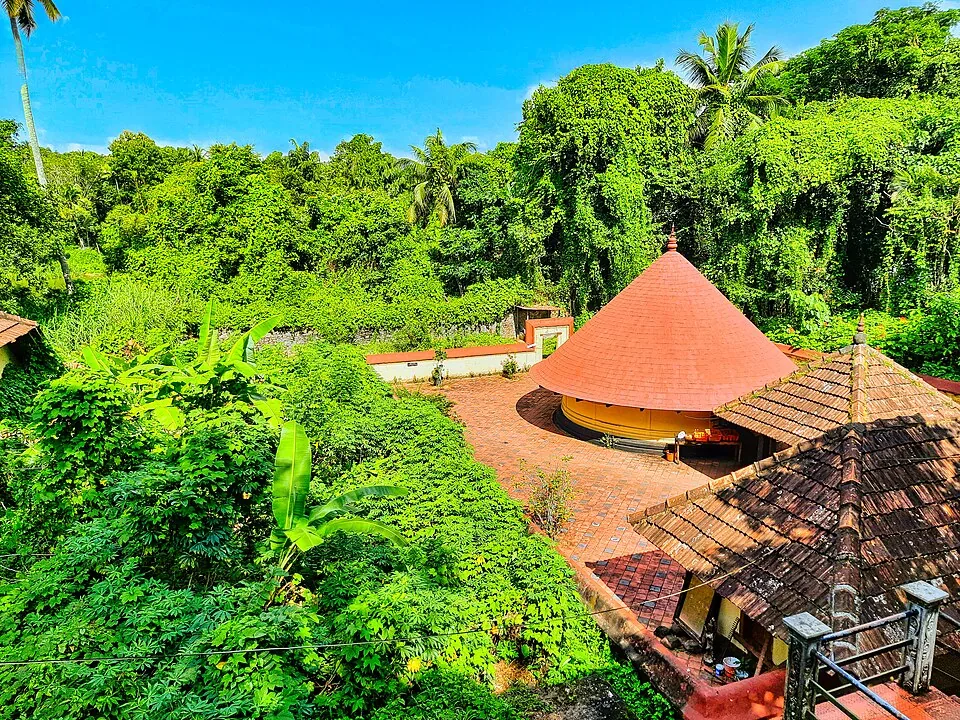
Climb a low rock hill above the Manimala river near Thiruvalla and you come upon something startling for Kerala — a land that has always built in wood, laterite and tile: a whole shrine carved directly out of a single mass of living stone. Not built, carved — sanctum, pillars, figures and all, cut inward from the rock face by hands that worked here more than twelve hundred years ago. This is the Thrikkakudi cave temple, one of only a handful of rock-cut shrines in all Kerala, and it belongs to the story of Kaviyoor Mahadeva Temple.
The eighth-century cave
The Thrikkakudi rock-cut temple was hewn in the eighth century in the Pallava style — the same tradition of scooping temples out of solid rock that produced the celebrated monuments of Mahabalipuram, far across the mountains on the Tamil coast. Step into the square, cool cave and there, in the sanctum, stands a Shiva linga about three feet high, carved from the same rock as the floor beneath it. It is now protected as a monument by the archaeology department, and rightly so: what it holds is rare.
Faces cut into the wall
For into the cave walls are cut some of the very earliest stone sculptures anywhere in Kerala — figures that have watched over this chamber for thirteen centuries. There is Ganapathi; there is a Maharshi, a great bearded sage; and there are Dwarapalakas, the guardians who stand eternal watch at the sanctum door. To meet their weathered faces in the half-light, knowing how few such carvings survived in a land that built mostly in perishable wood, is quietly overwhelming — you are looking at the childhood of Kerala’s stone art.
A legend in the chisel marks
Look closely and parts of the cave seem unfinished, the rock left rough where a carver simply stopped mid-stroke. Legend holds the work was interrupted when Shiva and Hanuman of the nearby Kaviyoor temple appeared and halted it — a folk explanation, offered to make sense of those raw, abandoned corners. Believe it or not as you like; either way, the half-finished stone lends the place an oddly living feeling, as though the sculptor had set down his chisel only a moment ago and might return to pick it up again.
Where Hanuman rules
A short walk away, on its own small hillock, stands the main Kaviyoor Mahadeva Temple, a graceful gabled shrine in the classic Kerala style. Its chief deity is Shiva — and yet Kaviyoor is loved, above all else, for Hanuman. Devotees pour in to worship the monkey-god at his sub-shrine here, and the favourite offering is aval, beaten rice, which is Hanuman’s own beloved food. Few temples anywhere in Kerala give Hanuman such warmth and such crowds, and it is this, as much as the ancient cave, that gives Kaviyoor its particular pull.
Visiting Kaviyoor
The Mahadeva temple and the Thrikkakudi cave lie a short distance apart near Thiruvalla, and together they reward anyone who likes their heritage old, quiet and unspoiled — a working temple humming with devotion, and a silent rock chamber from the dawn of Kerala’s stone-carving. Details are on the Kaviyoor place page; more of the district is on the Pathanamthitta hub.
Frequently asked questions
What is the Thrikkakudi rock-cut temple at Kaviyoor?
It is an 8th-century cave shrine carved from a single mass of rock in the Pallava style, near the Kaviyoor Mahadeva Temple. It has a rock-cut sanctum with a Shiva linga about three feet high, and wall sculptures of Ganapathi, a sage (Maharshi) and door-guardians (Dwarapalakas) — among the earliest stone carvings in Kerala. It is protected as an archaeological monument.
Why is Kaviyoor temple famous for Hanuman?
Although its chief deity is Shiva, Kaviyoor Mahadeva Temple is especially known for devotion to Hanuman, worshipped at a hillock sub-shrine. Large numbers of devotees come to offer him aval (beaten rice), his favourite food — a warmth of Hanuman worship rare among Kerala temples.
Where is Kaviyoor?
Kaviyoor is near Thiruvalla in Pathanamthitta district, on the banks of the Manimala river. The Mahadeva temple and the nearby Thrikkakudi rock-cut cave are a short distance apart.