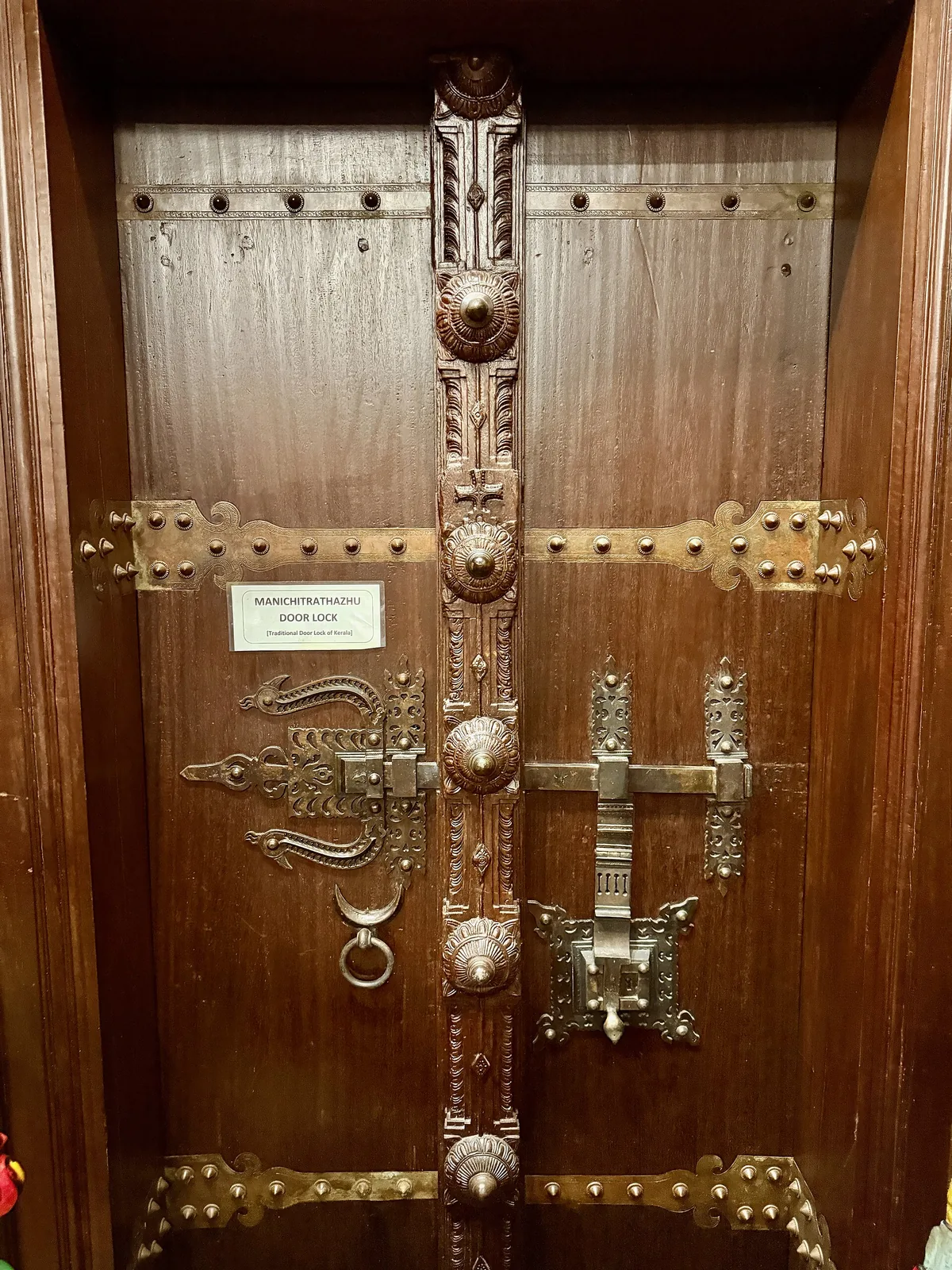
Every Malayali knows the word “manichitrathazhu”. It is the title of the most famous film in the language, the one with the sealed room, and it has been in common speech for thirty years.
Rather fewer have looked at one. There is a door at the Kerala Folklore Museum at Thevara with a manichitrathazhu on it, labelled as such, and it is one of the more quietly satisfying objects in Kochi.
What the word means
The “thazhu” is the lock or bolt. “Manichitra” is the ornament — the worked, jewelled, figured decoration on it. A manichitrathazhu is simply the elaborate carved-and-cast door fastening of a traditional Kerala house, and the film’s title means, more or less, the ornate lock. On the door at Thevara you can see why the word carries weight: a vertical carved batten down the centre, rosette bosses, brass straps studded across the leaves, a moon-shaped pull ring, and the bolt itself set in a plate of pierced metalwork.
This is joinery meant to be handled every day for two hundred years, in a climate that destroys everything. It is also the piece of a house that says what the household thought of itself — the lock is at eye height, on the way in, and nobody would spend that much on ornament in a place visitors did not stand.
Why the door is in a museum and not in a house
This is the real story of the building you are standing in, and it is a legal one.
The great houses of Kerala — the “nalukettu” of four blocks around a courtyard, the “ettukettu” of eight — were built for the tharavadu, the joint family of the Nair and Nambudiri households, holding property in common. They were designed around a group that owned things together and could not divide them.
The Kerala Joint Hindu Family System (Abolition) Act, 1975, in force from 1 December 1976, ended that arrangement. Members of a joint family were deemed thereafter to hold as tenants-in-common — which meant any one of them could demand partition and realise a share.
Now consider what a tharavadu house actually is when it must be divided. You cannot cut a courtyard into seven pieces. Add the shift to nuclear households, the cost of maintaining a large timber structure through the monsoon, and heirs living in Bangalore or the Gulf, and the arithmetic goes one way. The only part of a nalukettu that can be split between people is its value, and its value was in the carved teak and anjili.
- The tharavadu house was built for joint ownership; nothing about it divides.
- The 1975 Act, in force from 1 December 1976, made members tenants-in-common — any one could demand partition.
- Nuclear families, migration and monsoon maintenance costs did the rest.
- What could be realised was the carved wood. A trade grew up to buy it.
And that trade built this museum
The Kerala Folklore Museum was assembled over roughly seven years by around sixty-two craftsmen out of some twenty-five dismantled heritage structures, dating between the seventeenth and early twentieth centuries, and reassembled at Thevara across three floors in the Malabar, Kochi and Travancore styles. It opened in 2009. The founder, George J Thaliath, came to it through the trade rather than around it — his father, Jacob V. Thaliath, dealt in Indian art before him.
So a museum of Kerala’s heritage is physically made of Kerala’s heritage, taken apart. The defence is real: this timber was on the market and would otherwise have been sold on piecemeal or burnt, and that is the ordinary fate of an unwanted Kerala house. But it is still material removed from the places that gave it meaning and rebuilt into a structure that never existed. Rescue and removal at once. We think the honest thing is to hold both.
Which brings us back to the film
There is a neat closing irony here. The locked room in Manichitrathazhu — the thing the whole story turns on — was not a real room in a real house at all. It was a set, built inside Vasan House in Chennai, as we set out in the piece on Hill Palace, where much of the rest of the film was shot.
So the most famous locked door in Malayalam culture was a fiction, and the real ones — hundreds of them, on houses that stood for two centuries — were pulled off their frames and sold. One of them is on a wall at Thevara with a small printed label. It is worth going to look at.
Practically
The museum is at Thevara, south of Ernakulam city centre and not in Fort Kochi, so it needs its own trip. There is an entry charge, a separate camera fee, and evening performances in the top-floor koothambalam-style theatre are usually ticketed separately. Allow two hours, and look up — the ceilings are where most of the salvaged craftsmanship went.
Frequently asked questions
What is a manichitrathazhu?
The ornate carved and cast lock or bolt of a traditional Kerala door. Thazhu means the lock; manichitra refers to its worked, figured ornament. The 1993 film takes its title from the object, which is why the word is so widely known and so rarely examined.
Can I see one at the Kerala Folklore Museum?
Yes. There is a carved teak door in the collection fitted with a manichitrathazhu and labelled as such — brass straps, rosette bosses, a moon-shaped pull ring and a pierced bolt plate. It is one of the more rewarding objects in the museum precisely because the word is so familiar and the thing is not.
Why were so many old Kerala houses taken apart?
Because the family system they were built for was abolished. The Kerala Joint Hindu Family System (Abolition) Act, 1975, effective from 1 December 1976, made members of a joint family tenants-in-common, so any of them could demand partition. A nalukettu cannot be divided; its carved teak and anjili can. Combined with nuclear households, migration and the cost of maintaining timber in the monsoon, that put an enormous quantity of architectural woodwork on the market.
How was the museum built?
Over about seven years, by roughly sixty-two craftsmen, from some twenty-five dismantled antique and heritage structures dating from the seventeenth to early twentieth centuries. The three storeys were executed in the Malabar, Kochi and Travancore styles respectively, with a koothambalam-style theatre on top. It opened in 2009.
Is it right to build a museum out of dismantled heritage buildings?
It is a genuine question and the museum does not dodge it. The timber was already on the market and would in most cases have been dispersed or destroyed; here it is standing and maintained. Against that, it has been removed from the buildings, villages and families that gave it meaning and recombined into something new. Both are true, and the place is more interesting if you keep both in mind while you walk round.
Who founded it?
George J Thaliath, an antique dealer and collector, with his wife Annie. His father, Jacob V. Thaliath, dealt in Indian art before him. His name appears online in several garbled forms, including George Thariakan; Thaliath is the form the museum uses.