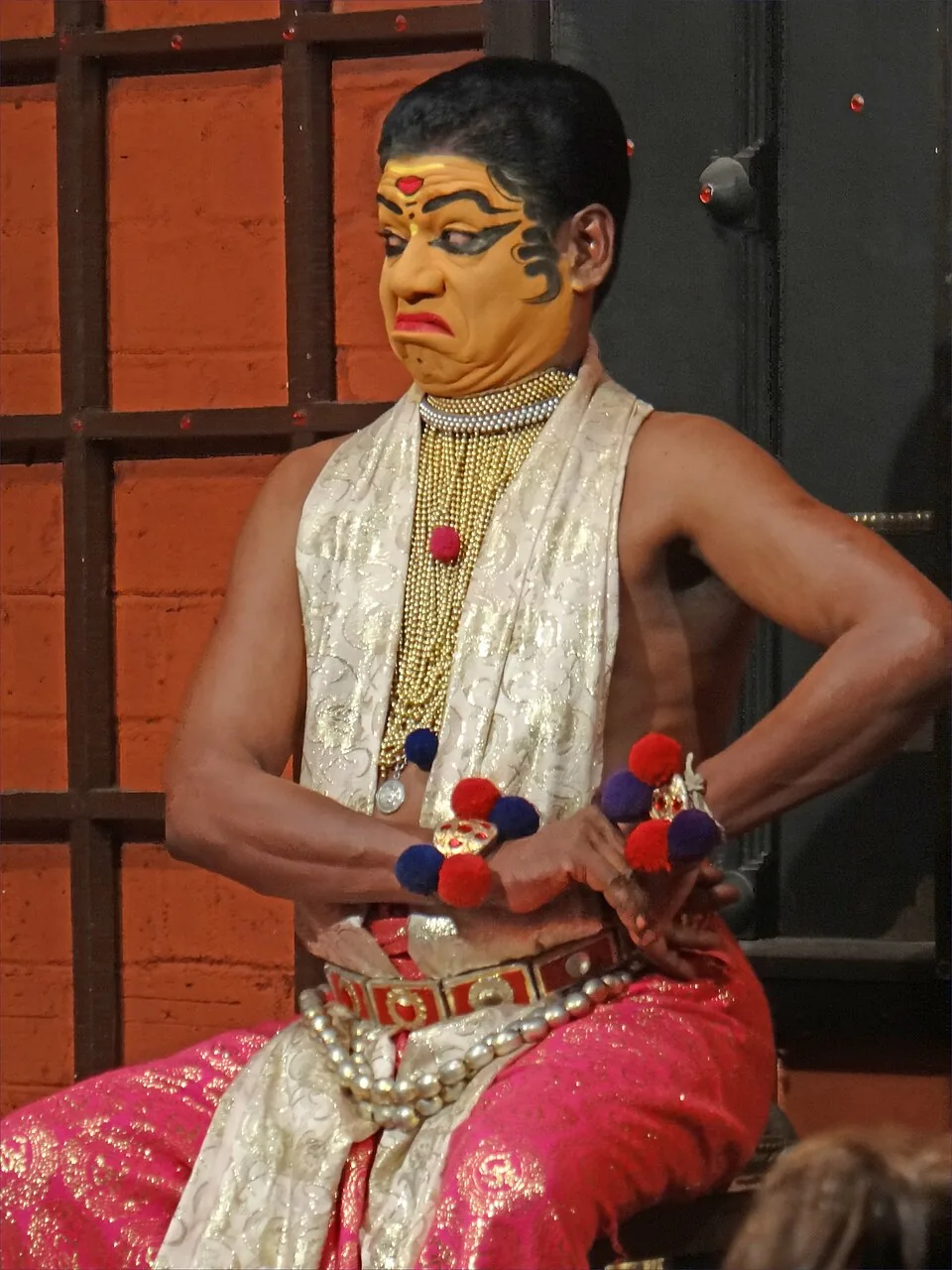
The evening show at the Kerala Kathakali Centre and the venues around it is the way almost every visitor to Kerala encounters Kathakali: an hour of make-up, then a short performance, then out into the lane by nine. It is worth knowing what that format is, because it is not a reduced version of the traditional thing. It is a different thing, invented recently, for you.
What it replaced
Kathakali was performed through the night, at temples and under princely patronage, for an audience that already knew the stories. That is the crucial part. Nobody needed the plot explained, so the performance could spend twenty minutes on a single emotional transition, or on one character noticing something. The pace was not slow by accident — it was slow because the audience had the plot and wanted the interpretation.
Take away that shared knowledge and the form becomes almost unwatchable at its own tempo. So the tourist format does the obvious thing: it explains, it excerpts, and it stops before midnight.
Where the Fort Kochi format came from
It is recent and it is commercial. Dedicated evening venues staging shortened performances with a preceding make-up demonstration grew up here as Kerala’s tourism expanded from the 1990s onward, and they are now the ordinary way the form is seen.
That is a genuine change in the setting of an art: from all-night ritual theatre for initiates to a timed show for people who arrived that afternoon. Two things are true about it at once. The compression loses a great deal. And without it, almost none of the people now watching Kathakali would ever have seen any.
- Gains: a make-up demonstration you can watch from a metre away.
- Gains: a spoken introduction to the mudras and the facial expressions.
- Gains: an excerpt chosen because it reads without prior knowledge.
- Loses: duration — the long transitions that were the point of the form.
- Loses: context — a temple, a night, and an audience that knew the story.
- Loses: the full repertoire; you get the legible scenes, not the difficult ones.
Come early, for the eyes
The make-up session before the performance is not a warm-up act. It is the most interesting hour of the evening and it is where the one genuinely startling thing happens.
The performers’ eyes are really red. It is not paint, and it is not a lens. Before going on, the actor places the prepared base of a chundappoo — the flower of the chunda plant, Solanum, which is also used in preparing holy water in Kerala temples — inside the lower eyelid, and rotates the eyeball until it settles. It stays there for the whole performance, holding the eye a vivid red against the painted face, and comes out as soon as the role is done.
Watch for that and you will understand what the make-up room is doing. The face is being built — the chutti ridge, the colour codes — but the eyes are being altered, which is a different order of commitment.
Who is on stage, and who is not
You will almost certainly watch men. Kathakali was performed by men for roughly three centuries, and for most of that time by men of one high caste — the caste restriction was not legally abolished until 1946.
That has changed, though not at the venues visitors use. A women’s troupe, Nadananiketan, was formed at Thrissur in 1962 and lasted until 1968. The durable one came in 1975: the Tripunithura Vanitha Kathakali Sangham, formed under the guidance of Kalamandalam Krishnan Nair, which staged Kalyanasougandhikam with women playing Bhima and Hanuman. Tripunithura is an hour away and still has its women’s troupe. If you want to see that, you have to go looking for it — it is not what a Fort Kochi evening show puts on.
How to get the most out of the ninety minutes
Arrive for the make-up, an hour before, and stand close. Sit near the front for the performance, because Kathakali is acted with the eyes and the eyebrows and a great deal of it is lost from row eight. And spend the introduction actually watching the hands rather than reading the leaflet — the vocabulary is demonstrated once and then used all evening.
Then, if it grips you, treat the short show as a doorway rather than the destination. Kerala Kalamandalam, founded in 1930 by the poet Vallathol Narayana Menon, is the institution that saved the form when court patronage collapsed, and full-length performances still happen at temple festivals across the state. The Fort Kochi show is an introduction that knows it is one.
Frequently asked questions
How long is a Fort Kochi Kathakali show?
Typically about an hour of make-up beforehand, which you can watch, followed by a performance of roughly an hour to ninety minutes including a spoken introduction to the gestures and expressions. Traditionally Kathakali was performed through the night.
Why is the tourist version so much shorter?
Because the traditional pace assumed an audience that already knew the stories, which freed the performance to spend a very long time on a single emotional transition. Visitors do not have that background, so the venues excerpt, explain and compress. It loses a great deal and it is also the reason most visitors see any Kathakali at all.
Are the performers’ eyes really red?
Yes, and it is not make-up. The actor places the prepared base of a chundappoo — the flower of the chunda plant, Solanum, also used in preparing holy water in Kerala temples — inside the lower eyelid and rotates the eyeball until it settles. It stays in for the performance and is removed immediately afterwards.
Should I arrive early for the make-up?
Yes — it is the best part of the evening. The chutti, the painted colour codes and the eye preparation all happen in front of you, at close range, and take far longer than the performance itself. Most venues open the make-up room around an hour before the show.
Do women perform Kathakali?
They do, though rarely at visitor venues. The form was male for roughly three centuries, and largely restricted by caste until 1946. A women’s troupe, Nadananiketan, ran at Thrissur from 1962 to 1968, and the Tripunithura Vanitha Kathakali Sangham was formed in 1975 under Kalamandalam Krishnan Nair, staging Kalyanasougandhikam with women as Bhima and Hanuman. Tripunithura still has a women’s troupe.
Where can I see a full-length performance?
At temple festivals across Kerala, where full-length night performances still take place, and through Kerala Kalamandalam — the institution founded in 1930 by the poet Vallathol Narayana Menon, which took Kathakali out of collapsing court patronage and into formal training. The Fort Kochi evening show is an introduction rather than the whole art.