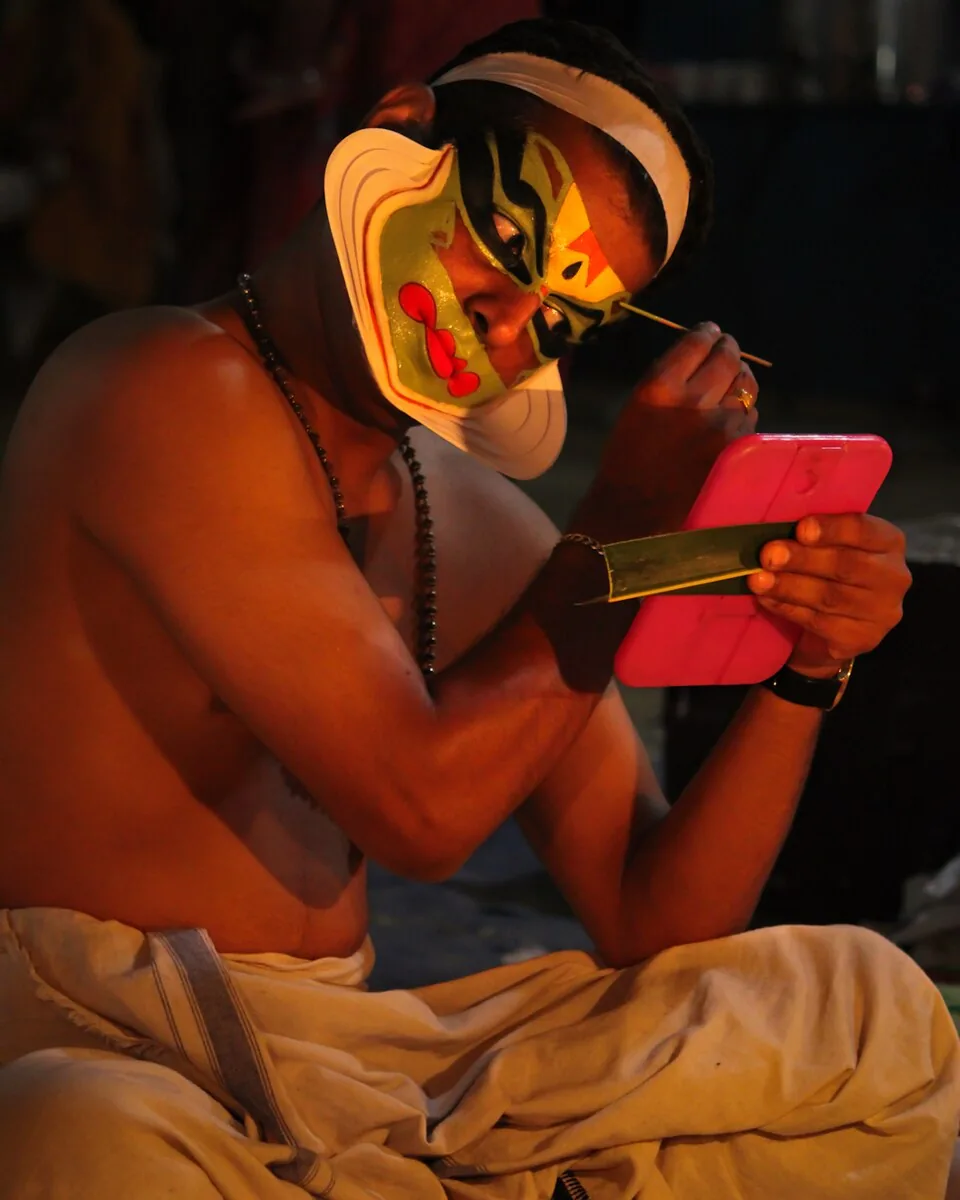
Every piece of advice about the Kerala Kathakali Centre and its neighbours says the same thing: arrive early for the make-up. It is sound advice and it is almost never explained. Here is what you are actually watching.
The pigments are minerals
Kathakali colour does not come out of a tube. Traditionally it is ground stone, mixed with coconut oil as the base.
Red is chayilyam, from powdered cinnabar. Yellow is manayola — orpiment, an arsenic mineral. Green, the colour of the noble characters, is made by mixing manayola with neelam, blue. White is lime and rice flour. Black, kanmashi, is lamp-black prepared by burning gingelly oil. Another stone, chenchilyam, is powdered and applied to protect the skin underneath.
Read that list again and notice what is in it. The heroic green of a Kathakali god is arsenic and indigo mixed in coconut oil and worn on a face for six hours. This is not a metaphor about suffering for art. It is a materials list.
The chutti is built on the actor, not stuck to him
The raised white ridge that frames the face — the chutti — is the part that takes the time and gives the form its silhouette. It is not a mask and it is not a prop. It is constructed directly on the actor’s own skin, layer by layer, out of an organic paste of rice and lime in roughly three parts to one, with cotton and organic glue.
The specialist who does it is the chuttikkaran, a distinct craft from acting, and building the chutti alone takes something like ninety minutes to two and a half hours. Full make-up commonly runs three to four hours, staged, with the time varying by character and by how elaborate the costume is.
So the man lying on the floor while another man leans over his face is not being decorated. He is being assembled, slowly, by a second artist, and neither of them is going to hurry for you.
- The base colour going on with coconut oil — flat, unglamorous, and surprisingly quick.
- The chuttikkaran starting the rice-and-lime frame at the chin and working outward. This is the long part.
- Layer building up on layer, the ridge rising off the face until it catches its own shadow.
- The eyes reddened last — traditionally by placing the dried ovule of a chunda flower inside the lower lid.
- The costume and headdress going on at the end, at which point the person disappears entirely.
The eyes
The final touch is the one that unsettles people. The whites of the eyes are reddened, traditionally by slipping the dried ovule of the chunda flower — a small solanum — inside the lower lid. The irritation reddens the sclera, and under stage light the effect is an eye that reads across an open courtyard.
It is not universal practice today. But it explains what you are about to see: Kathakali acting is done substantially with the eyes, trained for years to move independently of the head, and the make-up exists to make that visible from thirty metres away in a room with no lighting rig.
Why this is the better half of the ticket
Because the performance you will see afterwards is compressed. A traditional Kathakali play ran through the night in a temple courtyard for an audience that already knew the story. What Fort Kochi offers is an hour: make-up, an explanation of the hand signs and the nine emotional states, and one or two extracted scenes. That compression loses a great deal, and it is also the only reason a first-time visitor has any way into the form at all.
The make-up room loses nothing. It is exactly as slow as it has always been, done by the same craft with the same materials, and nobody has shortened it for tourism because it cannot be shortened. It is the most authentic hour in Fort Kochi, and it is the hour most visitors skip.
Sit down. Do not talk. Do not use flash. Ask before photographing a face that is halfway built.
Frequently asked questions
How long does Kathakali make-up take?
Commonly three to four hours in total, applied in stages, with the time varying by character and costume. The chutti — the raised white frame around the face — accounts for roughly ninety minutes to two and a half hours of that on its own.
What is Kathakali make-up made of?
Traditionally ground minerals mixed with coconut oil: chayilyam (cinnabar) for red, manayola (orpiment, an arsenic mineral) for yellow, manayola mixed with neelam (blue) for green, lime and rice flour for white, and kanmashi — lamp-black from burning gingelly oil — for black. Powdered chenchilyam is applied to protect the skin.
What is the chutti?
The raised white ridge that frames a Kathakali face. It is built directly on the actor’s own skin in layers, from an organic paste of rice and lime in roughly a three-to-one ratio, with cotton and organic glue. The specialist who applies it is the chuttikkaran, a separate craft from acting.
Why are the performers’ eyes red?
Traditionally the whites are reddened by placing the dried ovule of a chunda flower inside the lower lid. Kathakali acting is done substantially with the eyes, and the reddening makes them read from across an open courtyard. The practice is not universal today.
Should I really arrive early for the make-up?
Yes. It is the most-repeated advice about Kathakali in Fort Kochi and it is correct — and unlike the performance, the make-up has not been shortened for visitors, because it cannot be. Confirm the opening time of the make-up room directly with the venue, as it varies.
Can I photograph the make-up?
Generally yes, but ask first, do not use flash, and keep quiet. You are watching two artists work at close range on a face that is halfway built, in a room that is functioning as a dressing room rather than a stage.