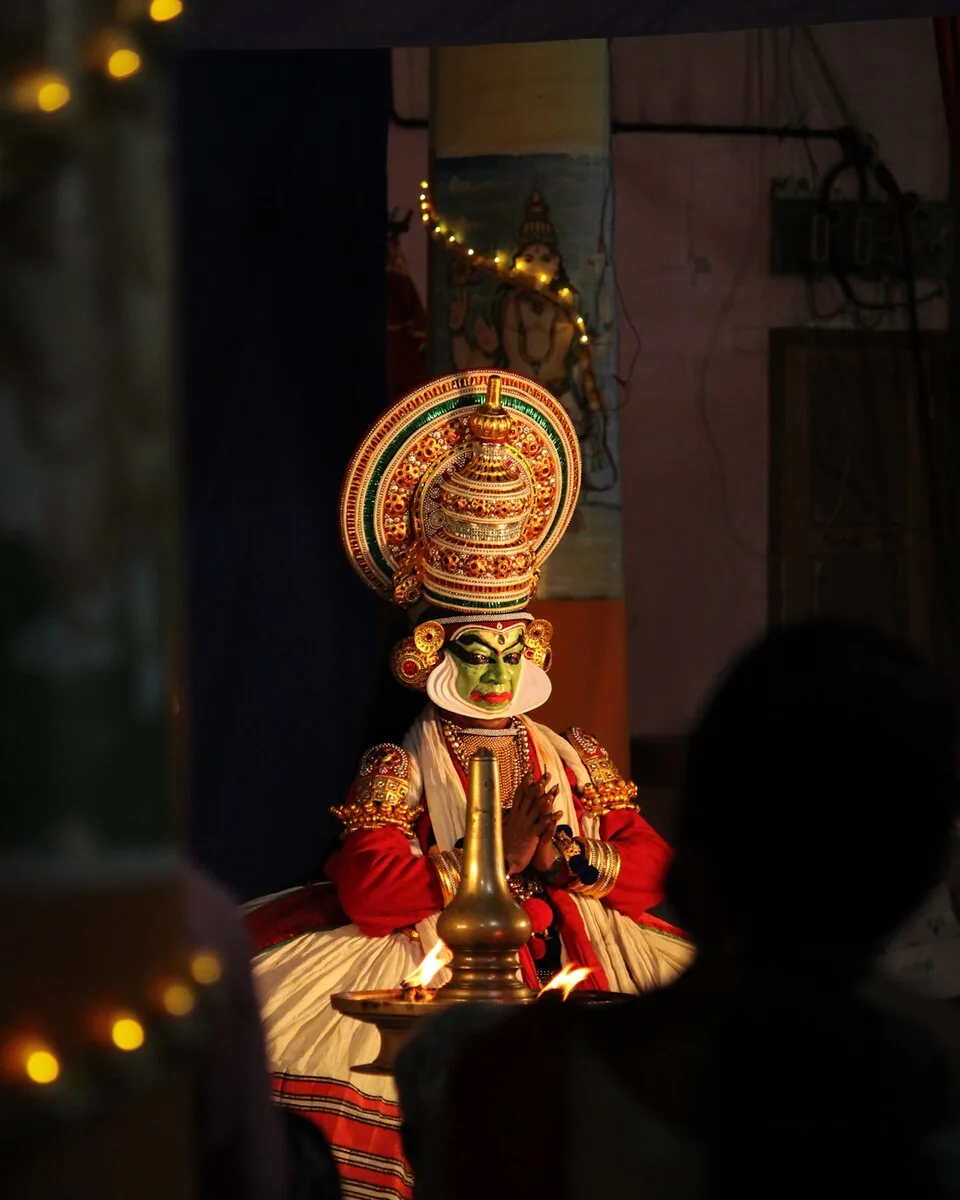
The single most useful thing to know before an evening at the Kerala Kathakali Centre is this: the actor is not miming. He is speaking, in a formal language, in complete sentences. You are not being asked to intuit a mood. You are being addressed.
You will not learn the language in one evening. But four pieces of information will change what you see, and they take about ten minutes to absorb.
1. The actor never speaks. Somebody else does
All the text is sung by vocalists standing at the back of the stage — the lead ponnani keeping time on a gong, the shinkidi answering on cymbals. The actor carries the meaning entirely in hands, eyes and body. So the voice you hear and the body you watch belong to different people, deliberately, and the actor’s job is to be the visible half of a sentence somebody else is saying.
2. The hands are a vocabulary, not a gesture
Kathakali uses a set of basic hand positions catalogued in the old manual Hastalakshanadeepika, which combine into several hundred recognised signs. They are not invented in the moment and they are not approximate. A mudra can mean a specific noun, a specific verb, or a grammatical relation, and the same hand shape shifts meaning with position and movement.
Most Fort Kochi venues demonstrate a handful before the performance. Take them seriously — even four or five named signs will let you catch fragments later, and catching one fragment is enough to change how you watch the rest.
3. The nine states
The navarasas are the nine emotional states an actor must be able to summon on demand, and the demonstration where a performer runs through them one after another is usually the moment the audience sits up. It is worth watching for the technique rather than the effect: the eyes and the muscles around them are doing nearly all of it, isolated from the head, trained over years the way a pianist trains fingers.
- Pacha (green) — noble. Gods, kings, heroes.
- Kathi (knife) — the grand villain: green base with an upturned moustache and a knife-shaped mark. Ravana, Duryodhana. Magnificent rather than merely wicked.
- Thadi (beard), white — the noble monkey characters, such as Hanuman.
- Thadi, red — the violent. Thadi, black — the schemer.
- Kari (black) — demonesses. Minukku (polished) — women, brahmins and sages.
4. The drums are weather, not accompaniment
The chenda, a hard upright drum struck with sticks, drives the male and martial passages. The maddalam, played with the hands, carries the gentler ones. The music belongs to the sopanam tradition, the temple-step singing of Kerala, and it is loud on purpose: Kathakali was built to be heard across an open courtyard by an audience that was not sitting quietly.
If the volume surprises you in a small Fort Kochi hall, that is the form arriving in a room it was not designed for, rather than a sound problem.
What you are watching, honestly
A traditional Kathakali play began after dark with drums calling the village in, ran through the night, and ended near dawn, with the audience free to sleep through the passages they knew and wake for the ones they loved. What you will see is about an hour: make-up, a demonstration of mudras and navarasas, and one or two extracted scenes.
Purists call that a reduction and strictly they are right. It is also the reason you have any way in. Both things are true, and the demonstration format is unusually honest about which one it is doing.
One last piece of practical advice: read the outline of the scene before you go in. Kathakali audiences historically knew the story cold and came for the interpretation, not the plot. Ten minutes with a synopsis puts you closer to that position than any amount of concentration during the performance will.
Frequently asked questions
Will I understand Kathakali if I do not know the stories?
Partly, and the demonstration format is designed for exactly that. There is no spoken dialogue — the text is sung by vocalists while the actor works in hand signs and eye movement — and most Fort Kochi performances explain the mudras and the nine emotional states first. Reading the outline of the scene beforehand helps a great deal.
What are mudras?
The hand signs that carry the meaning. Kathakali uses a set of basic hand positions catalogued in the old manual Hastalakshanadeepika, which combine into several hundred recognised signs, shifting meaning with position and movement. They are a formal vocabulary rather than improvised gesture.
What are the navarasas?
The nine emotional states a Kathakali actor must be able to produce on demand. The demonstration in which a performer moves through them one after another is usually the moment the audience sits up — and it is done almost entirely with the eyes and the muscles around them, trained to move independently of the head.
What do the face colours mean?
They classify the character. Green (pacha) is noble — gods, kings, heroes. Green with an upturned moustache and a knife mark (kathi) is the grand villain, such as Ravana or Duryodhana. Beards (thadi) are colour-coded: white for noble monkey characters like Hanuman, red for the violent, black for the schemer. Black (kari) is for demonesses, and polished minukku for women, brahmins and sages.
What are the drums?
The chenda, a hard upright drum struck with sticks, drives the male and martial passages; the maddalam, played with the hands, carries the gentler ones. The music belongs to Kerala’s sopanam temple-step singing tradition, and it is loud by design — the form was built for an open courtyard, not a small hall.
Is a Fort Kochi performance authentic?
It is genuine work in a shortened form. Traditionally a play ran all night in a temple courtyard; what is staged for visitors is typically about an hour of make-up, technique demonstration and one or two extracted scenes. The training, music and technique are real; the length and the setting are not traditional.