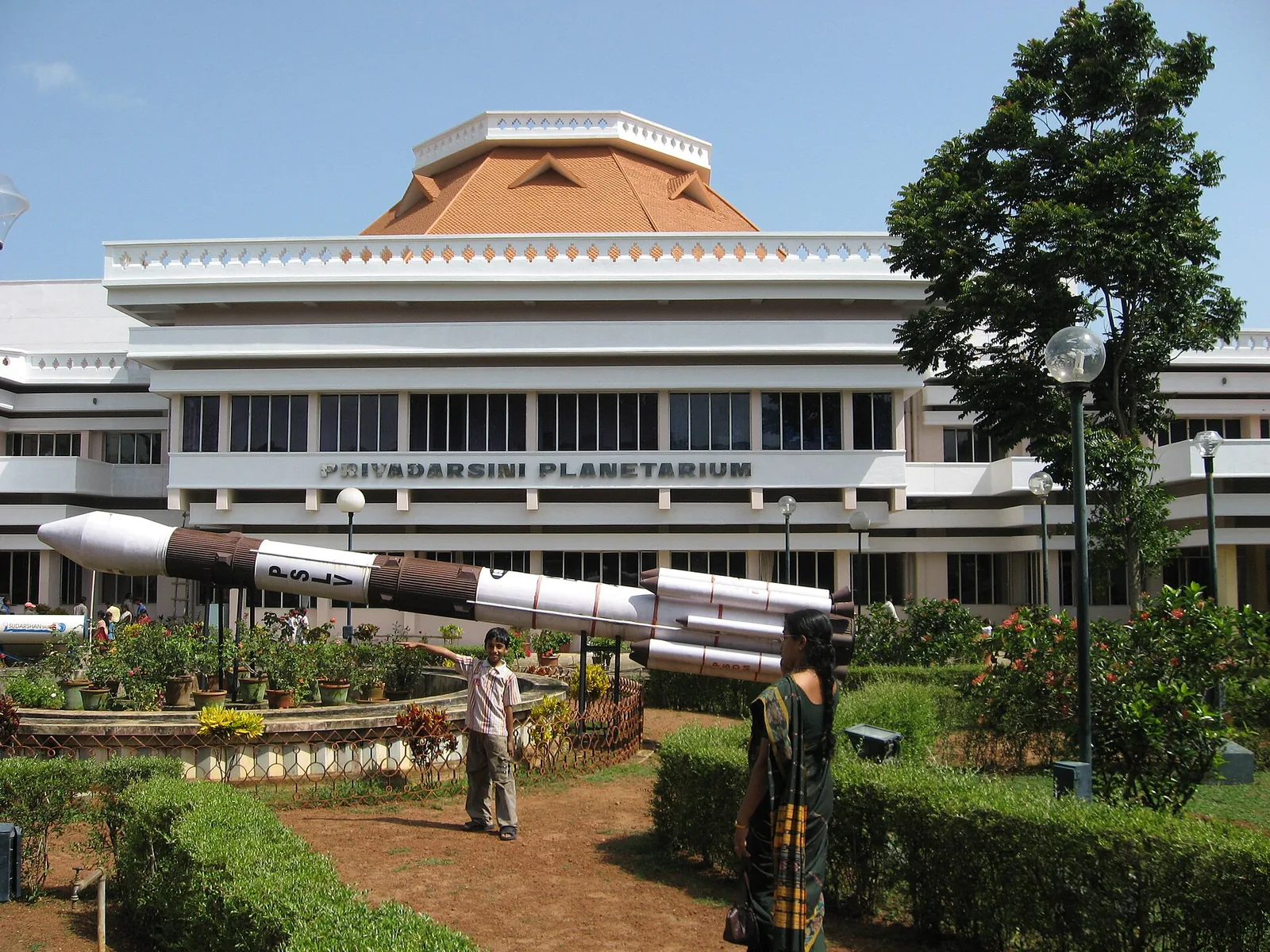
Thiruvananthapuram is a hard city to do with children. The great temple has a dress code and a queue, the palaces are about woodwork, the museums are about bronzes. The science museum is the one place in the city built for people under fifteen, and it is bigger than its frontage suggests.
What is actually in there
The electricity, electronics, power and motion-mechanics galleries alone hold more than three hundred exhibits between them, nearly all of them meant to be operated. Beyond those are galleries on popular science, mathematics, automobile engineering, bio-medical engineering, computing and solar energy, plus a 3D theatre, a motion simulator with six degrees of freedom, an energy park, an outdoor science park, a play park with thirteen educational devices, and a library. Add the planetarium and the honest problem is not whether there is enough to do. It is that you cannot do all of it well.
A plan that works
Start with the dome show, or rather start with its schedule: find the times first and fix your slot, because everything else here is available all afternoon and the show is not. Then do the hands-on galleries in the cool part of the day — motion mechanics and electricity are the strongest, and a child who has pulled a lever and felt the mechanical advantage has learnt something a label could not teach. Save the outdoor science park and the play park for last, when everyone needs to move and the sun has come off the top of the sky. If the 3D theatre or the simulator matter to your party, ask about them at the counter on the way in, since they run to their own timings.
Manage the vintage gap
The museum opened in 1984 and has grown by accretion ever since — the planetarium in 1994, a children’s science park in 1997, the play park in 2005. Four decades of additions means the galleries vary a good deal in age and polish, and some exhibits will be worn or out of order on any given day. That is normal for a working science centre and worth setting expectations about before you go in, particularly with a child who has seen a glossier one elsewhere. The best exhibits here are the mechanical ones, and mechanical things age well.
The local advantage
One section lands harder here than it would anywhere else: the space and rocketry material. Thiruvananthapuram is the home of the Vikram Sarabhai Space Centre, where India’s launch vehicles are developed, so this is not a general-interest topic imported for the children — it is the city’s own industry, and a fair number of the parents in the room will work in it. It is worth saying so to a child. A rocket in a museum is interesting; a rocket built four miles away by somebody’s mother is a different proposition.
And if it rains, which between June and September it will, this is the correct plan for the afternoon: indoors, cool, and entirely indifferent to the weather. Timings and tickets are on the museum page; the dome is covered in Two Projectors Under One Dome.
Frequently asked questions
How long do I need at the science museum?
Half a day is comfortable. The galleries and planetarium will take most of it; the outdoor science park and play park are best left to the end when children need to run.
What order should I do things in?
Fix your planetarium slot first, since show times are fixed and seats run out. Then the hands-on galleries — motion mechanics and electricity are the strongest — and the outdoor parks last, once the heat has gone.
Is it suitable for very young children?
Yes, though the galleries are pitched at school age. Younger children get most out of the play park, the outdoor exhibits and the dome show; the technical galleries will pass them by.
Is it a good rainy-day option?
It is the best one in the city. The main galleries are indoors and cool, which also makes it a sound choice for the hottest part of an afternoon.