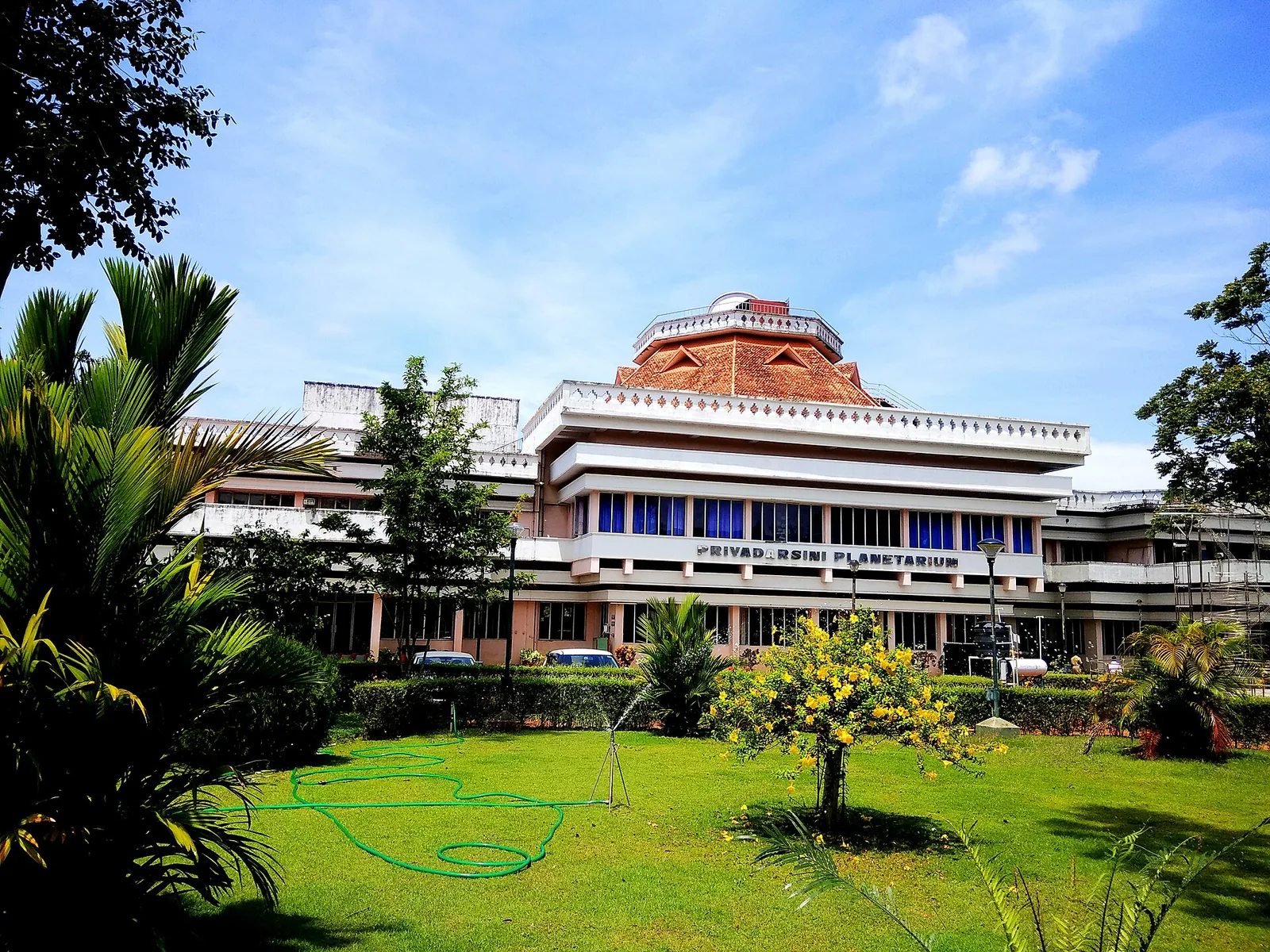
The dome at the Kerala Science and Technology Museum is what most families come for, and it is better equipment than the modest building suggests: eighteen metres across, a hundred and eighty-four seats, and two quite different projection systems running in the same room.
What “hybrid” actually means
A traditional planetarium projector is an opto-mechanical machine — a star ball, pierced with thousands of tiny apertures, throwing real points of light onto the dome through lenses. It does one thing superbly: stars. They are pin-sharp, they are the right brightness relative to one another, and no digital projector matches them. Here that machine is a GM-11 starfield projector, and it can present the sky as it stood or will stand across something like twelve and a half thousand years in either direction.
A digital system does the opposite job. It cannot make a star look as good, but it can take you off the Earth entirely — fly out to Saturn, run a simulation, show a diagram wrapped over the whole dome. A hybrid installation runs both, which is why one show can put you under a genuinely convincing night sky and then leave the planet in the next sequence. Kerala Tourism calls this the first hybrid planetarium in India with a tilted dome. Count the qualifiers before you repeat that; the equipment is impressive without needing to be a record.
The tilt, and where to sit
A tilted dome is angled rather than set flat overhead, so the audience faces forward and slightly up instead of lying back. It suits full-dome film better and is easier on the neck; the trade-off is that the geometry is no longer symmetrical, so seats are not equal. In a tilted room the good seats are centre and slightly back from the middle. Arriving early is worth doing for that reason alone, quite apart from the fact that shows fill on weekends and holidays.
The thing nobody lists
The planetarium also runs public telescope observation on Thursday and Friday evenings, roughly half past six to eight. This barely appears in any listing, which is a pity, because it is the only after-dark attraction in a city where the temples, museums and zoo have all shut by six. Evening sessions depend on staff and on the sky, so confirm on the day — but ask about it specifically rather than assuming a website that lists dome-show times is telling you everything the institution does.
Planning around the show
Show times are fixed and seating is finite, so the single most useful thing you can do is find out the schedule before you arrive and build the visit round it rather than hoping. Language matters too — shows run in more than one, and which is scheduled when varies, so ask at the counter rather than at the door. And be clear on the geography: the planetarium is not a separate destination, whatever your booking app says. It is a component of the museum, at the same address, on the same ticket counter.
What to do with the rest of the visit is in Half a Day of Buttons, and the museum’s odd history — including the science centre it drives out to schools — is in The Museum That Comes to You.
Frequently asked questions
How big is the Priyadarsini Planetarium dome?
Eighteen metres across, with 184 seats. It is a tilted dome, so the audience faces forward and slightly up rather than lying back, and the best seats are centre and a little behind the middle.
What is a hybrid planetarium?
One that runs two systems at once: an opto-mechanical star projector — here a GM-11, which can show the sky across roughly 12,500 years in either direction — for pin-sharp stars, and a digital projector for everything a star ball cannot do, such as leaving the Earth or wrapping a diagram across the dome.
Can I look through a telescope?
Yes. Public observation sessions run on Thursday and Friday evenings, roughly 6.30 to 8. They depend on staff and weather, so confirm on the day — and ask explicitly, because most listings omit them.
Do I need to book the dome show?
Shows run to a fixed schedule with finite seating and fill on weekends and holidays. Check the day’s schedule before you travel and plan the rest of the museum around your slot rather than the other way round.