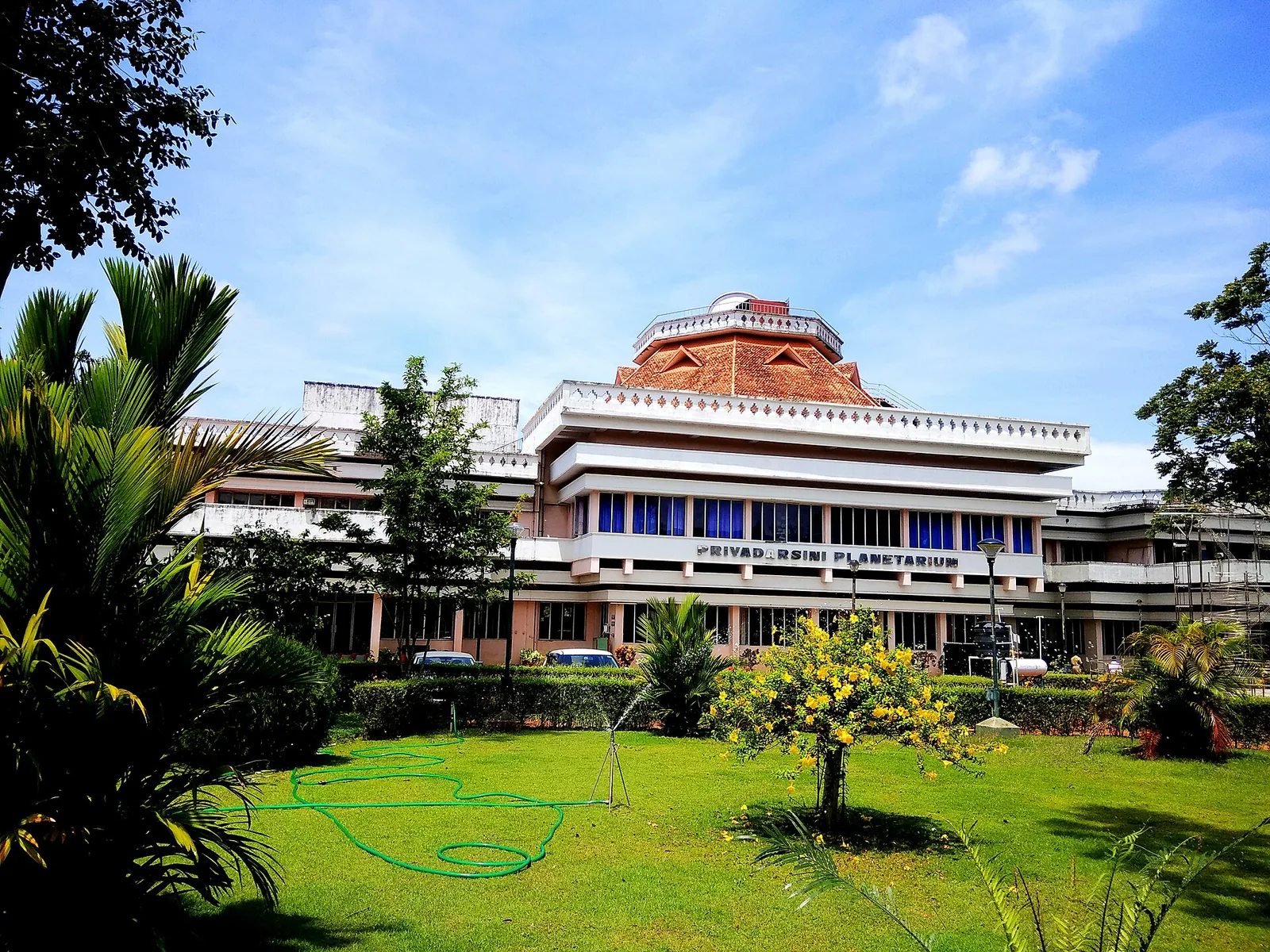
The Kerala State Science and Technology Museum was established by the state government in 1984, as an autonomous institution with a stated purpose: to popularise science and scientific temper, particularly among the young. That phrase is not decorative. It explains almost everything about how the place is built.
A teaching programme with a building attached
A museum founded to hold a collection accumulates objects and arranges them. A museum founded to teach accumulates demonstrations and arranges those, and the difference shows the moment you walk in: there is almost nothing here that is old, rare or valuable, and everything is designed to be operated. Judged as a collection this would be a poor museum. Judged as what it is — a permanent, state-funded teaching apparatus that happens to sell tickets — it is doing precisely its job.
The clearest proof of that is the part no visitor sees. Since 1999 the museum has operated a Mobile Science Exhibition: a science centre built into a vehicle that travels to schools across Kerala. It is a museum that inverts the usual arrangement. Instead of waiting for children to be brought to it — which, in practice, means the children whose schools can afford a bus and whose families live near a city — it drives to them. For a state that has spent decades treating education as public infrastructure, that is an entirely characteristic thing to build.
Four decades in layers
The site has grown in identifiable stages, and knowing them explains why the galleries feel so uneven. The museum opened in 1984. The Priyadarsini Planetarium followed a decade later, in 1994 — the two are constantly given the same founding date, and the ten-year gap vanishes in most write-ups. A Children’s Science Park opened in 1997, the Mobile Science Exhibition in 1999, and a play park with thirteen educational devices in 2005. What you walk through is not a designed whole. It is four decades of accretion, each layer reflecting what a science centre was supposed to be in the decade that built it.
Three names, one address
A practical note that saves people a wasted trip. Three names circulate for this one site: the Kerala State Science and Technology Museum, its formal title; the shorter Kerala Science and Technology Museum; and the Priyadarsini Planetarium, which is a component rather than a separate attraction. Booking sites list the planetarium as its own destination often enough that visitors plan two stops and make one. They are the same address. A related confusion sends a surprising number of listings to Kochi — the museum is in central Thiruvananthapuram, in the museum quarter, and always has been.
The dome and its equipment are in Two Projectors Under One Dome; a practical plan for a family afternoon is in Half a Day of Buttons.
Frequently asked questions
When was the museum founded?
In 1984, by the Government of Kerala, as an autonomous institution for popularising science and scientific temper among young people. The Priyadarsini Planetarium came a decade later, in 1994.
What is the Mobile Science Exhibition?
A science centre built into a vehicle, running since 1999, that travels to schools across Kerala. It takes demonstrations to children who would otherwise never reach a science museum — the part of the institution no ticket-holder ever sees.
Why do the galleries feel uneven?
Because the site grew in layers: the museum in 1984, the planetarium in 1994, a children’s science park in 1997, the mobile unit in 1999, a play park in 2005. Each addition reflects the decade that built it.
Is the planetarium a separate place?
No. The Priyadarsini Planetarium is part of the Kerala State Science and Technology Museum, at the same address on the same site, even though booking sites frequently list it as a separate destination. Some listings also file it under Kochi; it is in Thiruvananthapuram.