A coastline is not one address
Kizhunna often appears beside Ezhara and Thottada in descriptions of Kannur’s coast. Their proximity makes them easy to combine in a regional plan, but does not make the names interchangeable. Kerala Tourism describes Thottada to the north and Ezhara to the south of Kizhunna, while the coastal tourism study groups them within one broader stretch.
That distinction between a broad stretch and an individual beach is useful when arriving. An accommodation search can return a property marketed through a wider locality. A beach photograph can show a nearby cove. Neither is enough to establish that the public approach is the one intended for Kizhunna.
Let the landform explain the separate stops
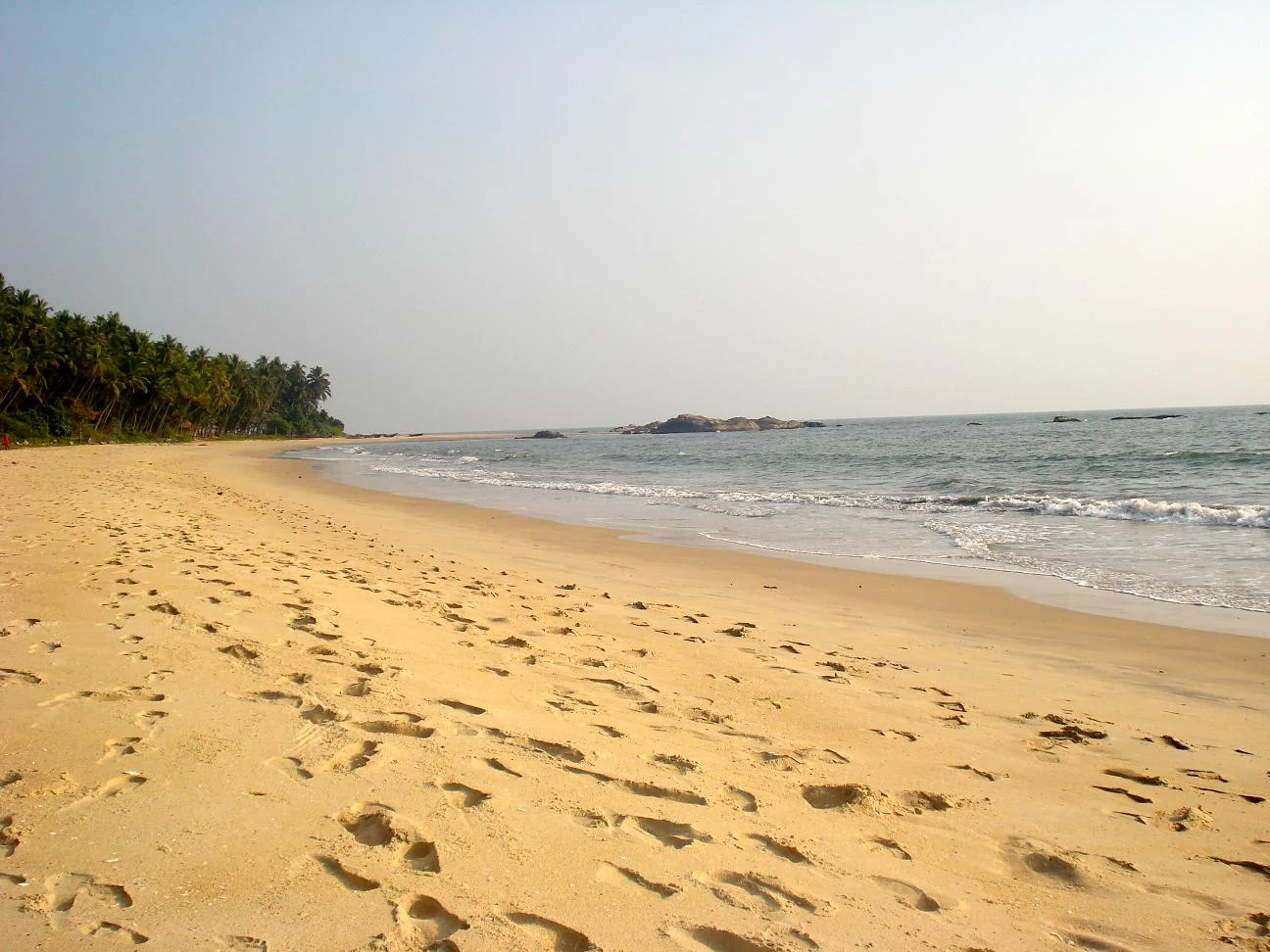
The photographs of Kizhunna show sand interrupted by low rock outcrops, with palms and settlement behind the shore. These features create smaller views within the longer coast. A visitor on one sandy section may not be able to see the next approach, even though both lie within the same regional beach description.
The story photograph includes footprints leading across open sand towards darker rock. It makes a walk look inviting, but it does not prove that the route continues indefinitely beyond the frame. A beach name on a map and a visible line of footprints are different kinds of information.
Before setting off, choose a return point that remains within the usable public shore. If a rocky interruption is wave-washed or the sand ends, return to the known approach. A continuous walk between every named beach should not depend on crossing private land or scrambling around an outcrop.
A practical way to plan the coast
Use Kizhunna as a specific stop with a named arrival point. If the day also includes Ezhara or Thottada, establish their separate road approaches and allow a transfer. This gives each beach its own attention instead of turning the outing into a search for a single imagined path connecting them all.
For a stay, match the property’s address to the beach actually beside it. A sea-facing room may overlook a smaller cove, while the public beach approach sits elsewhere. Ask for the property gate when arriving with luggage and use the public approach when planning an independent shore visit.
The same care improves photographs and memories afterwards. Label an image with the place whose identity is established, and retain a useful feature in the frame: a rock shelf, the palm-lined edge or the direction of the shore. Do not rename a neighbouring beach simply because the images share sand and sea.
Kizhunna becomes more interesting when its particular shore is allowed to remain distinct. The broader coast explains the journey, while the actual rocks, sand and approach explain the stop. Both scales are useful, provided they are not collapsed into one address.
Sources: Kerala Tourism: Kizhunna and Ezhara.
Plan the visit: Kizhunna Beach.