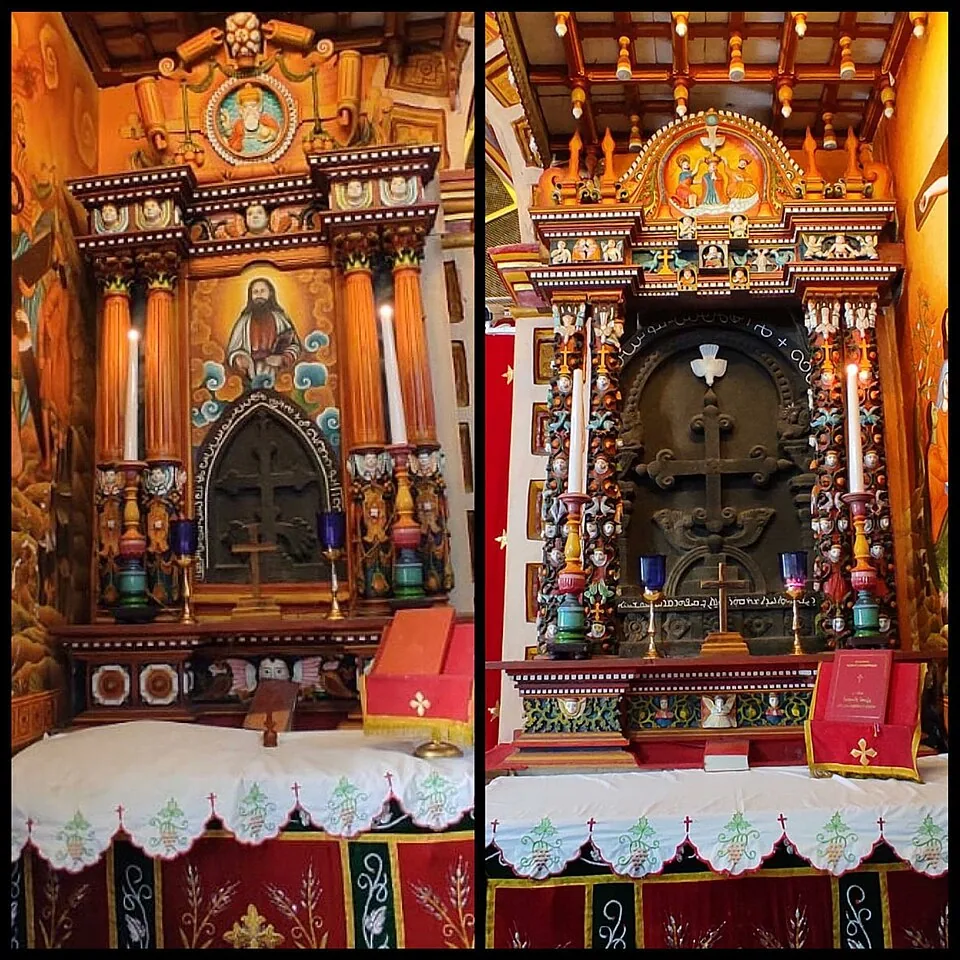
Inside the St Mary’s Knanaya Valiyapally at Thazhathangadi in Kottayam, built in 1550, stand two granite crosses that are far older than the church around them — carved with inscriptions in Pahlavi, the language of Sassanid Persia. They are among the most remarkable early-Christian relics in India.
The St Thomas Christians
Kerala’s Syrian Christians — the Nasranis — trace their origins to the Apostle Thomas, believed to have reached the Malabar coast in AD 52. Over the centuries the community kept close ties with the churches of Persia and the Middle East, using Syriac in worship, and it is from that world that these crosses come. Such stone crosses, with their distinctive form and Persian lettering, are usually called Persian or Nasrani crosses.
The Knanaya migration
The Valiyapally belongs to the Knanaya community, which traces its arrival in Kerala to a migration led by the merchant Thomas of Cana (Knai Thoma) from Mesopotamia. The church was built on land granted by the Thekkumkoor royal house, and it became one of the community’s principal centres. The crosses themselves are said to have been brought here from an older church at Kodungallur, the ancient Muziris port where tradition places the earliest Christian settlements.
Reading the stones
Each cross was cut from a single slab of granite. Both bear Pahlavi inscriptions; the larger one, on the southern altar, carries an additional inscription in Syriac in the Estrangelo script. The lettering has drawn scholars for generations, precisely because it links a Kerala parish to the wider late-antique Christian world of Persia and Mesopotamia. Local tradition even connects them to the seven-and-a-half churches associated with St Thomas.
Visiting the Valiyapally
The church stands beside the older Cheriapally in the Thazhathangadi heritage quarter of Kottayam. Details are on the Kottayam Valiyapally place page; the Kottayam hub links the town’s other historic churches and temples.
Frequently asked questions
What are the Persian crosses of Kottayam?
They are two ancient granite crosses in the Knanaya Valiyapally, each carved from a single slab and inscribed in Pahlavi (with Syriac on the larger one). They are relics of Kerala’s St Thomas Christians and their historic links with the Persian church.
How old are the crosses?
Their exact date is debated, but they are considerably older than the 1550 church that houses them and are counted among the oldest Christian relics in India; they are said to have been brought from an older church at Kodungallur.
Who are the Knanaya?
The Knanaya are a community of Syrian Christians in Kerala who trace their origin to a migration from Mesopotamia led by the merchant Thomas of Cana. The Kottayam Valiyapally is one of their most important churches.