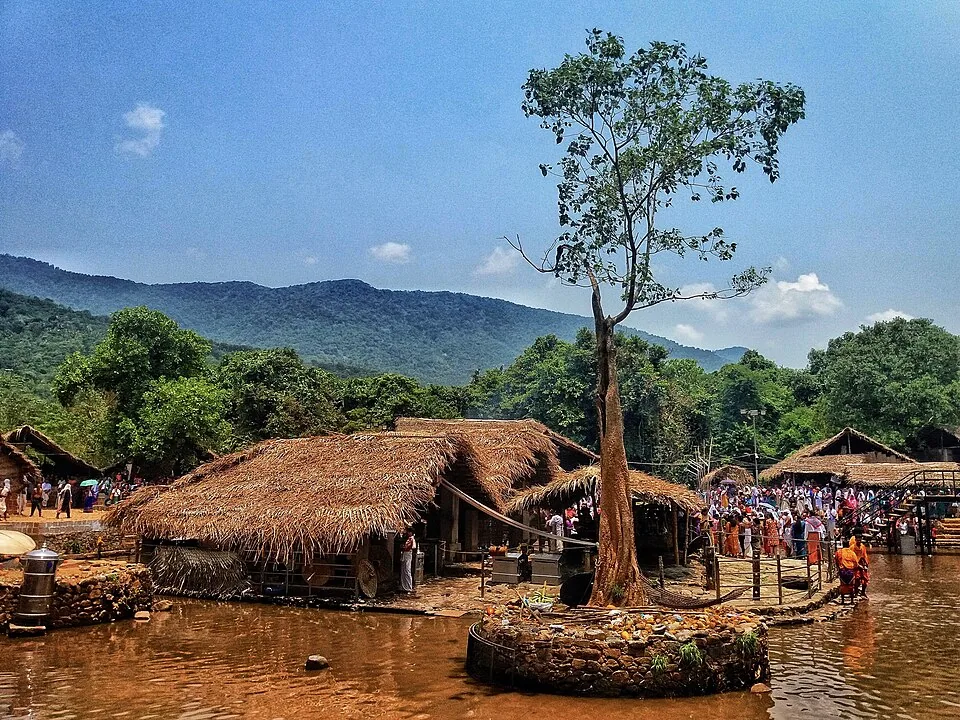
Deep in the forests of the Kannur highlands, across the roaring Vavali river, is a clearing where — for eleven months of the year — there is no temple at all. No walls, no roof, no idol on show; only trees, the river, and an enormous green silence. Enter the grove out of season and you would never know it was one of the holiest spots in Kerala. And then, for a few weeks each monsoon, it comes violently alive with tens of thousands of pilgrims. This is Kottiyoor, and its story runs back to one of the fiercest legends in all of Hinduism.
The sacrifice that ended in fire
Legend holds that this clearing is the very ground of the Daksha Yaga. Daksha, a proud patriarch, held a great sacrifice and pointedly refused to invite his daughter Sati and her husband Shiva, whom he despised. Sati went anyway — and, forced to stand and hear her father heap insults on her lord, she could not bear it. She threw herself into the sacrificial fire. When word reached Shiva, his grief became a fury that shook the worlds: from his rage sprang the terrible Virabhadra and the goddess Bhadrakali, who fell upon the sacrifice, scattered the gods and beheaded Daksha himself. Only when the ceremony lay in ruins was Daksha, at Vishnu’s plea, revived — with the head of a ram. And Shiva wandered the earth carrying Sati’s body, its falling fragments becoming the fifty-one Shakti Peethas. The place where it all began, the story says, is Akkare Kottiyoor.
A temple you cannot enter most of the year
Two shrines face each other across the Vavali. On the near (west) bank stands the permanent temple, Ikkare Kottiyoor, a classic Kerala nalukettu attributed to Parasurama. But the sacred spot itself — Akkare Kottiyoor, on the far bank — has no permanent building at all. At its heart is the Manithara (also called Ammarakkal Thara), a raised circular stone platform holding a swayambhu, self-manifested, Shivalinga, ringed by a sacred pool called the Tiruvanchira; beside it stand a giant Jayanti lamp and a mirror-idol of Bhagavathi beneath a palmyra-leaf umbrella. Seen from above, the whole arrangement is said to form the shape of a linga. Only for the festival is a temporary hermitage of palmyra leaves — the Yajna Bhoomi — raised over it. When the days are done, everything is dismantled and the forest is left, they say, so that Shiva and Shakti, merged in their grief and reunion here, may keep their solitude undisturbed until the next year.
Twenty-eight days of ritual in the open forest
That festival is the Vysakha Mahotsavam, running for about 27 to 28 days from the Swati star of Vaisakha to the Chitra star of Jyaistha — roughly late May into June, in the teeth of the monsoon. Pilgrims wade the swollen river to reach the grove, and the rites unfold day and night in the rain and the open air, each in a fixed, ancient sequence with names most Malayalis have never heard: the Neyyattam, when stream after stream of ghee is poured over the sacred stone; the Ilaneervaipu, an offering of thousands of tender coconuts; the Rohini Aradhana, when a Brahmin of a particular Vaishnavite family — holding the birthright by blood — embraces the Shivalinga in the Alingana Pushpanjali, re-enacting the moment Vishnu held the grieving Shiva in his arms. Every community has its own hereditary duty here. Tellingly, the purification rite of Punyaham is never performed — because a ground where the Shaiva, Shakta and Vaishnava divinities all meet is held to need no purifying.
The strangest prasadam in Kerala
When the pilgrims leave, they carry home something you will see nowhere else: the Odapoo, a “flower” shredded from soft reed, its fine white filaments said to represent the beard of the sage Bhrigu, torn out in the violence of the Daksha Yaga. It is worn and treasured as the blessing of the forest shrine. Between the ghee and the reed-flowers, the river-crossings and the all-night rites under the trees, Kottiyoor is quite simply the rawest, most elemental pilgrimage left in Kerala — Vedic worship as it might have looked three thousand years ago, still performed in the open.
Timing your visit
This is the rare temple where when you go decides whether there is anything to see at all: outside the Vysakha Mahotsavam, Akkare Kottiyoor is closed forest, and entry is forbidden. Come during the festival and you witness one of India’s most extraordinary sacred events; come at any other time and you can still visit the permanent Ikkare shrine on the near bank. Check the dates carefully — they shift each year with the Malayalam calendar, falling roughly late May to June. Details are on the Kottiyoor place page; the wider region is on the Kannur hub.
Frequently asked questions
Why does Kottiyoor have no permanent temple?
The far-bank shrine, Akkare Kottiyoor, is regarded as the very site of the Daksha Yaga, kept as a sacred grove around a self-manifested (swayambhu) Shivalinga on the Manithara platform. Instead of a permanent building, a temporary shrine of palmyra leaves (the Yajna Bhoomi) is raised only for the annual festival and dismantled afterwards, leaving the merged Shiva and Shakti in solitude. The permanent temple, Ikkare Kottiyoor, stands on the near (west) bank.
When is the Kottiyoor Vysakha Mahotsavam?
It is an annual festival of about 27–28 days running from the Swati star of Vaisakha to the Chitra star of Jyaistha — roughly late May to June, during the monsoon. Outside this period the Akkare Kottiyoor site is closed forest, so timing your visit to the festival is essential.
What is the legend behind Kottiyoor?
Legend identifies the site with the Daksha Yaga — the sacrifice at which the goddess Sati immolated herself after her father Daksha insulted Shiva. Shiva’s wrath, embodied as Virabhadra and Bhadrakali, destroyed the ceremony; Daksha was beheaded and later revived with a ram’s head. The festival commemorates this event.
What is the Odapoo prasadam?
The Odapoo is a delicate “flower” shredded from soft reed, given to pilgrims at Kottiyoor. Its fine white filaments are said to symbolise the beard of the sage Bhrigu, torn out during the chaos of the Daksha Yaga, and it is treasured as the blessing of the shrine.