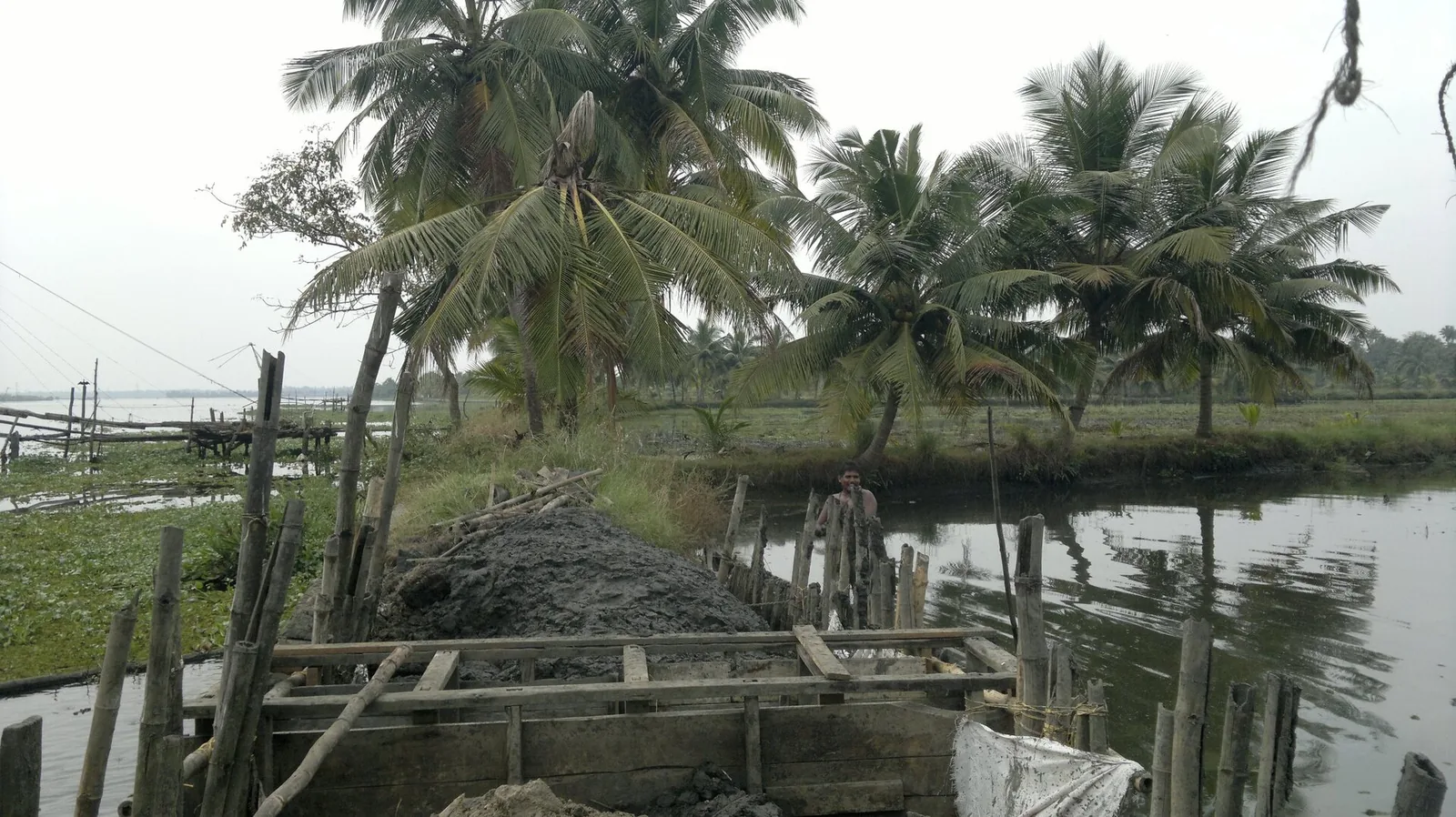
On a Kumbalangi village walk you will pass a low, slightly scruffy field behind an earth bund with a wooden gate in it. It does not look like anything. It is one of the oldest continuously practised farming systems on the planet, and it is quietly going out of existence.
What pokkali is
Pokkali is a saline-tolerant rice, grown in the waterlogged coastal wetlands of Ernakulam, Thrissur and Alappuzha. It survives salt levels that would kill an ordinary rice plant outright, and it has been cultivated in these fields for something on the order of three thousand years. It received a Geographical Indication tag in 2007.
The plant itself is tall — it has to be, to keep its head above brackish flood water. But the remarkable thing is not the variety. It is the calendar it is grown on.
Rice, then prawns, then rice
Through the monsoon, rain pushes the salt back out of the fields and the water turns nearly fresh. That is the rice season. The pokkali is grown, and harvested by cutting only the upper portion of the plant, leaving the stalk standing in the mud.
Then the rains stop. The sluice gates are opened, and salt water comes in on the tide, bringing prawn larvae with it. For the saline months the same field is a prawn pond — the prawns feeding on the decomposing rice stubble left standing from the harvest. When the prawns are taken, the gates open again, the monsoon returns, the salt is flushed, and it becomes a rice field.
- The prawns feed on the decomposing rice stubble left after harvest.
- The next rice crop feeds on what the prawns leave behind.
- No fertiliser. No pesticide. No prawn feed.
- The monsoon flushes the salt; the tide brings it back. The gate does the rest.
- It is a closed organic loop that predates the word "organic" by roughly three millennia.
This is locally described as pokkali-karimeen krishi, and it is worth pausing on how unusual it is. Almost every intensive farming system on earth requires inputs from outside itself. This one is fed entirely by the waste of its own alternating halves, and it has been running that way since before the Roman ships came to this coast for pepper.
And it is disappearing
Pokkali cultivation has contracted sharply. The rice half of the cycle is labour-intensive, poorly paid and hard to mechanise in soft waterlogged ground; prawns on their own are far more profitable. So fields are increasingly kept in prawn production year-round and the rice is dropped.
That breaks the loop. Without the rice stubble the prawns need feed; without the monsoon rice season the salt is not flushed; and the closed system becomes an ordinary aquaculture pond with inputs and effluent. Commentary in the agricultural press has gone as far as describing the variety as possibly heading for extinction. If a working pokkali field with an operating gate is on your route, you are looking at something genuinely ancient that may not be here in fifty years.
What else a walk shows you
The pokkali cycle is the intellectual centre of a Kumbalangi walk, but it is not all of it. A good route also takes in coir being twisted from soaked husk in somebody’s yard, a toddy tapper going up a coconut palm with a knife and a foot loop and no harness at all, clam shells being processed, and prawn filtration at a sluice gate — which is the moment the farming and the fishery visibly become the same activity.
The lanes themselves are short, flat and ordinary. What you are paying a village host for is not the route. It is access to people working, and permission to stand there and watch.
Frequently asked questions
What is pokkali rice?
A saline-tolerant, GI-tagged rice variety grown in the waterlogged coastal wetlands of Ernakulam, Thrissur and Alappuzha. It survives salinity that would kill ordinary rice, has been cultivated for around three thousand years, and received its Geographical Indication tag in 2007.
How does the rice-prawn rotation work?
Rice grows through the monsoon, when rain flushes the salt out. After harvest the sluice gates are opened and saline water floods in with prawn larvae, turning the same field into a prawn pond for the dry months. When the prawns are taken the gates open again and the monsoon restores the rice season.
Why does pokkali farming need no fertiliser?
Because each half of the cycle feeds the other. The prawns eat the decomposing rice stubble left standing after harvest; the next rice crop draws its nutrients from what the prawns leave behind. No fertiliser, pesticide or prawn feed is used — a closed organic loop far older than the term.
Is pokkali cultivation dying out?
It has contracted sharply, and agricultural commentary has warned it could be heading for extinction. The rice half is labour-intensive and poorly paid while prawns alone are more profitable, so fields are increasingly kept in year-round aquaculture — which breaks the loop that made the system work.
Can I see a pokkali field on a Kumbalangi village walk?
Usually yes, and it is worth asking for specifically — particularly a sluice gate being operated, which explains the entire cycle in about two minutes. Ask your homestay host to include it when arranging the walk.
What else does a Kumbalangi village walk include?
Coir being twisted from soaked husk, toddy tapping, clam-shell processing and prawn filtration at the sluice gates. The lanes themselves are flat and unremarkable — what you are paying for is a host who can get you into yards where people are working, and permission to watch.