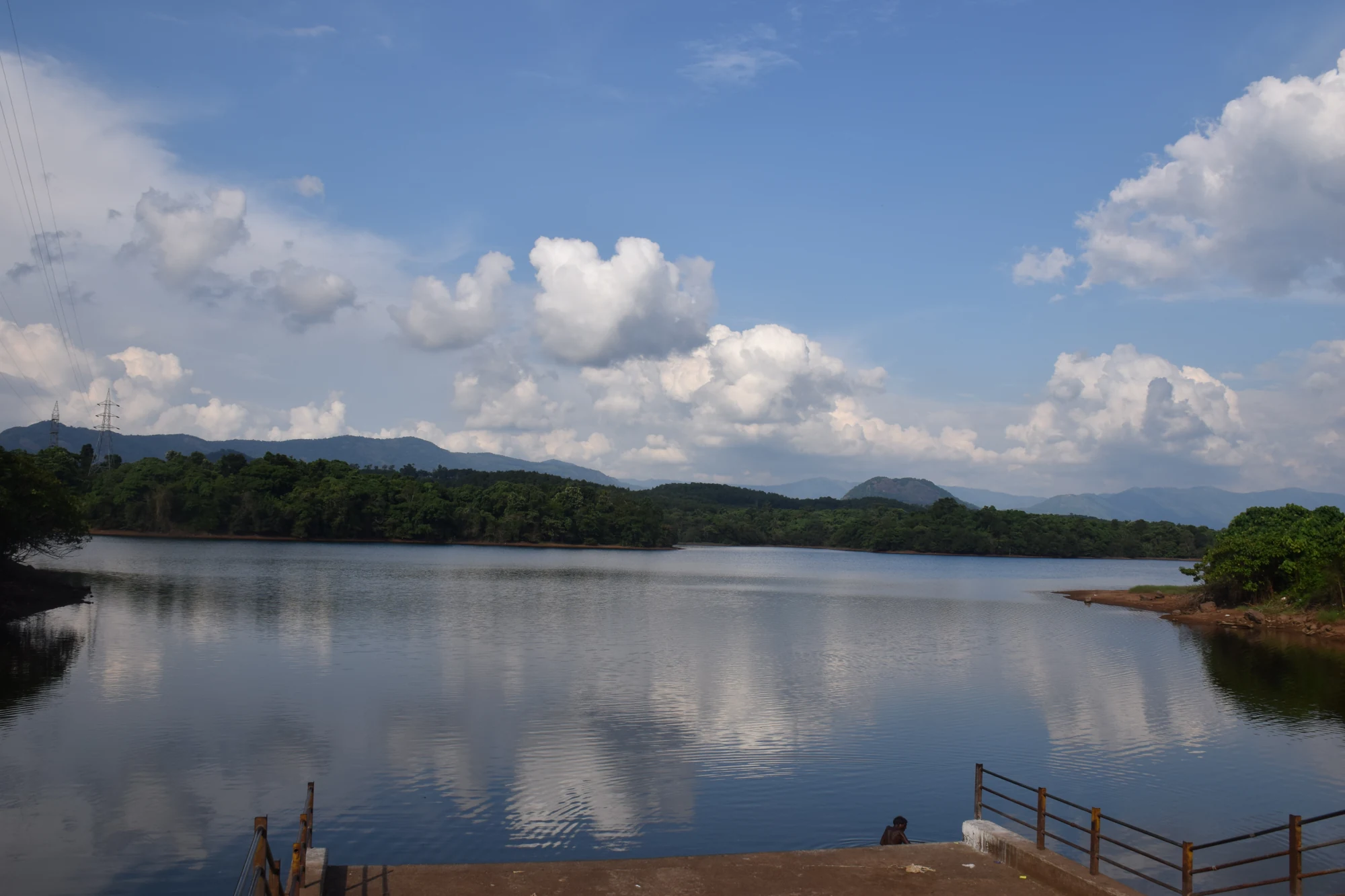
Malankara is often introduced as a reservoir near Thodupuzha. Its more interesting role begins upstream, with water that has already passed through Idukki’s power-generating system. The dam connects that water with the Thodupuzha River and the irrigation network of the Muvattupuzha Valley project.
After the turbines
Water released after generation at Moolamattom enters the Thodupuzha-side drainage. Malankara holds and regulates water farther along that route. It is therefore a different stage of the system from the large Idukki reservoir: the visitor is looking at water being managed after its passage through power generation, rather than at another arm of the same high-level lake.
The distinction explains why a journey between the two places is not simply a drive around one reservoir. Idukki’s storage structures, Moolamattom’s generating station and Malankara’s regulating dam occupy separate positions in the landscape. Their relationship is hydraulic and operational, with roads providing a different set of connections for visitors.
A dam with an irrigation job
Kerala’s Irrigation Department identifies Malankara as the headworks of the Muvattupuzha Valley Irrigation Project. Water stored here feeds the canal system serving land farther downstream. The left and right bank canals begin a distribution network whose purpose extends beyond the attractive water surface seen from the visitor park.
This is why the owner matters. Malankara belongs to the Irrigation Department’s project, even though the water’s upstream journey and a power installation at the dam also involve hydropower. Calling every Idukki-area dam a KSEB asset would blur the different responsibilities. For a park visit, the admission arrangements at Malankara are the relevant ones.
Three dates describe different works
The department records completion of the dam in 1994. It separately records a 10.5-megawatt toe power station commissioned in September 2005 and the wider irrigation project’s commissioning on 10 July 2020. These dates can all appear in accounts of Malankara because they refer to different pieces of the scheme.
A useful history keeps those pieces distinct. The dam did not first appear in 2020 merely because the broader project was commissioned then. Nor does the 2005 generating installation change the irrigation purpose of the headworks. Engineering landscapes often grow through additions, and Malankara makes that layered development visible in one compact area.
At the site, look for the contrast between the broad reservoir and the concentrated control structures. Water is spread across a wooded landscape on one side, then directed through a much narrower set of gates and channels. The visitor viewpoint gives a way to understand regulation without entering the operating parts of the dam.
The story continues beyond the view. The reservoir supports an irrigation network reaching agricultural land, while the park gives the public a place to encounter the scheme. Remembering that wider purpose turns a pleasant waterside stop into an introduction to how one body of water can serve successive uses across different elevations and catchments.
Engineering reference: Irrigation Department: Malankara Dam and Muvattupuzha Valley Irrigation Project.
Plan the visit: Malankara Dam.