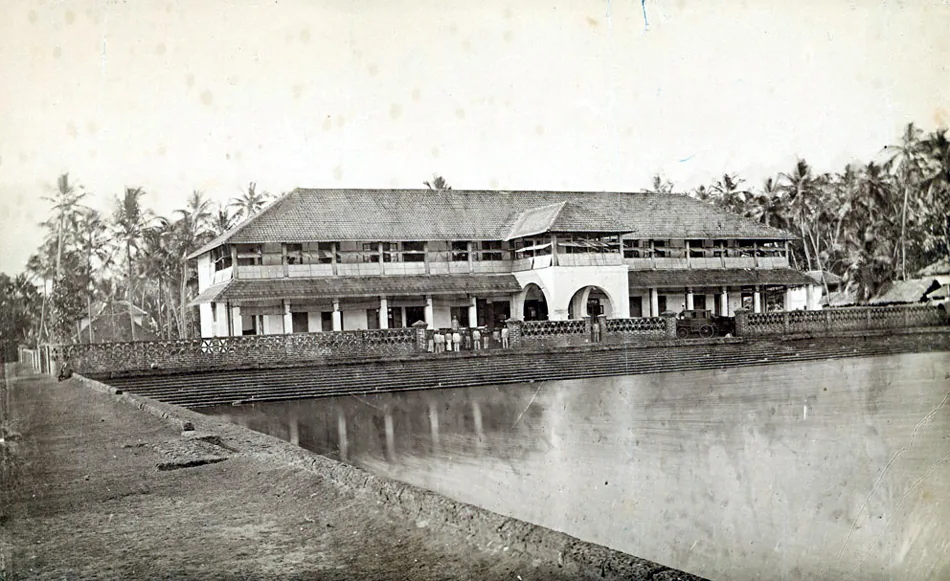
The most remarkable thing about the water at Mananchira Square is not that it is old. It is that it is still there at all. Large public tanks sat at the centre of Indian towns for centuries, and across the twentieth century most of them were filled in and built over. Mananchira is the exception, and the reason it is the exception is not sentiment. It is regulation.
A royal pond
The tank is traditionally dated to around the fourteenth century and attributed to the Zamorin Mana Vikrama, whose name it still carries — Manavikraman’s chira, the tank of Mana Vikrama, worn down by ordinary speech into Mananchira. It was dug in connection with the ruling house, on ground beside the palace, and at that point it was what such tanks always were: a private amenity at the centre of power, for bathing and for supply.
It is roughly 130 metres by a little over 100, and it is not filled by any pipe. It is fed from below by a natural spring, which is the single fact that explains its whole history. A tank that depends on rainfall and runoff becomes stagnant, silted and eventually expendable. A spring-fed tank stays sweet, and a supply of sweet water in a coastal town where wells go brackish is not a luxury. It is the reason the town can be there.
From palace amenity to public utility
That is the transition that saved it. As Calicut grew, the tank stopped being the king’s and became the town’s — the drinking supply for a working port city. By the later nineteenth century municipal rules forbade bathing and washing in it, which is a small sentence with large consequences. It converted the pond from an ornament into infrastructure, with a legal status and an administrative body responsible for keeping it clean.
You can see the change of purpose in the oldest surviving photographs of the site, which show the water held behind a stepped laterite embankment with a substantial building standing over it. That is not the look of a pleasure garden. It is the look of a facility.
The embankment itself deserves attention. Laterite is the local stone — soft and workable when freshly cut, hardening on exposure to air — and the stepped form is doing two jobs at once. It retains the bank against the weight of the water, and it gives access down to a surface that rises and falls by a couple of metres between the end of the monsoon and the end of the dry season. Steps, rather than a single wall, are what a tank needs when the level will not stay put.
Why the others disappeared
To appreciate what survived here, it helps to know what happened elsewhere. Urban tanks across India were lost in a fairly consistent sequence. Piped water arrives, so the tank is no longer needed for supply. Once it is not needed, it is not maintained. Unmaintained, it silts, weeds over and becomes a mosquito problem and a rubbish dump. At that point it is publicly regarded as a nuisance rather than an asset, and filling it in and building a bus stand or a market on the site is not merely permitted but popular. Open water at the centre of a growing city is extraordinarily valuable land, and the argument for keeping it is aesthetic while the argument for filling it is financial.
Mananchira did not go down that path, because the protections attached to it as a drinking-water source were never quietly dropped, and because the spring kept the water good enough that the tank never reached the derelict stage where the public would have supported losing it.
There is a second reason, less often stated, which is location. The tank sat at the exact civic centre of Kozhikode, ringed by the buildings that mattered — the town hall, the post office, the library, the trading houses. Ground that visible is ground that a great many people have opinions about. A tank tucked behind a market can be filled in over a weekend and few will notice until it is done. A tank that the whole town walks past daily is a much harder thing to quietly erase, and Mananchira had the good fortune to be impossible to ignore.
What that means when you are standing there
Maintenance is the unglamorous half of that story and the half that decides it. A spring-fed tank still silts — the spring brings water, but the surrounding city brings dust, leaf fall, road grit and whatever the drains contribute — and a tank that is not periodically desilted will lose depth steadily until it is a marsh. Every surviving urban tank in India is surviving because somebody, at intervals, has paid for the unpleasant and expensive job of taking the accumulated sediment out of it. None of this is visible to a visitor, and all of it is the actual reason there is water in front of you.
The seasons show on the tank if you know to look. At the end of the south-west monsoon the level sits high against the embankment and the water is turbid with runoff; by the end of the dry months it has dropped noticeably and cleared, exposing more of the stepped stonework. That range is exactly what the stepped construction was built to accommodate, and it is the clearest surviving evidence that this was designed as a working water source rather than as an ornamental pool with a fixed decorative level.
So the fenced edges and the prohibition on swimming are not the local authority being officious about a water feature. They are the direct descendants of the rules that kept this tank alive while comparable tanks in comparable towns vanished. The fence is the reason there is anything to look at.
It also explains the odd relationship the square has with its own centrepiece. You cannot get to the water. You walk around it, look at it, photograph it, and are kept off it — which feels like a design failure until you understand that the distance is the whole point. Everything else here was landscaped in 1994 and could be landscaped again. The pond is the one thing on the site that no designer was ever allowed to touch, and it is still supplying the reason the city grew up around this spot. Plan the rest of old Calicut from the Kozhikode hub.