Search for Marari Beach and you will be told, in almost identical words on almost every page, that it is an unspoilt and deserted stretch of sand where you will meet more fishermen than sunbathers. Our own page said exactly that until we went back and looked at the photographs.
They do not support it. This is what they show.
Three dates
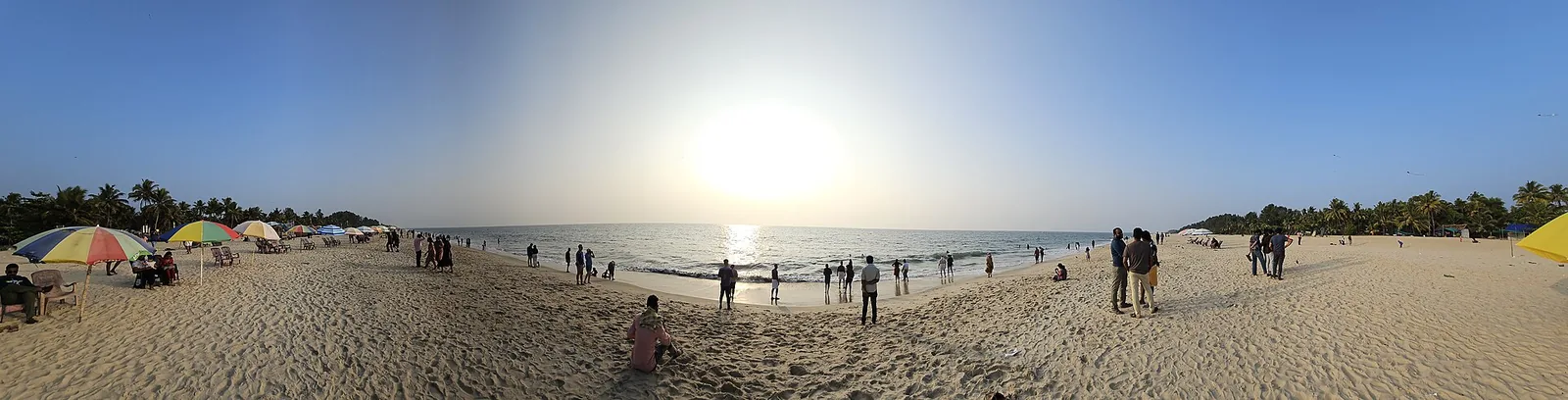
On the evening of 11 February 2024, a photographer walked this beach and uploaded a series of frames. They show kites in the air by the half-dozen at once. A hawker working the crowd with a tall rack of kites and balloons. Sunloungers. A long row of coloured beach umbrellas running back towards the palms. Plastic chairs. And several hundred people, spread out along the sand and standing ankle-deep in the shallows in a line that runs away up the coast until it dissolves in the haze.
On an evening in August 2022 — the tail of the monsoon, an ordinary weekday, the least likely conditions on the calendar — the same beach has families sitting out on mats, people walking, three kites up, and a scatter of litter and weed along the tideline.
In January 2025, a third photographer, again in the evening: a great pale expanse of dry sand, a crowd along the waterline in the middle distance, and at the top of the beach a set of cafe tables and chairs under a line of bulbs slung from a palm.
Three photographers, three years, three seasons, one picture. The frames carry EXIF capture dates with camera models attached, so this is not guesswork about when they were taken.
So is it a bad beach now?
No — and that is the point. Nothing here says Marari has been ruined. It says the received description was never accurate in the first place, and that the thing being sold as emptiness is actually something better and more interesting: a working village shore that is also a genuinely popular local evening destination.
Marari really is quieter than Kovalam and Varkala. It really is far less built up — there is no cliff-top strip of cafes here, no promenade, no hotel wall. The resorts sit back behind the coconut groves rather than on the sand. All of that is true and none of it required the beach to be deserted.
What is actually exceptional at Marari is the width. The belt of dry sand is unusually deep, deep enough that the evening crowd gathers in a band along the water and leaves a broad pale expanse behind it, and the beach runs far enough in both directions that the crowd is a local phenomenon rather than a general one.
How to get the quiet, if quiet is what you came for
It is entirely available. It is just not the default.
Come in the morning. The boats are already out, the sand is printed with last night’s footsteps and very little else, and you will have as much of it as you want. Or come in the evening and walk — fifteen minutes in either direction from the main access point will generally take you past the last of the umbrellas. The crowd concentrates where the road meets the sand, as crowds do.
And be aware of the pattern: fine weekend evenings in the December-to-February season are the busiest thing this beach does. A wet Tuesday in July is a different place entirely.
The fishery is still the constant
Underneath all of it the working village carries on. At dawn and dusk the fishermen push their craft out through the surf, catamarans lie hauled up on the sand, nets are mended and shore-seines are dragged in by teams. One of the best photographs of this coast is from 2012 and shows a single figure in silhouette paddling a small boat out through a heavy grey monsoon swell, and that has not stopped happening because there are kite sellers on the beach.
What has changed is who else is there in the last two hours of light: families driving down from Cherthala and Alappuzha, children with kites, hawkers who set up for the sunset trade, and a modest fringe of chairs and umbrellas at the top of the sand. That is not a fall from grace. That is what a good beach near a lot of people looks like at the end of the day, in Kerala as anywhere else.
For the practical side of a stay — how to get here, when to come, what to pair it with — see our Marari Beach guide, and the Marari Beach place page for logistics.
Frequently asked questions
Is Marari Beach crowded?
On fine evenings, especially at weekends and in the December-to-February season, yes — expect local families, kite flyers, hawkers, umbrellas and sunloungers, and a long line of people paddling at the water’s edge. It is never wall-to-wall, and it is much quieter than Kovalam or Varkala, but it is not the deserted beach it is usually described as.
When is Marari Beach quietest?
Early morning, any day. The boats are out and the sand is essentially empty. Failing that, walk about fifteen minutes along the beach away from the main access point — the crowd concentrates where the road meets the sand.
Is Marari still a working fishing village?
Yes. Boats are launched and landed through the surf at dawn and dusk, catamarans lie on the sand, and shore-seines are hauled in by teams. The evening visitors and the fishery share the beach rather than replacing one another.
How does Marari compare with Kovalam and Varkala?
Much less built up — no clifftop strip, no promenade, and the resorts set back behind the coconut groves rather than on the sand. It is also unusually wide. Quieter, yes; empty, no.