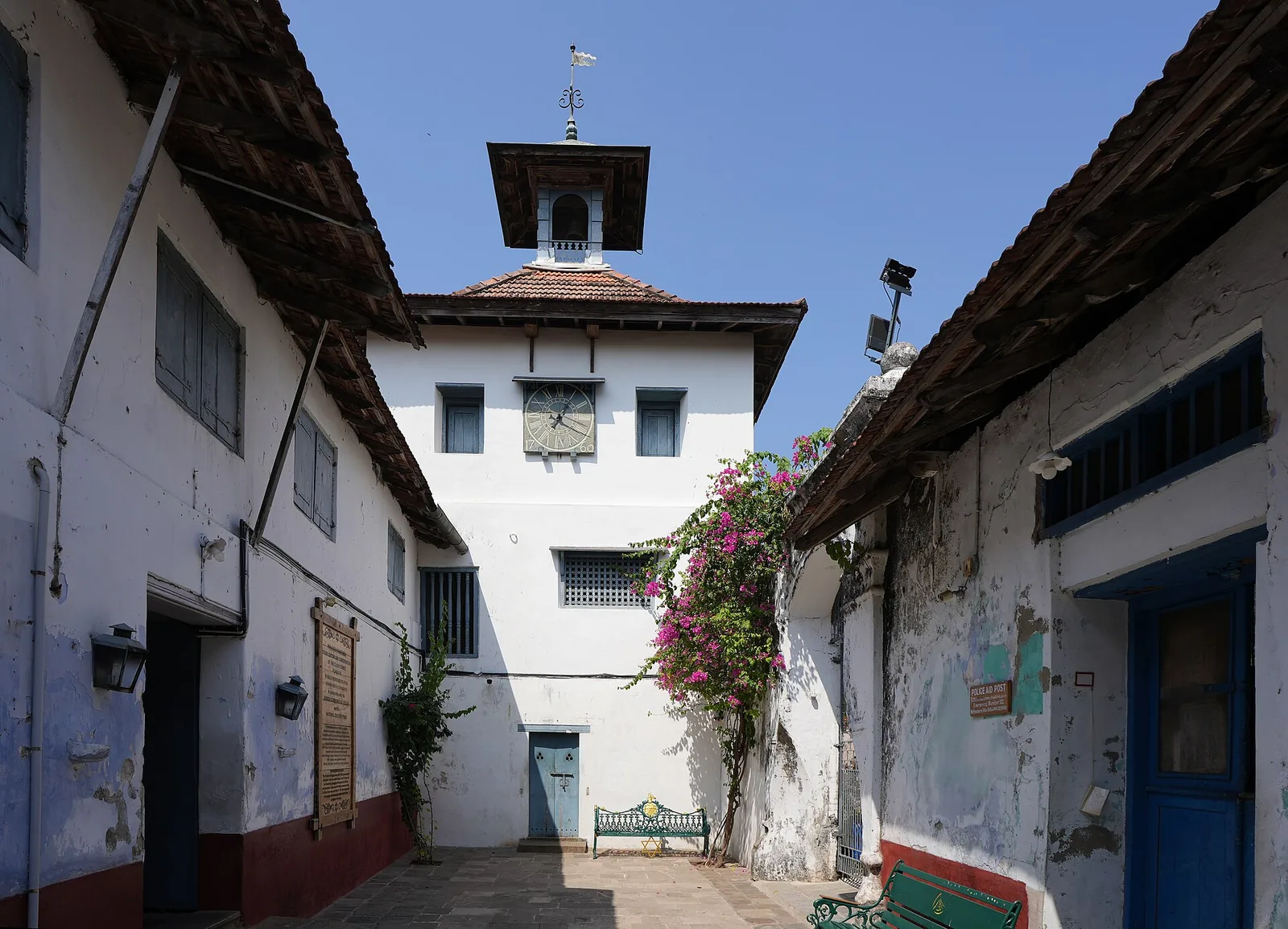
The queue for the Mattancherry Paradesi Synagogue forms in a lane, and while you stand in it you are looking at the most interesting object in the compound. The white clock tower at the end of the lane is free, permanently on view, and almost nobody stops at it. It was put up around 1760 to 1761 by Ezekiel Rahabi, the merchant who acted as the Dutch East India Company’s agent in Cochin, and it stands about forty-five feet.
A clock with an audience problem
Rahabi had a practical difficulty. The people who needed to read this clock did not share a calendar. His own community reckoned by the Hebrew calendar. The Cochin court reckoned by the Malayalam era. The Dutch he traded with reckoned by the Christian one. A single dial would have quietly told one of the three that the clock was not for them.
So the tower was given faces on more than one side, each numbered for a different audience — and this is the part worth walking round for.
- West — Hebrew numerals, giving the year 5521.
- North — Malayalam numerals, giving the Kollam era year 936. This is the face that looks towards the Raja’s palace, and that is not thought to be an accident.
- South — Roman numerals, AD 1760.
- East — blank.
Read the three together and they are the same year written three ways. That is the whole design: a single instrument that refuses to make anyone convert. In a lane where a Jewish congregation, a Hindu court and a Protestant trading company all had business, that is a piece of diplomacy built into masonry.
The face that argues
The east side is blank, and the blankness is disputed.
In 1929 A. B. Salem — the Kochi lawyer better known for taking on the colour bar inside the synagogue itself — recorded a fourth dial on the eastern face. Salem is not a careless source. He was a meticulous man who documented his community closely, and he was writing about a building he stood in front of constantly.
The difficulty is photographic. Images of the tower from 1906, 1923 and 1947 have been examined, and none of them shows a dial on the east. Salem’s note sits in the middle of that sequence, with photographs on both sides of it that appear to contradict him.
There is no resolution to offer. A dial may have been added and removed between photographs. Salem may have been describing an intention, a plan, or something painted rather than fitted. He may have been mistaken. What is certain is that a careful local witness and the photographic record do not agree, and neither of them can now be cross-examined.
What to do with it as a visitor
Walk round the tower before you join the queue, and read the three faces in order. It takes two minutes and it reorganises the visit, because the synagogue then stops being a curiosity behind a ticket and becomes what it actually was: the religious building of a community that did business with everyone in the lane and needed all of them to be able to tell the time.
Then look at the east face and notice that you cannot tell. That is a fair introduction to Jew Town generally, where a great deal is documented and a great deal is asserted, and the two are not always the same set of facts.
Frequently asked questions
When was the Paradesi Synagogue clock tower built?
Around 1760–61, by Ezekiel Rahabi, the merchant who served as the Dutch East India Company’s agent in Cochin. It stands about 45 feet.
Why does the clock tower have dials in different scripts?
Because its readers used different calendars. The west face carries Hebrew numerals (year 5521), the north face Malayalam numerals (Kollam era 936), and the south face Roman numerals (AD 1760). They are the same year written three ways, so that no community had to convert.
Why does the north face point at the palace?
The Malayalam-numeral face looks towards the Raja’s palace, and it is generally read as deliberate — the dial for the court, turned towards the court.
Is there a fourth clock face?
The eastern face is blank today. A. B. Salem recorded a fourth dial there in 1929, but photographs of the tower from 1906, 1923 and 1947 do not show one. We publish it as an unresolved disagreement rather than picking a side.
Can I see the clock tower without a ticket?
Yes. The tower stands at the end of the lane and is visible from the street at any time. The synagogue interior is ticketed and has restricted hours and photography rules; the tower has neither.
Who was A. B. Salem?
A Kochi lawyer, born 1882, the first Cochin Jew to train in law, and the man who used satyagraha against the seating and membership restrictions imposed on the Meshuchrarim within his own congregation. He documented the community closely, which is why his 1929 note about the fourth dial is taken seriously.