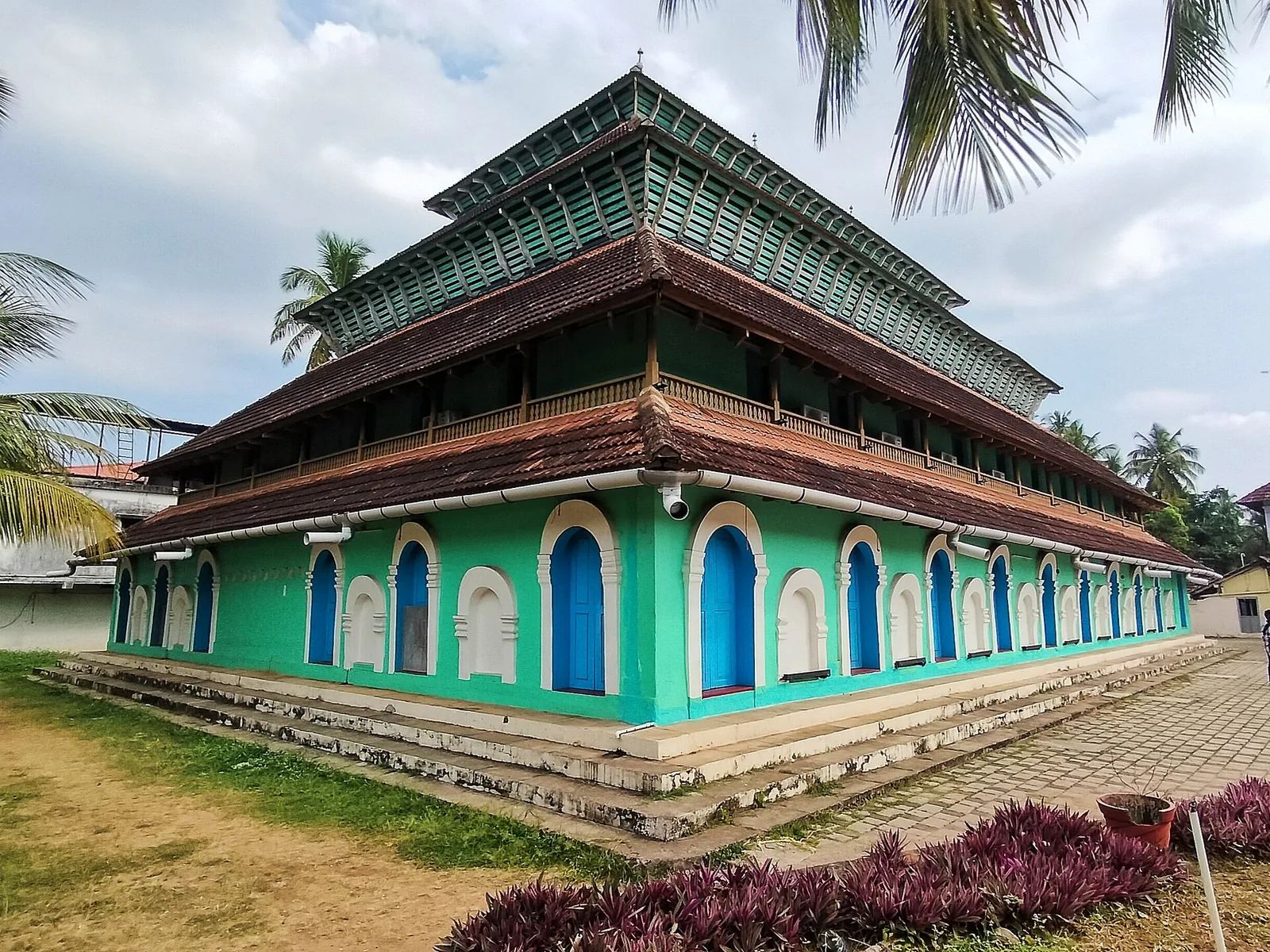
If you did not know what you were looking at, you could walk straight past the Mishkal Mosque and file it away as a temple, or as the ancestral mansion of some very rich and very old family. It has no dome. It has no minaret. There is no horseshoe arch over the entrance, no band of calligraphy, none of the visual shorthand that announces a mosque almost anywhere else in the world. What stands in the Kuttichira lanes of Kozhikode instead is a tall stack of tiled roofs resting on carved wooden posts — and it is one of the oldest and most significant mosques in India. Learning to read it is the whole pleasure of a visit to Mishkal Mosque.
What is missing, and why
The absent dome is not an oversight or a sign of poverty. The Malabar coast takes some of the heaviest monsoon rainfall in India, and the two features that define the classical mosque elsewhere — the masonry dome and the tall minaret — are answers to the problems of a dry climate. A dome sheds water slowly across a shallow curve, and every joint in it is the first thing a monsoon will find. A steeply pitched roof of clay tiles, thrown out far past the wall line on projecting rafters, sheds a downpour instantly and keeps the timber and laterite beneath it dry for centuries. Kerala’s builders had solved that problem long before Islam reached this shoreline. When Muslim merchants settled here and wanted somewhere to pray, they did not import a solution — they hired the people who already had one.
Twenty-four pillars and forty-seven doors
The figures usually quoted for the mosque are around twenty-four carved timber pillars, some forty-seven doors, and a prayer hall that holds roughly four hundred worshippers (these numbers are widely repeated rather than formally surveyed). What matters more than the count is what they are for. A hall of that size in the tropics has to breathe, and the building is designed almost entirely around moving air. Doors open on every side. Under each roof tier runs a band of louvred clerestory openings, the green-painted slats you can pick out from the lane, and these draw hot air up and out while the deep eaves keep both sun and rain off the walls. The mosque is cool inside on the worst afternoon of the year without a single mechanical thing helping it.
The carpenters who also built temples
Look up, if you are admitted, and the ceiling carries floral woodwork; the pillars are closely engraved; and among the carving there are, by most descriptions, animal figures. That last detail surprises people, because Islamic tradition generally avoids figurative representation, and here it sits in one of the oldest mosques in the country. The usual explanation is the simplest one. The craftsmen were local. The hereditary carpenter and carver communities of Malabar worked on temples, on the great tharavadu houses of landowning families, and on mosques, and they carried one trained vocabulary between all three. A merchant commissioning a building in fourteenth-century Calicut hired the finest woodworkers on the coast, and those woodworkers carved the way they had been taught to carve.
This is the real point about what gets called Kerala Islamic architecture. It is not an imported style that was later softened by local taste. It is local architecture, built by local hands, in local timber, put to a new use — the same roof, the same joinery, the same craft, turned to face Mecca. Very few places in the world let you see that happening as plainly as this one does.
Why a wooden building lasts six hundred years
There is an obvious objection to all this: timber rots, termites eat, and the monsoon is relentless. How is any of it still standing? The answer is that a timber building is repairable in a way a stone one is not. A beam that fails can be cut out and replaced without touching anything around it; a cracked tile is lifted off and a new one dropped in. Kerala’s wooden architecture survives precisely because it is maintained piece by piece, continuously, for as long as a community cares enough to keep doing it. Some of the wood you are looking at is very old and some of it is not old at all, and nobody can easily tell you which is which. The mosque is both a medieval building and a continuously renewed one, and those two facts are not in tension.
Reading the tiers from the lane
Before that, though, if you are admitted, give the interior a moment on its own terms. The two fixed pieces of furniture in any mosque are the mihrab, the niche in the wall indicating the direction of Mecca, and the mimbar, the stepped pulpit from which the Friday sermon is given. At Mishkal both are worked in timber rather than stone or plaster, and the mimbar in particular is the kind of object that a wealthy merchant congregation commissions once and then maintains for centuries. Look at the treads. Six hundred years of feet going up and coming down have taken the sharpness off the edges in a way no craftsman could imitate and no restoration should ever correct.
From the outside, count the roofs. There are four tiers today. Tradition holds that there were five before a Portuguese raiding party set the building alight in January 1510, and that the topmost storey never came back — the fuller account of that attack, and of the long gap before the mosque was rebuilt in 1578–79, is told on the place page. What it means for the thing in front of you is that the roofline is a sixteenth-century repair sitting on fourteenth-century foundations, and that the join between the two is somewhere in the timber above your head.
Visiting with the right manners
This is not a monument with a ticket counter. It is an active mosque where five daily prayers are called and answered, and it has been in continuous use for something close to seven centuries. Access is restricted around prayer times, and non-Muslim visitors and women may find that entry to the prayer areas is limited or not permitted at all — this varies, so ask rather than assume. Dress modestly with shoulders and knees covered, remove your footwear, keep your voice down, and always ask before photographing anyone or anything. Around the mosque, the Kuttichira quarter rewards a slow wander: the great rectangular tank beside it, the old tharavadu houses of the Mappila families, and other historic mosques a few minutes away. Plan the rest of the city from the Kozhikode hub.