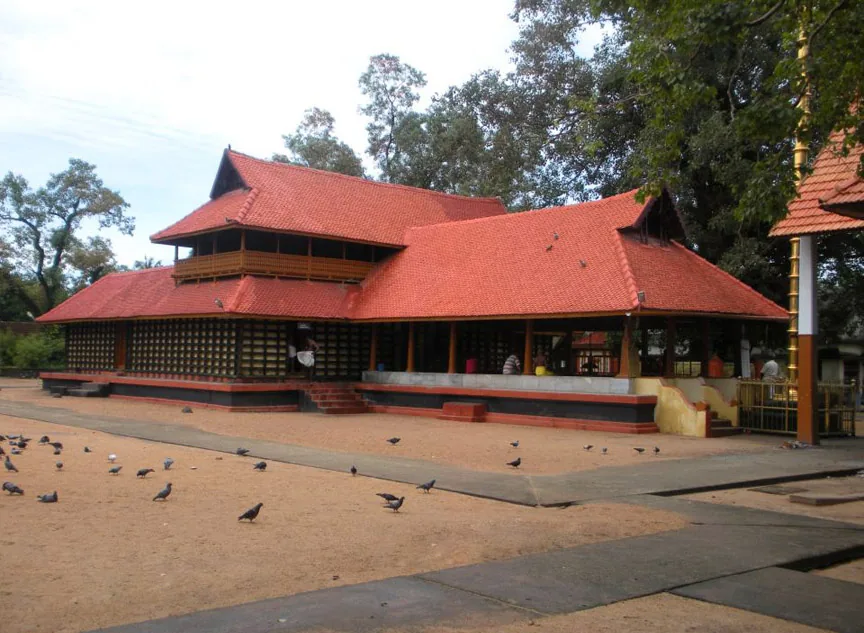
A Kerala temple can be renovated, re-roofed, re-endowed and re-administered without anything essential changing. The one thing that does not ordinarily change is the deity in the sreekovil. At Mullakkal, in the middle of Alappuzha town, it changed — not in some unrecoverable century, but within the memory of people still living, on a date that can be written down.
The goddess who holds a ladle
Until 1961 the image in this sanctum was Annapurneswari. She is not an obscure figure but she is a particular one, and her iconography tells you exactly what she is for: she holds a ladle in one hand and a pot in the other. She is the goddess who feeds. Anna is food. A shrine to Annapurneswari is a shrine to sustenance, to the household, to the certainty that there will be something in the pot — which in a coastal district of fishermen, coir workers and boatmen is not an abstract consolation.
That identity also does a piece of historical work, because it fits only one of the temple’s four origin legends. Three of them — the palm-leaf umbrella that would not lift from the jasmine bed, the exiled soldiers of Thekkumkur, the dining hall of Marthanda Varma — put the shrine’s beginnings somewhere in the deep past and say nothing about which goddess arrived. The fourth says that Namboodiri Brahmins fleeing south during the Mysorean campaigns carried an Annapurneswari idol with them and set it down in a jasmine garden. That legend dates the shrine to the 1780s or 1790s rather than to five centuries ago, and it is the only one that explains the goddess we can actually document. We are not asserting it is the true one. We are pointing out that it is the only one that has to account for anything.
A stranger, and some cracks
What happened in 1961 is recorded briefly and without embellishment. A stranger entered the sanctum and embraced the idol. Cracks were afterwards observed on it.
That is the whole of it. There is no name, no account of how he got in, no record of what became of him afterwards. The usual telling describes him as "a mentally troubled devotee" who embraced the statue "so fiercely that it was damaged beyond repair". None of that is in any source we can find. We had invented a state of mind for a man nobody named, and a degree of destruction nobody measured. It is a small fabrication and an easy one — the story feels incomplete without a motive, so a motive gets supplied — but a stranger in 1961 is not available to be diagnosed by us in 2026.
Damage read as instruction
The interesting decision is the priests’, and it is the part of this story worth sitting with. Cracks on a consecrated image could have been treated as desecration, as pollution, as something requiring expiation and repair. They were not. They were read as communication. The conclusion drawn was that the goddess was indicating that a new image should be made — that the damage was not something done to her but something said by her.
On 16 July 1962 a new idol was installed. Not another Annapurneswari, which is what you would expect if the object of the exercise were restoration: an idol of Rajarajeswari. And Rajarajeswari is a very different proposition. Where Annapurneswari is the sustainer with the ladle and the pot, Rajarajeswari is the sovereign — the empress, worshipped as ruler of rulers. Within thirteen months the theology at the centre of this temple moved from the domestic to the imperial.
⚠ One honest caveat about that date, because a precise date can carry more authority than it has earned. The 16 July 1962 figure comes from a single source — the standard encyclopedic account of the temple — and every travel listing that repeats it traces back there. We print it as recorded rather than as archivally verified. If you find a Devaswom record or a newspaper of the week, you will know more than we do.
What survived: a lentil
Here is the thing that makes this more than an anecdote about an idol. The characteristic offering at Mullakkal is a vada made with whole urad gram — not the split, skinned dal of the ordinary vada, but the whole bean. It is recorded as having originated with a family in the neighbourhood during the Annapurneswari period, and it is still offered in the evening today.
So the goddess who fed people was replaced by the goddess who rules, and the food stayed. Sixty-odd years after the image went, the offering that belonged to her is still made every evening — kept going not by a board or a trust or an endowment, but by a household and a recipe. It is the only unbroken physical continuity with the deity who stood in this sanctum before 1962, and it is a fried lentil cake. If you visit and want to touch the older layer of this temple, do not look for it in the architecture. Eat the vada.
What we still cannot tell you
Two things, and it is better to name them than to write around them. We do not know the man’s name, or anything about him. And we have never seen the sreekovil: the standard account describes it as open-roofed, Kerala Tourism does not mention it, and there is no photograph of it in any free archive — while the Malayalam account says only that it is small and low enough for the image to be seen clearly from outside. The two exterior photographs that exist show a conventionally tiled roof over the shrine block, which settles nothing, because a sreekovil sits inside the enclosure. Anyone who walks in can answer in a minute a question this page cannot answer at all.
Practical detail is on the Mullakkal place page, and the rest of the district is on the Alappuzha hub.
Frequently asked questions
Which goddess is worshipped at Mullakkal?
Locally, Mullakkal Bhagavathy — which is the safest answer, because published sources give three: Kerala Tourism says Durga, the standard encyclopedic account says Rajarajeswari, and at least one Alappuzha source says a form of Saraswati. The idol installed in 1962 is of Rajarajeswari. The idol before it was Annapurneswari.
Why was the idol at Mullakkal replaced?
In 1961 a stranger entered the sanctum and embraced the image, and cracks were afterwards observed on it. The priests interpreted the damage as the goddess instructing them to make a new image, and a new idol was installed on 16 July 1962. Nothing is recorded about the man, including his name.
What is the special offering at Mullakkal temple?
A vada made with whole urad gram, offered in the evening. It is recorded as having begun with a neighbourhood family during the period when the goddess here was Annapurneswari, which makes it the last unbroken link to the deity replaced in 1962.
Is the Mullakkal sanctum open to the sky?
A standard encyclopedic account describes an open-roofed sreekovil, but Kerala Tourism does not mention it and available exterior photographs show a conventionally tiled roof over the larger shrine block. Treat the detail as a reported architectural feature and ask at the temple.