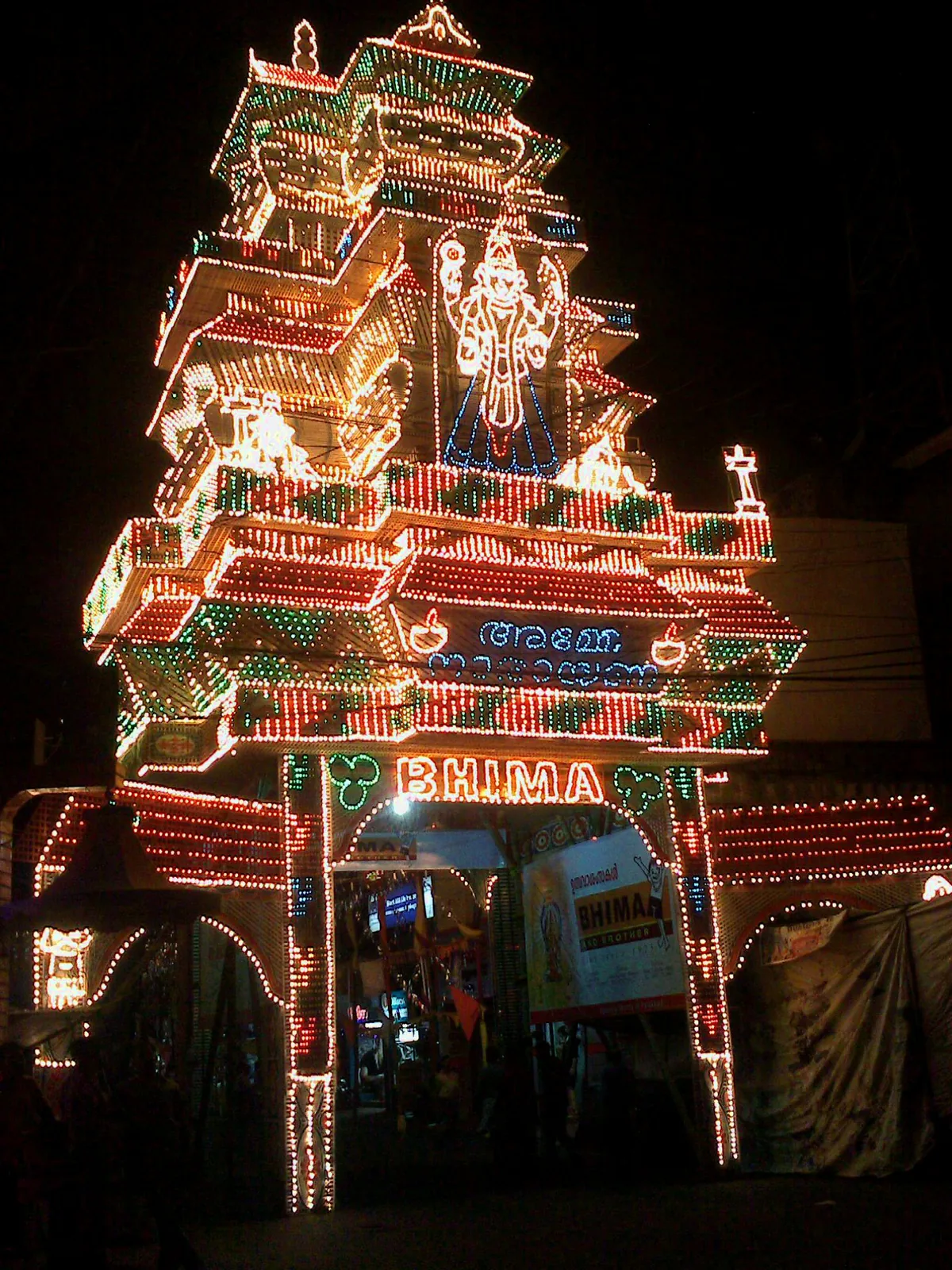
Most Kerala temple festivals happen on temple ground. The elephants line up in the anakkottil, the crowd fills the courtyard, the fireworks go up over the compound wall. The Mullakkal Chirappu does some of that. But the eleven days it is actually famous for happen somewhere else: on a public road lined with cloth shops and jewellers, under arches of light several storeys high that are dismantled again when it is over.
Forty-one days, or eleven, and both are right
You will see the Chirappu described as a 41-day festival and as an 11-day one, usually as though somebody has made a mistake. Nobody has. The festival period runs 41 days, opening on the first of Vrischikam around the middle of November and closing on the eleventh of Dhanu. The final 11 of those days are the Chirappu proper — the arches, the caparisoned elephants, the fireworks. The last two are its peak, with nine elephants in procession, and the closing feast is reckoned to serve something in the order of three to four thousand people.
Two footnotes that the Malayalam sources carry and the English ones generally do not. The Chirappu is shared with the Kidangamparambu Sree Bhuvaneswari temple — two temples, one festival. And the temple’s own kodiyettu utsavam is a separate observance entirely, held at Navaratri, with the flag raised the day after the Kanni new moon and the arattu on Vijayadasami. The thing the town calls the festival and the thing the temple calls its festival are not the same event.
What is actually built
For the eleven days, Mullakkal road is roofed. Tiered coloured bunting is strung across its whole length, in bands — purple over pink over orange over green — with fluorescent tubes hanging down between them, so that the street becomes a lit tunnel with toy stalls and balloon sellers underneath it. Across the road at intervals stand the gopurams: temporary arch-towers of framework and tens of thousands of small lamps, the tallest of them several storeys, tapering through five or six diminishing tiers to a finial, and flanked by illuminated cut-out figures of deities standing at head height on either side of the roadway.
They are not static objects. Two photographs taken seventeen seconds apart on the evening of 22 December 2025 show the same arch — same structure, same flanking figures, same lettering — once in green and blue, once in magenta and pink. The whole tower cycles through its programme over the heads of the crowd. The craft has changed too, and the photographic record catches it: the 2012 arch in the picture at the top of this article is built from individual filament bulbs, warm and slightly irregular, while the 2025 towers are dense, saturated and pixel-sharp. Thirteen years apart, the same idea in a different technology.
The name on the arch
Now the detail that explains the whole thing. The arches are sponsored, and the sponsor’s name is spelt out across them in lights. The recurring name is BHIMA, the jeweller. It is there on the 2012 arch. It is there on three separate arches in December 2025. And in one of the 2025 photographs the firm’s own shopfront sign is visible along the same street, a few doors from the arch that carries its name in lights.
It would be easy to read that as commerce intruding on devotion. It is more accurate, and more interesting, to say that in Alappuzha they were never separate. This is a town that exists because Raja Kesavadas built it as a port in the later eighteenth century; Mullakkal road grew as one of its principal bazaars; the temple stands in the middle of it; and the year’s great religious festival and the year’s great trading occasion are one event, paid for by the shops on the street and held over their heads. The merchants are not sponsoring somebody else’s festival. It is theirs.
What is distinctive, and what is not
It is worth being careful here, because the temptation is to call the Chirappu unique and it is not. Long, multi-week Bhagavathy festivals with street illumination, elephant processions and enormous crowds are the Kerala norm rather than the exception. Chettikulangara’s Kumbha Bharani is in this same district. Thrissur Pooram, Attukal Pongala and the Kodungallur Bharani are all larger or older or both. Anyone telling you this is the only festival of its kind is selling something.
What is genuinely distinctive is narrower and better: the 41-day span with an 11-day core nested inside it, and the location. The Chirappu’s physical centre of gravity is not a temple ground. It is a shopping street, and the festival is built over the traffic.
The day run by women
One observance deserves its own mention, and it is recorded in the Malayalam account rather than the English ones. The first Sunday of December is the women’s chirappu: a day on which every function of the festival is conducted by women, and thousands of lamps are lit in the evening. Other days of the eleven are led by named individuals and institutions of the town, which is another way of saying that the festival is distributed across the community rather than run from the temple office.
⚠ One thing we could not resolve, and would rather flag than paper over. Two free photographs labelled as Chirappu carry camera datestamps in mid-February — 17 February 2012 and 15 February 2020 — which is well outside the Vrischikam-to-Dhanu window that closes in late December. Mullakkal also observes Thaipooya Kavadi, which falls on the Pooyam asterism in Makaram, mid-January to mid-February, and a kavadi procession of around fifteen kavadis is recorded here. The likeliest explanation is that the street is lit for more than one festival and that photographers label all of it "chirappu". We have not asserted that, and we have dated the 2012 photograph above rather than claiming which festival it belongs to. ⚠ And do not believe the widely repeated line that Thaipooya Kavadi at Mullakkal is a 41-day November–December festival: that is a straight conflation with the Chirappu.
Timings, access and the rest are on the Mullakkal place page; the wider district is on the Alappuzha hub.
Frequently asked questions
How long is the Mullakkal Chirappu?
Both numbers you will see are correct. The festival period runs 41 days, from the first of Vrischikam in mid-November to the eleventh of Dhanu; the last 11 days are the Chirappu proper, with the arches, elephants and fireworks; and the final two days are the peak, with nine elephants in procession and a closing feast for roughly three to four thousand people.
What are the illuminated arches at Mullakkal?
Temporary gopuram towers built across the public road — framework hung with tens of thousands of small lamps, several storeys tall, tapering through five or six tiers to a finial and flanked by illuminated cut-out deity figures. They cycle through colours: two photographs taken seventeen seconds apart in 2025 show the same arch green and then magenta. They are erected for the festival and dismantled afterwards.
Who pays for the Chirappu arches?
Commercial houses on the street, with their names spelt across the arches in lights. The recurring sponsor in the photographic record is the jeweller BHIMA, whose name appears on an arch in 2012 and on three separate arches in 2025 — and whose own shopfront is visible a few doors away in one of those 2025 frames.
Is there a day of the festival run by women?
Yes. The first Sunday of December is the women’s chirappu, when every function of the festival is conducted by women and thousands of lamps are lit in the evening.