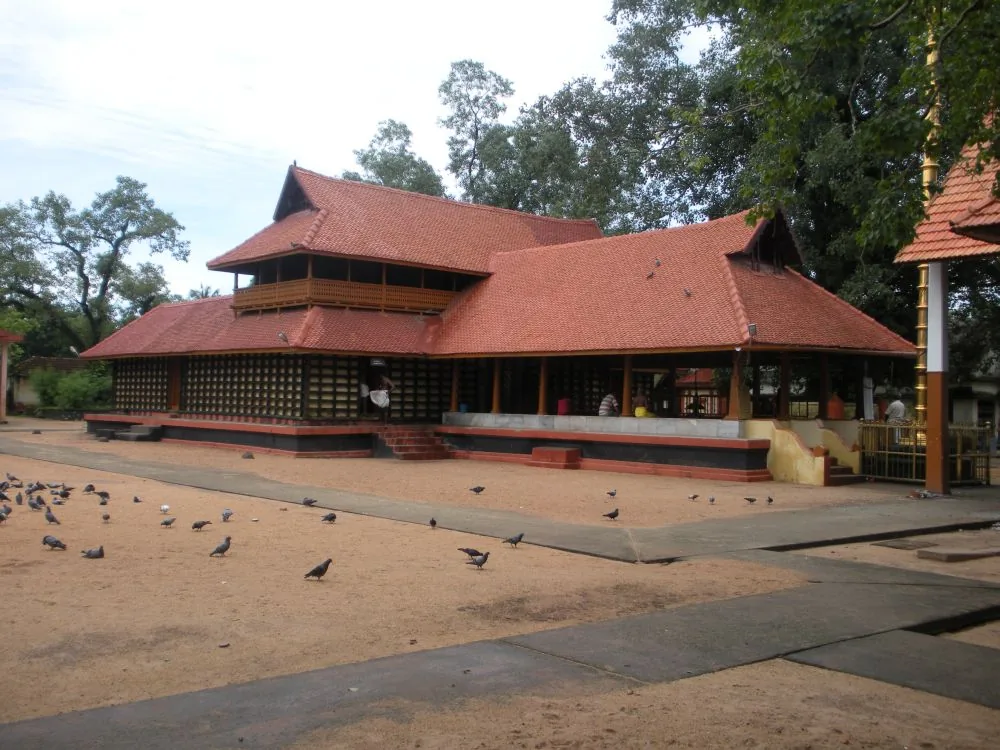
In the middle of Alappuzha’s busiest shopping street — a place of cloth shops and gold shops and hurrying crowds — is a pool of calm behind a temple wall: Mullakkal Rajarajeswari Temple. Its very name comes from flowers, and its founding legend from a goddess who, having travelled all this way, simply refused to go any further.
The temple named for jasmine
Mullakkal takes its name from the jasmine — mulla in Malayalam, mullai in Tamil — that once grew thick across this ground. The temple is traditionally reckoned at around five hundred years old — a figure every source prints and none supports with an inscription or a dated record — and it is said to have been built in the middle of a jasmine garden, so that the flower still scents its story. In a district famous for water — the backwaters, the boat races, the long lagoons — this is a shrine that belongs, instead, to a garden.
The umbrella that would not move
The best-loved legend explains how the goddess came to stay. King Devanarayana of Chembakassery, it is told, visited the great Bhagavathy temple at Kodungallur and longed to bring the goddess back to his own kingdom. That night she appeared to him in a dream and promised she would indeed come with him. On the journey home, reaching Alappuzha, the king stopped to rest in a jasmine garden and set his umbrella down on the ground. When he rose to leave, he found he could not lift it — it would not budge. He understood at once: the goddess wished to remain here, in the jasmine, and would go no further. And so he built her temple on that very spot.
The goddess who was remade
The presiding deity is worshipped here as Rajarajeswari, the sovereign form of the goddess — though published sources also give Durga and even Saraswati, and the name the town itself uses is simply Mullakkal Bhagavathy. The idol has its own history, and it is recent enough to date. Until 1961 the shrine held an image of Annapurneshwari, the goddess of plenty, holding a ladle in one hand and a pot in the other. In that year a stranger entered the sanctum and embraced the idol, and cracks were afterwards observed on it. The priests read the damage not as sacrilege but as instruction — the goddess, they concluded, was asking for a new image — and on 16 July 1962 an idol of Rajarajeswari was installed, and it is she who has stood in the sanctum ever since.
⚠ A correction this article carried until August 2026, and it matters. We described the man as "a mentally troubled devotee" who embraced the statue "so fiercely that it was damaged beyond repair". No source we can find says any of that. The accounts say a stranger embraced the idol and that cracks were then observed — nothing about his state of mind, and nothing about the scale of the damage. We had supplied a motive for an unnamed man and a diagnosis he was never given. The date is recorded; the man is not. We have left him as the sources leave him.
Forty-one days of Chirappu
The temple’s great festival is the Mullakkal Chirappu, and it is long: the celebrations open early in the month of Vrischikam, around the middle of November, and run for forty-one days into Dhanu (December–January), with the final eleven days — the Chirappu proper — the grandest of all. Thousands throng the market-street temple for parades led by caparisoned elephants, drums and lamplight, and the ordinary bustle of Alappuzha’s shopping district gives way, night after night, to devotion.
Visiting Mullakkal
The temple sits right on Mullackal Road in the centre of Alappuzha town, impossible to miss and easy to fold into a day of backwaters and beach. Come during the long Chirappu festival for the full spectacle, or any day to step from the market noise into the goddess’s calm. Details are on the Mullakkal place page; more of the district is on the Alappuzha hub.
Frequently asked questions
Why is it called Mullakkal temple?
The name comes from mulla, the Malayalam word for jasmine. The temple is said to have been built in a jasmine garden that once covered the ground, and the flower is central to its founding legend.
What is the legend of Mullakkal temple?
Legend holds that King Devanarayana of Chembakassery brought the goddess from the Kodungallur Bhagavathy temple; resting in a jasmine garden at Alappuzha, he set down his umbrella and later found he could not lift it — a sign that the goddess wished to remain there, so he built her temple on the spot.
When is the Mullakkal Chirappu festival?
The festival runs for forty-one days from around mid-November (early Vrischikam) into December–January (Dhanu), with the final eleven days — the Chirappu — being the grandest, marked by processions of caparisoned elephants.