We would rather open this bluntly than bury it. Do not swim at Munambam beach. It is not a swimming beach, it looks exactly like one, and the gap between those two facts is the most dangerous thing on the Vypin coast.
Why it looks safe
A swimmer reads water using a short list of cues: is there surf, is it shallow, is anyone in it, is it noisy. At Munambam all four cues give a reassuring answer. The water is often glassy. There is frequently no breaking wave at all. The edge shelves gently. There are boats crossing it constantly and children playing at the margin. Compared with the open Arabian Sea rolling into Cherai a few kilometres south, it looks like a lake.
It is not a lake. It is an azhimukham — a river mouth — and river mouths do not obey beach rules.
What is actually under it
Three forces meet in the same narrow gap here. The Periyar, the longest river in Kerala, is discharging seaward. The tide is running in or out across a shallow sandbar. And the ocean swell is arriving from the west. Where those interact you get fast, directional water — much of it moving offshore — that is strongest in the channel and can change hour by hour with the tide.
Crucially, that current does not generate surf. Deep, smooth, fast water looks calmer than shallow choppy water, not more dangerous. A swimmer who wades out to waist depth in a place with no waves can be in a seaward flow they cannot swim against, without ever having seen a warning sign in the water itself. Add a working harbour channel with trawler traffic and breakwater rock, and the margin for error is gone.
- No swimming. Not at the edge, not "just to cool off", not at low tide.
- Watch where the local boats go and do not go. They are reading the bar.
- Keep well back from the breakwater rocks, especially when wet.
- Children within arm’s reach at all times, including on the sand.
- If you want to swim on this coast, go to Cherai — gently shelving, soft surf, and genuinely a bathing beach.
The old instinct was right
Kerala’s coastal folklore has always treated river mouths as liminal and unlucky places — ground where crossings are timed carefully and offerings are made. It is easy to file that as superstition. It is better understood the other way round: it is accumulated practical knowledge about genuinely lethal water, preserved in the only form that survives generations of people who do not write things down.
The fishermen working this bar have inherited the useful half of it. They know which parts of the water to avoid and at what state of tide, and they will tell you if you ask. That local knowledge is not available to someone who arrives at two in the afternoon with a towel.
What Munambam is actually good for
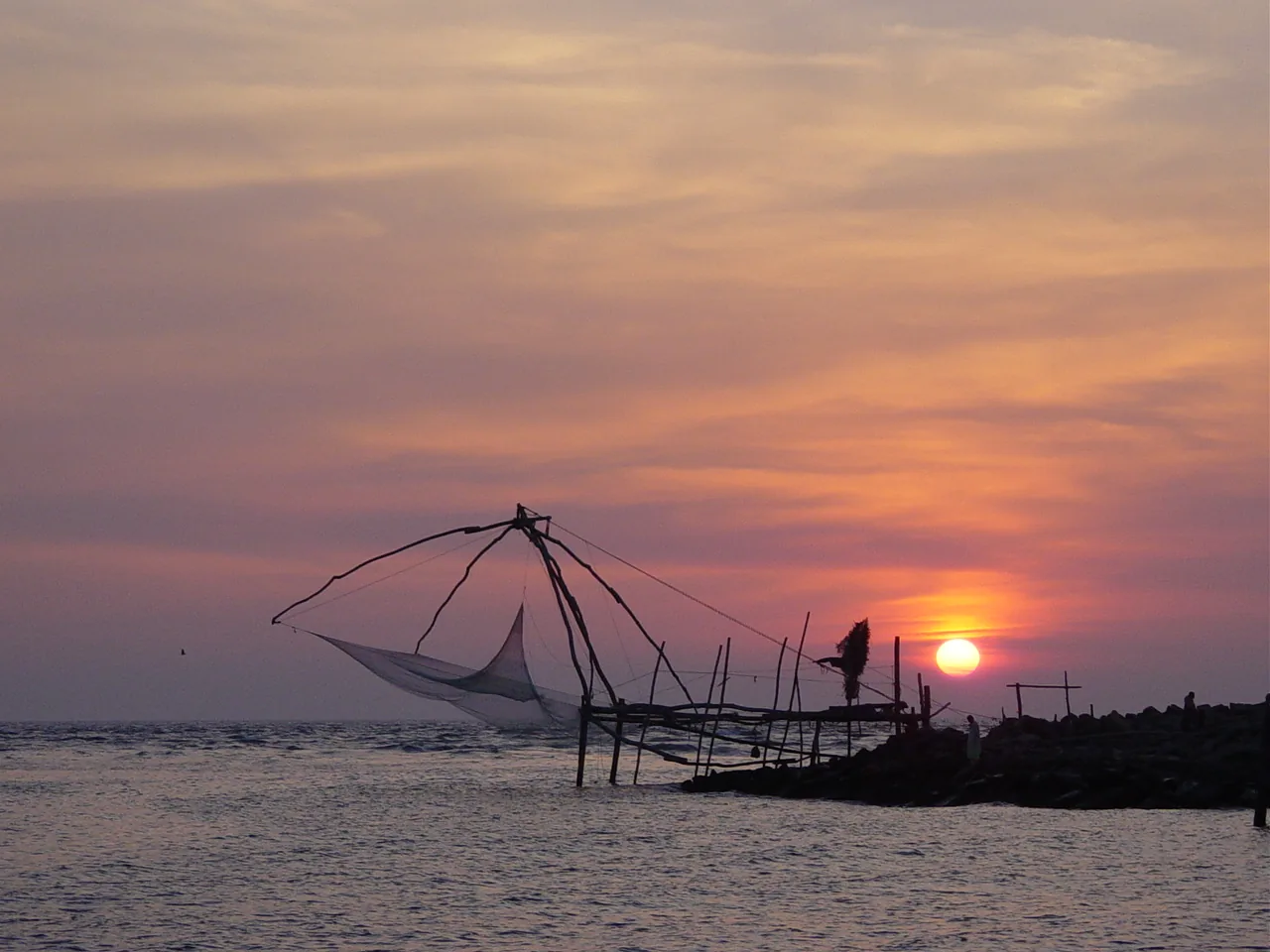
Everything except swimming, and it is genuinely worth the trip. This is a working estuary: trawlers crossing the bar, cantilevered Chinese nets dipping on the river side, kites in the air — kite-flying is a real local pastime here rather than a tourist offering — and, where fresh water meets salt, a concentration of gulls, terns and waders that makes the last hour of light very good for birds.
That light is the other reason to come. Sunset over the river mouth, with silhouetted nets and returning boats in the foreground, is the best evening on northern Vypin. Walk it, photograph it, eat afterwards at Cherai, and keep your feet dry.
Frequently asked questions
Can you swim at Munambam beach?
No. It is a river mouth beside a working harbour channel, with strong, shifting, largely offshore currents where the Periyar meets the sea. The water frequently looks calm because deep fast water does not break into surf — which is precisely what makes it dangerous. Cherai Beach, a short drive south, is the swimming beach on this coast.
Why is a river mouth more dangerous than open sea?
Because three forces meet in one narrow gap: the river discharging seaward, the tide crossing a shallow bar, and the ocean swell. The resulting current is fast and often directed offshore, and it produces no breaking waves — so every visual cue a swimmer uses to judge risk gives a falsely reassuring answer.
Is Munambam a real beach?
It is an estuary shore rather than a leisure beach. There are no shacks, deckchairs or lifeguards; there is a fishing harbour, breakwaters, boat traffic and a wide brown river mouth. It is atmospheric and well worth visiting, but not on the terms most people mean by "beach".
What is the best time of day at Munambam beach?
The last hour before sunset. The light over the river mouth is excellent, the boats are coming in, the Chinese nets are silhouetted and the birdlife around the estuary is at its most active. Early morning is the other good window, and pairs well with the harbour auction next door.
Are there really dolphins or birds at Munambam?
Birds, reliably — where fresh and salt water mix, fish gather, and so do gulls, terns and waders, especially in the cooler months. Dolphins are associated more with Cherai than with the river mouth here, and should be treated as luck rather than an itinerary item anywhere on this coast.
How does Munambam compare with Cherai Beach?
They are ten minutes apart and completely different. Cherai is a long, gently shelving golden beach where you can actually swim, with shacks and food. Munambam is a working river mouth with a fishing fleet, no swimming and a much stronger sense of place. Do both, in that order, ending at Munambam for the sunset.