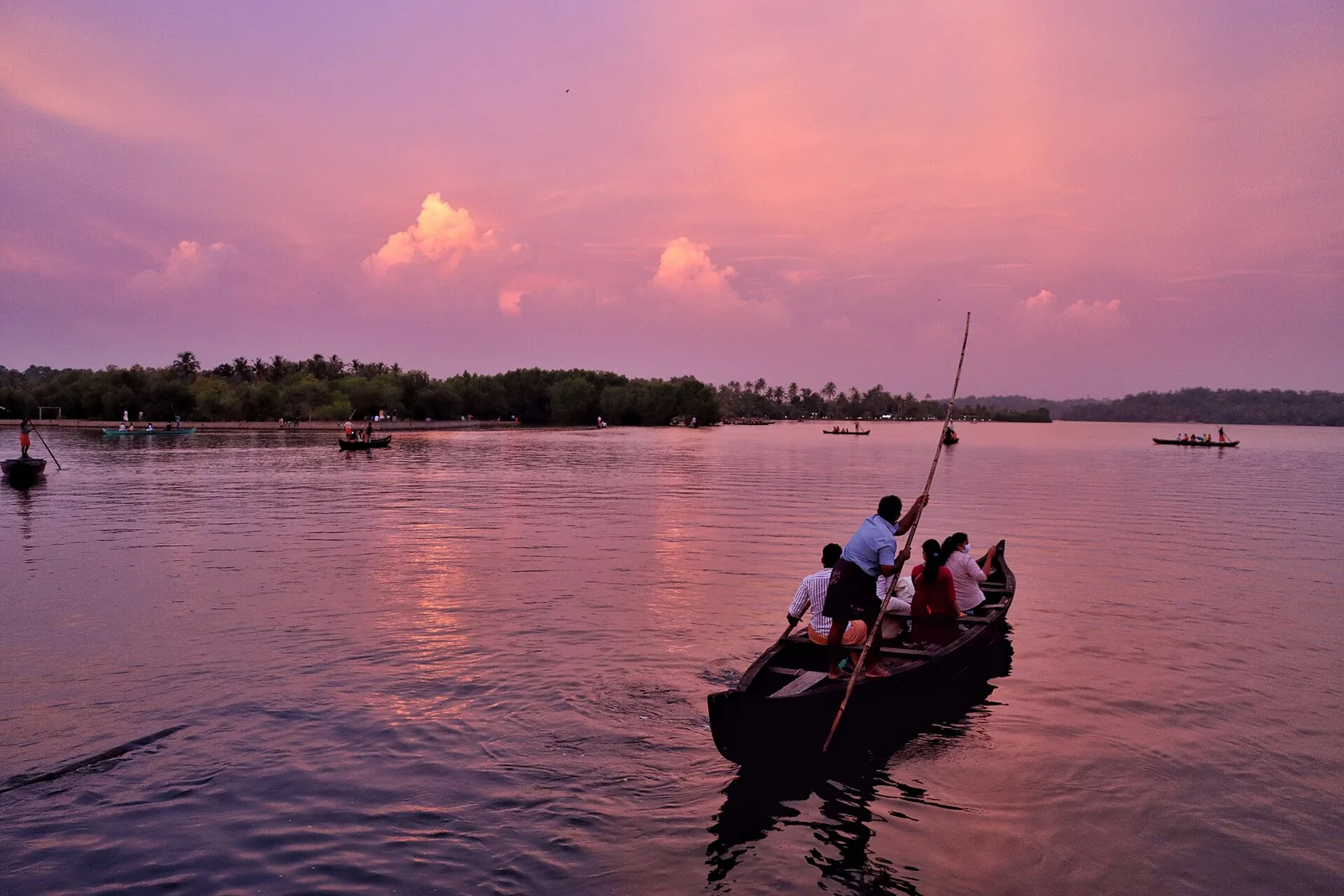
There is a version of the canoe trip on the canals in which the boatman is a picturesque survival, poling you past a way of life that has always been here.
The truer version is that his job is about as old as this century, and that it exists because the previous economy of this island collapsed.
What the island used to do
It grew rice. The Grama Panchayat’s own annual report gives the numbers, and they are among the bleakest in Kerala: 227 acres of paddy in 1950, 8 acres by 1995, under 2 acres by 2018. The 2023 NCESS study adds the finish — recent satellite images show that no paddy cultivation exists now.
The named tracts are recorded, which somehow makes it worse: Kaniyampalli Vayal, Manakkadavu Vayal, Panampu Vayal, Pattamthuruth Vayal. Vayal means paddy field. The names survive the fields.
Farmers moved to coconut, and the coconut is failing too — salt in the soil across Pattamthuruth and Peringalam has left barren stumps where the palms were. Both of the island’s agricultures have now gone the same way, one after the other, for the same reason.
What it does now
The study states it without ornament: local people are now more dependent on coconut cultivation and tourism for their livelihoods.
And RoundGlass Sustain’s reporting from the island puts a figure on the second half of that — over 90% of the island’s inhabitants now depend directly or indirectly on tourism. Not a supplement. The economy.
Sujilal, a boatman who has steered tourist boats here for eighteen years, remembers the start of it. When he began there were very few tourists, mostly foreigners taking a detour from Varkala or Alappuzha. The surge came after 2022.
Not a co-operative
A word about how this is often described, because we have described it loosely ourselves. Munroe Island is regularly presented as a community-owned tourism scheme, which suggests a co-operative, a register, a governing body.
There is no such body that we can find. What there is is DTPC Kollam, which operates boating directly and takes bookings on +91 474 2745625 and +91 474 2750170, and alongside it hundreds of individual island households that own tourist boats. Nobody organised this. It is a village that went into the boat business one family at a time, because the rice went.
That is a better story than a co-operative, and it has a practical consequence: there is no operator scale here and no central booking. Which boat you get and what you pay depends on which household you reach.
What it costs, and the shape of the pricing
The pricing tells you the structure. Private and homestay boats are sold per boat, not per head — around ₹1,000 for a three-hour canoe seating up to six when we checked in August 2026, ₹1,500 with resort access and a bit of pedal-boating and fishing thrown in, ₹2,500 with food. A covered roof boat for up to twelve ran ₹2,500 for two hours, or ₹3,500 with food.
Two things fall out of that. In a full boat the canoe works out at roughly ₹167 to ₹330 a head, which is very little. And the covered motorised boat — the comfortable one, the one with the shade and the seats — costs more than the canoe while showing you less, because it cannot enter the channels. The cheap option is the good one, which is not the usual arrangement.
DTPC’s own rates run on a different structure, reported at about ₹400 per person for a kayak or canoe and ₹600 for a country boat over roughly two hours and ten kilometres. Rates are set locally and move; confirm before you go rather than after.
Farming the flood
One detail deserves to end this, because it is the only genuinely hopeful engineering on the island and almost nobody reports it.
The same study notes, in a single line: some paddy fields are converted into filtration ponds to take the benefit of frequent tidal flooding.
Filtration ponds are shallow brackish enclosures used for prawn and fish. The flooding that destroyed the rice is the input. Having lost an argument with the water twice — once over paddy, once over coconut — some households have stopped arguing and started using it.
That is the same instinct as the boats. When you cannot keep the water out, you go into business with it.
Frequently asked questions
How much of the island depends on tourism?
Over 90% of residents, directly or indirectly, according to reporting from the island by RoundGlass Sustain. The 2023 NCESS study says residents now depend mainly on coconut cultivation and tourism.
What happened to farming here?
Paddy fell from 227 acres in 1950 to 8 acres in 1995 to under 2 acres by 2018, per the Grama Panchayat’s annual report, and recent satellite images show none at all. Named tracts including Kaniyampalli Vayal and Pattamthuruth Vayal are gone. Coconut, which farmers switched to, is now failing on salt.
Is the boat business a community co-operative?
No co-operative or register that we can find. DTPC Kollam operates boats, and hundreds of individual households own their own. It is a village that went into the boat business family by family, which is why there is no central booking and prices vary by whom you reach.
What should a canoe trip cost?
Private boats are priced per boat: about ₹1,000 for three hours for up to six people as observed in August 2026, more with food or resort access; a covered roof boat for up to twelve ran ₹2,500–₹3,500. DTPC is reported at about ₹400 per person by kayak or canoe and ₹600 by country boat. The canoe is both cheaper and better, since the covered boat cannot enter the channels.
What are filtration ponds?
Shallow brackish enclosures for prawn and fish. Some former paddy fields have been converted into them deliberately, to take the benefit of the frequent tidal flooding — turning the water that ended the rice crop into the input for a different one.