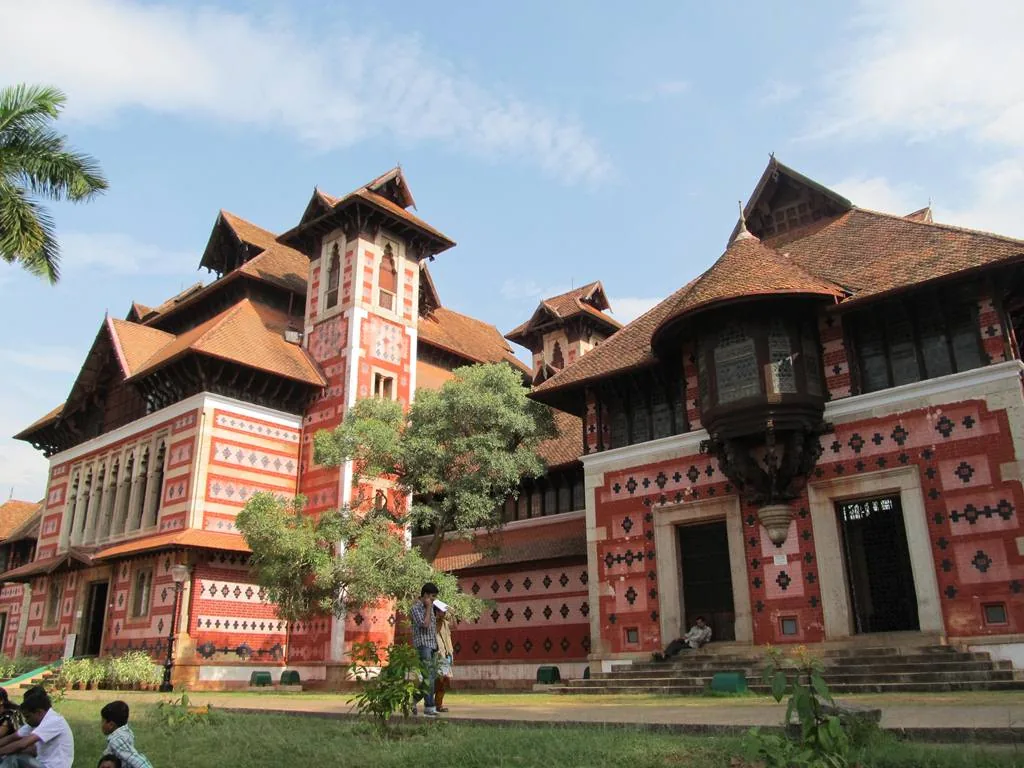
The Napier Museum is the building everyone photographs, but it is one item in a walled parkland on the city’s northern high ground that also holds a zoo, an art gallery, gardens, an old bandstand and a good deal of shade. Treating the complex as a single destination rather than treating the museum as the destination is the difference between a thirty-minute stop and a genuinely good afternoon.
The museum was not first
It is natural to assume the grounds were laid out around Chisholm’s masterpiece. They were not. The Thiruvananthapuram Zoo is one of the oldest in India and is older than the museum building beside it, so what happened was the reverse: a very grand new museum was inserted into an institutional landscape that already existed. That reframes the whole site. This is not a single conception but a Victorian public-culture campus that accumulated across decades — museum, menagerie, gallery, gardens — in a princely state that was unusually invested in that kind of civic display.
The Sree Chitra Art Gallery
A short walk from the museum, and the reason to allow a full afternoon. The Sree Chitra holds a significant group of Raja Ravi Varma canvases — the Travancore prince-painter whose oil paintings of gods and heroines shaped how a great many Indians still picture them — alongside work by the Russian painter Nicholas Roerich and his son Svetoslav, and miniatures from the Tanjore, Mughal, Rajput and Bengal schools, with further material from Japan, China, Bali and Tibet. In one moderate-sized gallery you can trace Indian painting from courtly miniature to Ravi Varma’s confident realism, which is a rare thing to be able to do in a single room.
The zoo
Sharing the same historic grounds and worth knowing about in advance: it is old, it is large, and it takes real time — an hour and a half at minimum if you intend to see it rather than pass through. Whether you include it depends on the group and on how you feel about zoos generally; what is worth saying is that it is not a small add-on to the museum visit and should not be planned as one. Families frequently come for the zoo and treat the museum as the add-on, which is a perfectly reasonable inversion.
The grounds themselves
The gardens are the part locals actually use. Manicured lawns, flowering trees, shaded benches, families, students, couples, photographers. There is an old bandstand where military bands once played to the strollers of colonial Trivandrum, and somewhere in the greenery grows what is claimed to be one of the oldest rubber trees in Kerala, said to have been raised from a sapling brought over from Ceylon in the 1870s. That is a good story and entirely plausible for the period; it is also not something we have been able to verify, so treat it as the grounds’ own tradition rather than as a documented fact.
Making a plan of it
A workable afternoon: museum for an hour, Sree Chitra for forty-five minutes, then the gardens at golden hour, when the low sun sets the polychrome banding glowing and the minarets throw long shadows across the lawns. Add the zoo at the start if it is on your list and you have the time. Check current opening days before going — museums here have a weekly closing day and the components of the complex do not always keep identical hours, so confirm rather than assume. Timings and access are on the Napier Museum page, and the building itself is covered in The Building That Breathes.
Frequently asked questions
What else is in the museum complex?
The Thiruvananthapuram Zoo, one of the oldest in India; the Sree Chitra Art Gallery; extensive gardens with an old bandstand; and a rubber tree said to be among the oldest in Kerala. The whole is a walled parkland on the city’s northern high ground.
Which is older, the museum or the zoo?
The zoo. It predates the museum building, so the grounds were not laid out around Chisholm’s design — the museum was inserted into an institutional landscape that already existed.
What is in the Sree Chitra Art Gallery?
Raja Ravi Varma canvases, work by Nicholas and Svetoslav Roerich, and miniatures from the Tanjore, Mughal, Rajput and Bengal schools, plus material from Japan, China, Bali and Tibet. Allow about forty-five minutes.
How long does the whole complex take?
About an hour for the museum, forty-five minutes for the Sree Chitra, and at least an hour and a half more if you are doing the zoo properly. Check current opening days first, as the components do not always keep identical hours.