This is the single most useful thing on this page, so it goes first. The Neyyar treks and the Agasthyakoodam trek are not the same thing, are not booked the same way, and do not run in the same season.
People arrive at the Neyyar sanctuary office having read about “trekking at Neyyar”, expecting to be pointed up the mountain, and are turned away. It is an avoidable wasted day.
What the Neyyar walks are
Forest Department eco-tourism programmes, arranged at the sanctuary office at the dam, running from half-day walks in the lower forest to longer routes towards the Agasthyamala foothills. The department’s own named programmes here include walks to Kombaikani and to Meenmutty falls.
You go with a departmental guide, you go early, and which route is available depends on season, weather and current forest conditions rather than on what you would like. That last point is worth taking literally: ask what is open before you fix the date, not after.
What the Agasthyakoodam trek is
A different proposition entirely. Agasthyakoodam is a 1,868-metre summit at the far end of the protected landscape, and climbing it is a multi-day, permit-only expedition that runs only in a notified season, with its own Forest Department permission process and a limited number of places.
It cannot be added on to a day at the dam. The permits go long before the season, and the starting point is not the Neyyar dam office. If Agasthyakoodam is what you want, that is a trip you plan months out.
Why the confusion is so persistent
Because the geography genuinely connects them. Neyyar Wildlife Sanctuary runs from around 100 metres at the reservoir up to the summit of Agasthyakoodam at its far end — the mountain really is inside the same protected block, and the sanctuary’s altitudinal range really does extend to the top.
So “Neyyar sanctuary includes Agasthyakoodam” is a true sentence, and it does not follow that a walk at Neyyar is a walk up Agasthyakoodam any more than owning a road means you may drive on all of it. Access is managed separately because the summit approach is a different order of ecological sensitivity and of physical difficulty.
What you get on the Neyyar walk instead
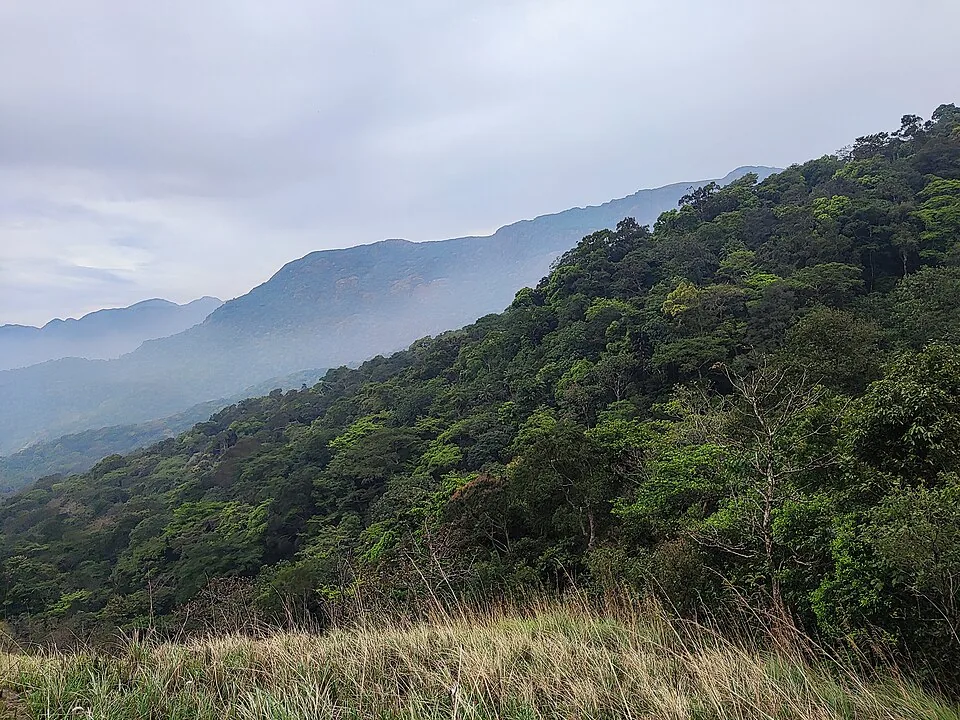
A genuine habitat gradient inside a single morning. The lower slopes are moist deciduous and open up in the dry season; higher, the canopy closes into semi-evergreen and then evergreen, with buttressed trunks, tree ferns, dense understorey and a permanent green half-light.
Malabar giant squirrel and Nilgiri langur are the realistic sightings, hornbills more often heard than seen. Elephant, gaur, sambar and sloth bear all use this ground, and elephant sign on the trails is common — which is exactly why a guide walks with you and why the guide’s instructions are not up for discussion.
And it is quiet within ten minutes. The dam end of Neyyar is busy: an hour from a city of a million people, with a boat jetty, a crocodile centre and a yoga ashram at the gate. All of that noise stops once you are in the trees.
Frequently asked questions
Can I climb Agasthyakoodam from Neyyar dam?
No. The Agasthyakoodam trek is a separate permit-only expedition that runs in a notified season with its own Forest Department permission process and a limited number of places, and it does not start at the Neyyar dam office. It cannot be added on to a day at the dam.
What treks actually run at Neyyar?
Forest Department eco-tourism walks arranged at the sanctuary office, from half-day routes in the lower forest to longer walks towards the Agasthyamala foothills. Named programmes include Kombaikani and Meenmutty falls. Which are running depends on season, weather and the rules in force.
Is Agasthyakoodam inside Neyyar sanctuary?
Yes — the sanctuary runs from about 100 m at the reservoir to the 1,868 m summit at its far end. But access to the summit is managed separately from the day walks, because the approach is a different order of both ecological sensitivity and difficulty.
When should I do a Neyyar walk?
The dry season, roughly November to March. Trails are wet and often closed in the monsoon, and leeches run hard from June to November — carry salt. Start early: check-post timings want you out well before dusk.
Do I need a guide?
Yes, and it is not a formality. This is unfenced elephant country with gaur, sambar and sloth bear using the same trails, and a Forest Department guide accompanies every walk. Follow the instructions given.
Is there phone coverage?
No, not once you are off the dam road. Plan on being uncontactable for the duration of the walk.