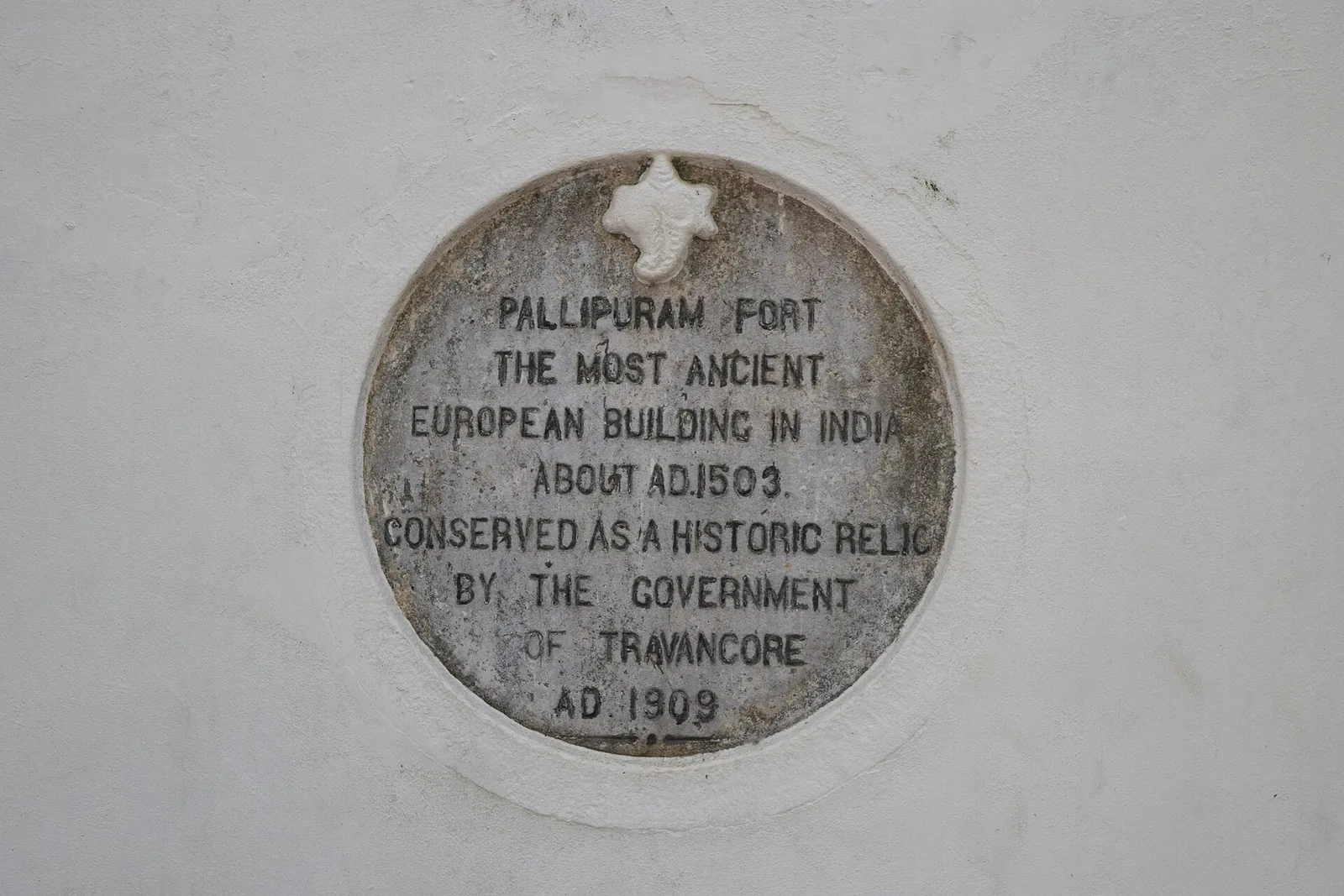
Set into the whitewashed wall of Pallipuram Fort is a round marble tablet. It reads:
That tablet is where the number comes from. Every signboard, every tour brochure and every article — including ours — carries 1503 for this building, and the anchor for it is a plaque a princely government set into a wall in 1909.
Read the third line again. It says about.
Whoever cut that tablet was being careful
That single word is the most honest thing written anywhere on this site, and it is the one part of the inscription nobody quotes. The Travancore government of 1909 was prepared to claim the superlative — the most ancient European building in India — and was not prepared to claim the year. It hedged, on marble, permanently.
A century of copying stripped the hedge out. What went into print afterwards was 1503, flat, with no qualifier, because a round number reproduces better than an approximate one.
What the sources actually say
Gaspar Correa, the Portuguese chronicler and the earliest writer we have on this building, dates it to 1507. He is not a distant commentator; he is the primary account.
And the Kerala Department of Archaeology — the body that has legally protected the monument since 1964, and whose staff maintain it — also gives 1507 in its own description of the site. So the two authorities with the strongest claim to know, the earliest chronicler and the present custodian, agree with each other and disagree with the plaque.
The modern popular account has the fort begun as a timber work on 27 September 1503 and rebuilt in stone by about 1505, which would reconcile things neatly if anybody could show where the precise September date came from. Nobody does. And the church immediately south carries exactly the same four-year split — founded 1503 by some accounts and 1507 by others, with the parish itself celebrating its five-hundredth anniversary in 2007. Two independent buildings, one unresolved argument.
Correa also got the shape wrong
It is worth knowing how thin the documentary base is here. Correa describes an octagonal tower. The fort is hexagonal — six faces, countable from the road in ten seconds, and the Kerala Department of Archaeology notes the discrepancy explicitly.
The earliest surviving description of what is billed as the oldest surviving European building in India miscounts its sides. That is not a reason to throw the source out. It is a reason to be careful with every confident sentence written about this place, including the confident sentences on the boards in front of it.
Two more things the boards get wrong
The superlative itself is loose. Fort Emmanuel at Fort Kochi was begun the same year, a few kilometres south. What Pallipuram genuinely holds is survival rather than primacy — it is described as the only monument of the early Portuguese period in India that has not fallen into ruin, which is a rarer distinction and a more interesting one.
And it is not an ASI monument, however often you read that it is. It was declared protected in 1964 as a State Protected Monument under the Kerala State Department of Archaeology. That error is pure copying: one page took it from another and nobody went back to the notification.
Why any of this matters at a twenty-minute stop
Because the tablet is a small lesson in how heritage dates are made, and it is standing right there in front of you. A government wanted a monument, wanted a claim, and was honest enough to qualify the year. Everyone who came afterwards wanted the claim without the qualifier.
None of it makes the building less remarkable. Whether it is 1503 or 1507, this is a European structure that predates almost everything else Europeans built in Asia, standing on land that itself only formed in 1341 — six faces of laterite in a coconut grove, with eighteen gun embrasures and room for about twenty men. Go and count the sides. That is the one fact about this fort you can establish for yourself.
Frequently asked questions
Was Pallipuram Fort built in 1503 or 1507?
It is genuinely unsettled. The 1503 date comes from a Travancore government tablet of 1909, which itself says “about A.D. 1503”. Gaspar Correa, the earliest Portuguese chronicler to describe the building, gives 1507 — and the Kerala Department of Archaeology, which has protected the monument since 1964, also gives 1507. The popular reconciliation is a timber work of 1503 rebuilt in stone by about 1505, but the precise September 1503 date has no visible source.
What does the tablet on the wall say?
“Pallipuram Fort, the most ancient European building in India, about A.D. 1503, conserved as a historic relic by the Government of Travancore, A.D. 1909.” The word “about” is the part that never gets quoted.
Is it really the oldest European building in India?
The strict claim is loose — Fort Emmanuel at Fort Kochi was begun the same year a few kilometres south. What Pallipuram holds is survival: it is described as the only monument of the early Portuguese period in India that has not fallen into ruin.
Is the fort octagonal or hexagonal?
Hexagonal — six faces, which you can count from outside. Gaspar Correa described it as octagonal, and the Kerala Department of Archaeology notes the error. The earliest description of the building miscounts its sides, which is worth remembering before trusting any single source about it.
Is it an ASI monument?
No, though it is very frequently described as one. It was declared protected in 1964 as a State Protected Monument under the Kerala State Department of Archaeology.
How long does it take to visit?
Twenty minutes for the fort itself. Entry is free and it is closed on Mondays. Pair it with the basilica immediately south, Munambam harbour just north and Cherai Beach a few kilometres down — it belongs in a Vypin island run rather than as a trip on its own.