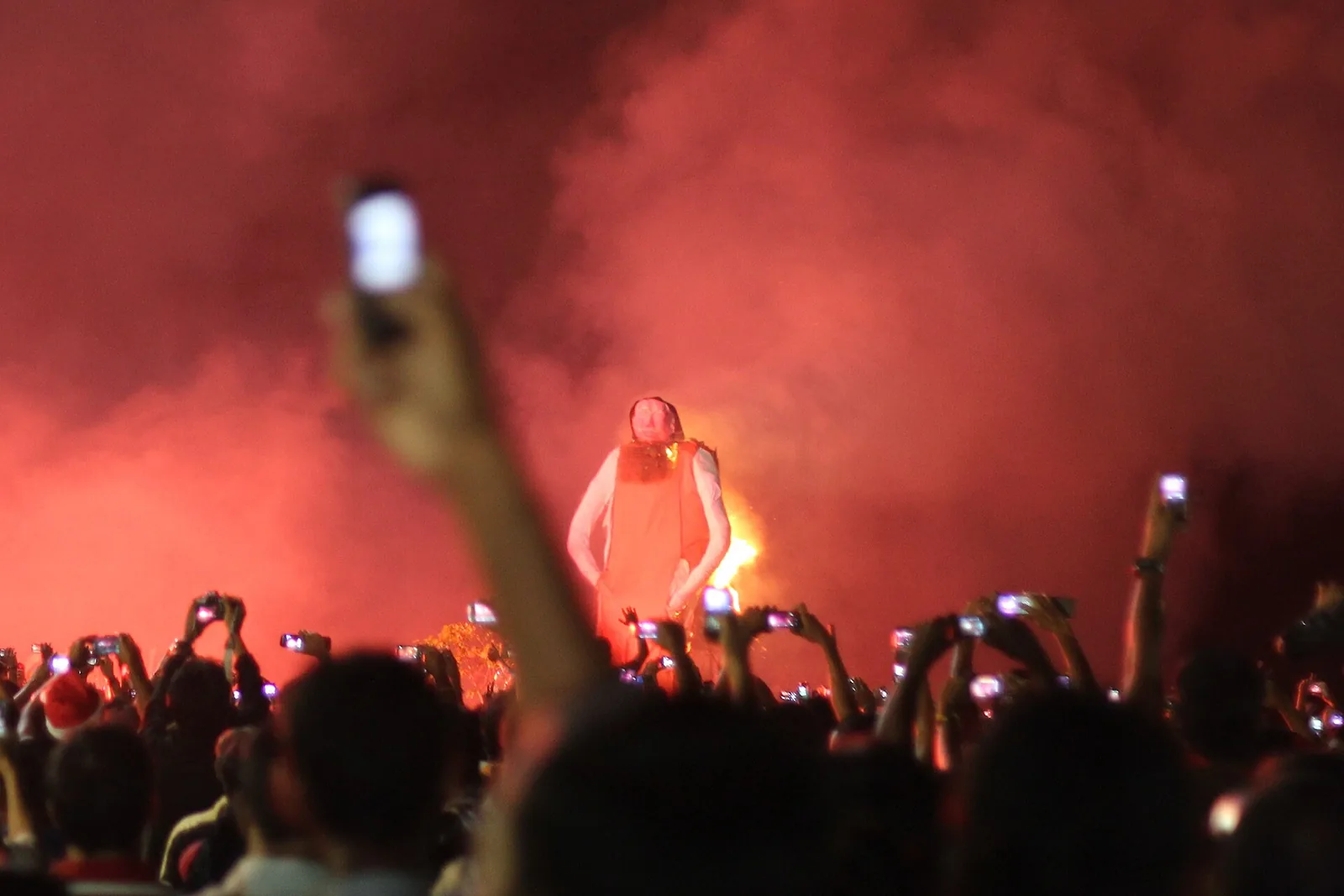
At midnight on 31 December, on the sand at Fort Kochi Beach, a towering effigy of a bearded old man in a suit is set alight in front of a very large crowd. He is called Pappanji, he represents the year that is ending, and burning him is the climax of the Cochin Carnival.
Visitors often assume he is Santa Claus, which is understandable — white beard, red-ish suit, late December — and which locals will gently correct. Pappanji is the old year personified. The point is not that Christmas is over. The point is that the year is.
What actually happens
The effigy is built in the weeks beforehand and stands on the beach for days, drawing a steady stream of people photographing it. The carnival itself runs through the last two weeks of December, with processions, decorated floats, music, and the traditional Fort Kochi street games and races. The burning is the final act, timed to the turn of the year.
Since the launch of the Kochi-Muziris Biennale in 2012, the making of Pappanji has been led by the Kochi Biennale Foundation, and the figure has been designed by some of the best-known artists working in Kerala. That is a real change in the tradition: what was once a neighbourhood effigy is now, in some years, a commissioned art object that happens to be destroyed on schedule.
The Portuguese explanation
The usual account traces Pappanji to the Portuguese, who governed this part of Kochi from 1503 until 1663 and left behind more of their calendar than is generally noticed. On this reading the burning is a survival of Portuguese Christmas and New Year customs, worn down and localised over four centuries until only the effigy and the fire were left.
It is the most widely repeated explanation and it fits the geography — this is the quarter of Kochi where Portuguese habits lasted longest. The name is often glossed as a Portuguese word for an old man or grandfather, though we have not been able to verify that etymology against a reliable source and would treat it as folk explanation rather than fact.
The Cochin Jewish explanation
There is a second account, and it is less known than it deserves to be. The Jewish community of Kochi — present in Kerala for a very long time, and centred a few kilometres away at Mattancherry — marked their victory over the Greek army by burning an effigy of the Greek commander, Bagris. Members of the community have suggested that the Fort Kochi practice of burning Pappanji may have been borrowed from that ritual.
The timing is offered in support: the Pappanji burning falls on the eighth day after Christmas Eve, which lines up with the eight-day structure of the Jewish festival. Whether that is derivation or coincidence is not something we can settle, and we are not going to pretend otherwise. But in a town where Portuguese, Dutch, Jewish and Malayali practice have been overlapping for five hundred years, a custom with two plausible parents is not surprising.
The carnival is younger than the custom
One thing that is documented: the Cochin Carnival in its organised modern form began in 1985, started by a group of young people in Kochi following a beach festival held for the United Nations International Youth Year. The effigy tradition it absorbed is older; the festival around it is not yet fifty. It was deliberately built as a secular, participatory event, which is why it draws across communities rather than belonging to one.
- The beach and the approach roads get extremely crowded well before midnight. Arrive early or accept that you will be watching from a distance.
- This is a large open fire in a dense crowd. Keep children close and know your way out before the burning starts.
- Fort Kochi is a peninsula with limited road access — leaving afterwards is slower than arriving. Plan how you are getting back.
- Dates for the carnival programme shift year to year. Confirm the current schedule locally before building a trip around it.
The burning happens on the same stretch of sand as the Chinese fishing nets, whose own contested history we unpick in Who really built the Chinese fishing nets.
Frequently asked questions
What is Pappanji?
A large effigy of a bearded old man, built and then burned at midnight on 31 December at Fort Kochi Beach. He represents the outgoing year, and burning him marks its end. He is not Santa Claus, despite the resemblance.
Where and when is the Pappanji burning?
On Fort Kochi Beach, at midnight on 31 December, as the closing act of the Cochin Carnival. The carnival itself runs across the last two weeks of December.
Where did the Pappanji tradition come from?
It is disputed. The common explanation traces it to Portuguese New Year customs surviving from their rule over Fort Kochi between 1503 and 1663. A second account links it to the Cochin Jewish practice of burning an effigy of the Greek commander Bagris. Neither has been conclusively established.
How old is the Cochin Carnival?
The organised carnival dates from 1985, when it was started by young people in Kochi after a beach festival held for the United Nations International Youth Year. The effigy-burning custom it built on is considerably older.
Who makes the Pappanji effigy?
Since the Kochi-Muziris Biennale began in 2012, production has been led by the Kochi Biennale Foundation, with the figure designed by leading Kerala artists. Before that it was a community-built effigy.