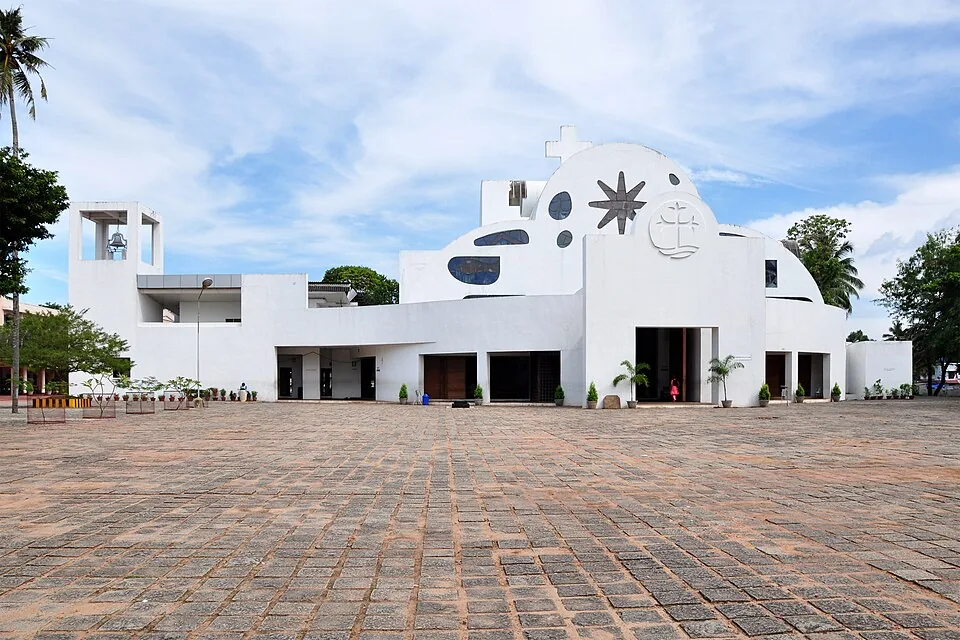
On a sliver of land in the Pamba river, reached across a bridge near Mannar, is a tomb that draws hundreds of thousands of people — Christian, Hindu and Muslim alike — every single year. They come to light a candle, to whisper a request, to touch the stone. It belongs to a gentle bishop who chose to live out his last years on this quiet island, and who would become Parumala Church’s gift to the whole country: the first person of Indian origin the church ever declared a saint.
The boy who was ordained at ten
He was born Geevarghese in June 1848 at Mulanthuruthy, into an old Syrian Christian family, and lost his mother while still a child. His gifts showed early and were taken seriously: he was made a sub-deacon at the astonishing age of ten, and studied under an uncle, a malpan (teacher), whom he nursed through smallpox — catching, and surviving, the disease himself. Ordained priest at eighteen and a monk-priest at twenty-two, he rose so fast that when he was consecrated Metropolitan in December 1876, at just twenty-eight, he was the youngest bishop the church had; people called him simply Kochu Thirumeni, the Young Bishop.
The bishop who built an island
Given charge of the Niranam diocese, he might have ruled from any great town. Instead he was drawn to Parumala, a low green island in the Pamba, and made it his spiritual home. He consecrated a seminary here, and in 1895 founded the church dedicated to Saints Peter and Paul that still stands. He rose at four each morning to pray, fasted through Wednesdays and Fridays, and poured himself into education — founding and inspiring schools across Travancore at a time when learning was the surest ladder out of poverty. In 1895 he also made the long pilgrimage to Jerusalem, leading Passion Week services in the Holy City. In his own lifetime, people spoke of him as a teacher, a healer, and a holy man.
How a man becomes a saint
He died on 2 November 1902, worn down by a chronic illness, at fifty-four, and was buried in the church he had raised on the island. His funeral drew thousands. And then something happened that no decree could have arranged: the pilgrims simply kept coming — year after year, faith after faith — to his tomb, and kept returning home with stories of prayers answered and sickness healed. On the forty-fifth anniversary of his death, in 1947, the Malankara Orthodox Syrian Church declared him a saint, St Gregorios of Parumala — the first person of Indian origin ever to be canonised. Decades later, in 1987, the Syriac Orthodox Church of Antioch proclaimed his sainthood too.
The Perunnal
Every year, around the anniversary of his death — the Parumala Perunnal, on the 1st and 2nd of November — the little island all but vanishes beneath a sea of pilgrims of every religion, come to light candles and pray at his tomb through the day and long into the night. It is one of Kerala’s most moving sights: a Christian saint honoured, without a second thought, by Hindus and Muslims, on a river island in the middle of the paddy country.
Visiting Parumala
Outside festival days the church sits calm and green on its island in the Pamba near Mannar and Thiruvalla, and a visit is peaceful and unhurried — a good place to feel the quiet at the centre of a very large devotion. Details are on the Parumala place page; more of the district is on the Pathanamthitta hub.
Frequently asked questions
Who was Parumala Thirumeni?
He was Geevarghese Mar Gregorios (1848–1902), born at Mulanthuruthy and consecrated a Metropolitan of the Malankara Orthodox Church at just 28. He made the river island of Parumala his spiritual centre, founding its church and seminary. In 1947 he was declared St Gregorios of Parumala — the first person of Indian origin to be canonised as a saint.
When is the Parumala Perunnal?
The main feast is held around 1–2 November, marking the anniversary of the saint’s death on 2 November 1902. It draws vast numbers of pilgrims of all faiths to his tomb on the island.
Why is St Gregorios of Parumala significant?
He was the first person of Indian origin to be canonised as a saint, by the Malankara Orthodox Syrian Church in 1947 (and later recognised by the Syriac Orthodox Church of Antioch in 1987). He was also a pioneering builder of churches, a seminary and schools across Travancore.
Where is Parumala Church?
It stands on an island in the Pamba river near Mannar and Thiruvalla in Pathanamthitta district, and holds the tomb of St Gregorios of Parumala.