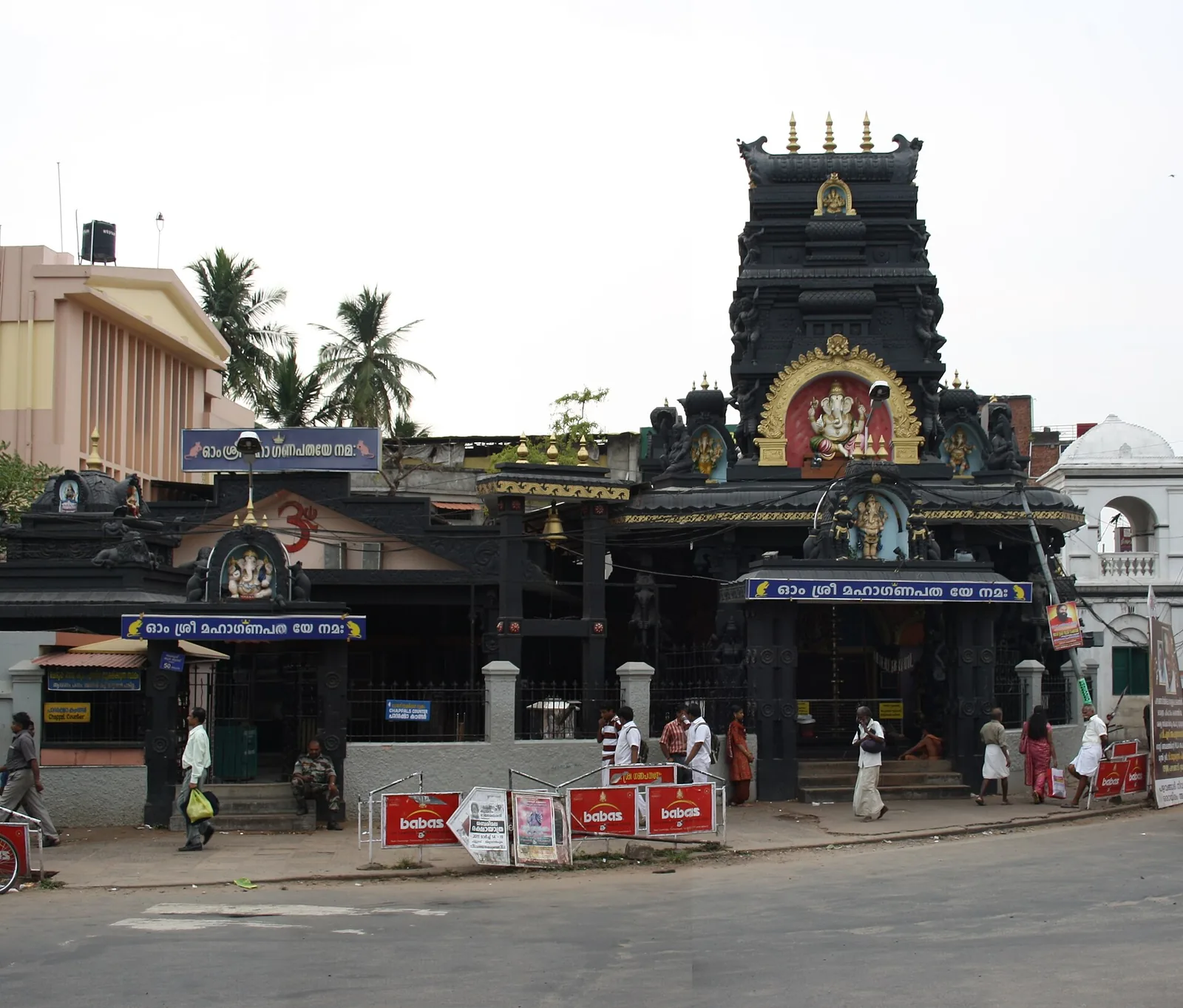
Almost every temple in Kerala is run by a Devaswom board, a trust or a family. The Pazhavangadi Ganapathy Temple at East Fort is run by the Indian Army — specifically the Madras Regimental Centre — and Pazhavangadi Ganapathy is the guardian deity of the Madras Regiment. That is not a ceremonial courtesy or a piece of post-Independence tidying. It is the unbroken continuation of an arrangement that began with a soldier, a river and a night watch, and the chain of custody can be followed link by link.
It starts with a sentry
The temple’s own account has a soldier finding a small Ganapathy idol in the Valliyoor river around 1750, when the Travancore capital was still at Padmanabhapuram. He kept it beside him on watch. The story attached to it — told at the temple as sacred history rather than as record — is that the guards were being troubled by a Yakshi, and that the man with the idol was left alone. His fellow soldiers noticed, and the idol acquired a congregation. That congregation was a garrison. Everything that follows is the institutional history of a military unit that happened to have a god.
Battalion, brigade, State Forces, Regiment
The links after that are better documented than the founding is, and they are worth setting out because they are routinely compressed into a single sentence. A Nair battalion existed from 1809. In 1830 the force was redesignated the Nair Brigade. In 1836 the British withdrew their troops from Travancore, leaving one regiment at Kollam, and the Nair Brigade took over the Thiruvananthapuram cantonment barracks they had vacated. In 1935 the force was renamed the Travancore State Forces and moved its headquarters to Pangode. In 1951, after Independence, the State Forces were integrated with the Indian Army, and their successor elements came under the Madras Regiment. The temple travelled with the unit through every one of those changes of name and master.
A correction worth making
The temple is often said to be administered ‘through the Pangode cantonment’, and that is not right. Pangode belongs to the 1935 step — it is where the State Forces moved their headquarters, not the body that runs the shrine. Present-day management sits with the Madras Regimental Centre. It is an easy error to make because Pangode is a real part of the same story, and it is the kind that spreads: a true fact attached to the wrong point in a sequence looks exactly like a fact.
What military administration actually looks like
Visitors notice the difference before they know the reason for it. The compound is conspicuously orderly and well kept by the standards of a very busy urban shrine handling thousands of people and thousands of coconuts a day — the queuing works, the breaking area is managed, the clearing is continuous. You will often see uniformed personnel about the place, which in most Indian temples would suggest a security operation and here simply means the administration is present. The temple has not been militarised in any visible sense: it is a small, popular, noisy Ganapathy shrine that anyone can walk into. It is just run by people whose institutional habit is to run things.
The coconuts pay for something
The arrangement extends to the economics, and this is the detail most visitors miss entirely. The right to collect the broken coconuts offered at the temple is auctioned periodically, and the proceeds go to a charitable trust run by the Madras Regiment. So the sweeping-up around the breaking stone is not waste clearance; it is the revenue side of the offering. Someone breaking a coconut before an examination is also, without particularly intending to, contributing to a regimental charity. We have written about the offering itself, its symbolism and its scale in 2,500 Coconuts a Day.
Going
The temple sits at East Fort, minutes from the Padmanabhaswamy temple and the Kuthiramalika palace, so it needs no detour on any old-city walk. It is small, it takes fifteen minutes, and it costs nothing beyond the price of a coconut. The usual Kerala temple conventions apply — dress conservatively with legs covered, no photography inside, and entry rules that may restrict access to Hindus and should be checked at the gate rather than assumed. Timings and access notes are on the Pazhavangadi Ganapathy Temple page.
Frequently asked questions
Is the Pazhavangadi temple really run by the Indian Army?
Yes. It is administered by the Madras Regimental Centre, and Pazhavangadi Ganapathy is the guardian deity of the Madras Regiment. It is one of a very small number of temples in India under military administration.
How did the army end up running a temple?
By continuity rather than acquisition. The idol was found and worshipped by Travancore soldiers around 1750 and travelled with the unit. That unit became a Nair battalion in 1809, the Nair Brigade in 1830, the Travancore State Forces in 1935, and was integrated into the Indian Army in 1951, its successor elements coming under the Madras Regiment.
What is the connection with Pangode?
Pangode is where the Travancore State Forces moved their headquarters in 1935. It is sometimes wrongly given as the body administering the temple — an error this site previously repeated. The administering body is the Madras Regimental Centre.
Where does the temple’s income go?
The right to collect the coconuts offered at the temple is auctioned periodically, and the proceeds go to a charitable trust run by the Madras Regiment.