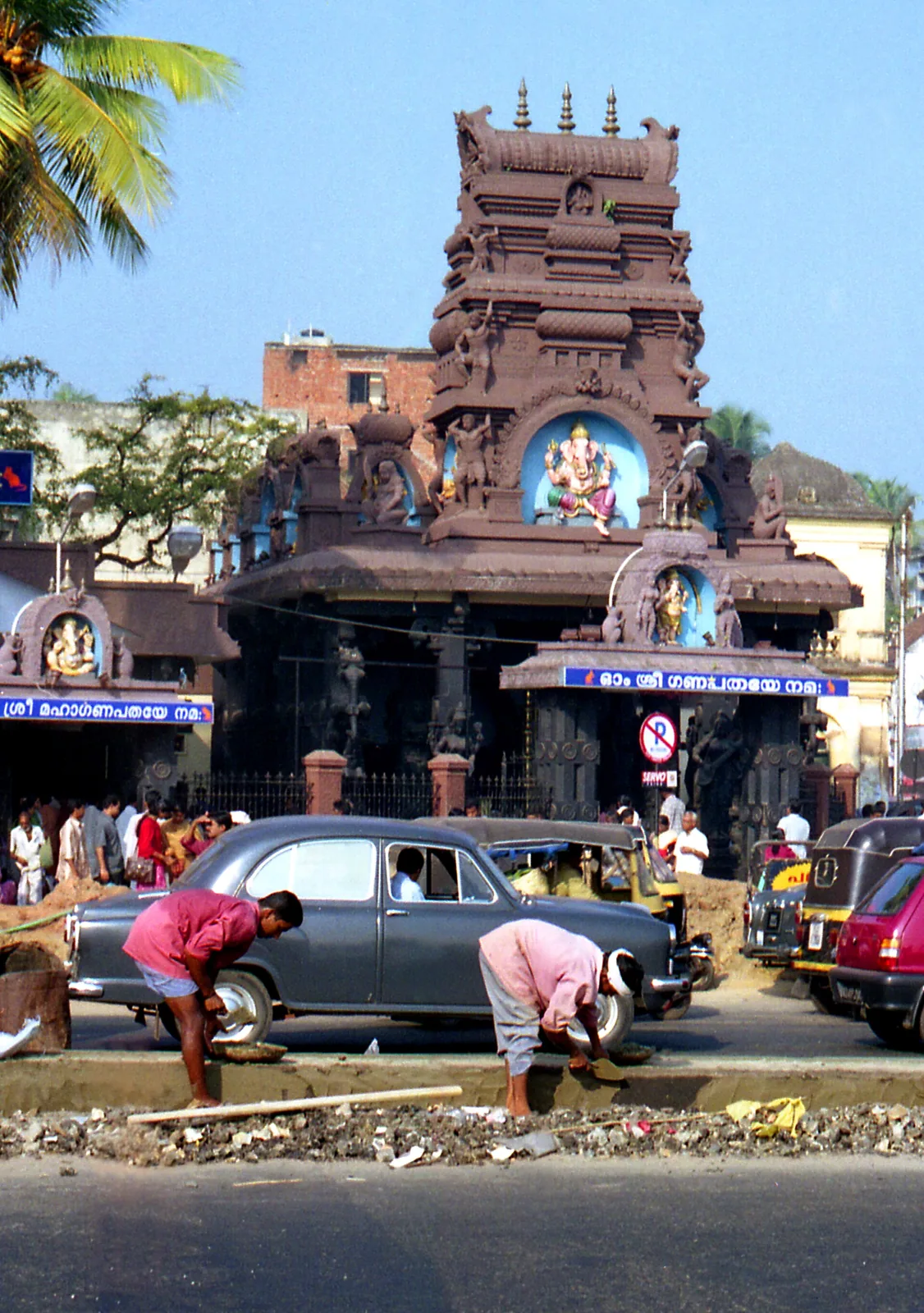
You hear the Pazhavangadi Ganapathy Temple before you understand it. The characteristic offering here is a coconut, bought from the stalls outside, carried to the designated breaking area and smashed hard against stone — and because upwards of two and a half thousand of them are broken on an ordinary day, the crack of it is effectively continuous. It is the most distinctive sound at any temple in Kerala, and it is the whole point of the place.
What the shell is for
The symbolism is not obscure and nobody guards it: ask anyone at the temple and you will get the same answer. The hard shell is the ego, the obstruction, the thing standing between you and what you want; the sweet white interior is what lies behind it; and Ganapathy is the remover of obstacles. Breaking the coconut is the obstacle being removed, performed rather than requested. This is one of the rare cases where the explanation offered to a curious visitor and the explanation a devotee would give themselves are the same explanation, with nothing lost in the translation.
Beginnings, mostly
Watch who is queuing and the pattern is immediately legible. People come here at the start of things: before examinations, before journeys, before a new job, before a business opens, before anything is undertaken that could go wrong. At the start of an exam season the numbers rise sharply and the sound with them. This gives the temple an atmosphere quite unlike a shrine people visit for calm — it is brisk, purposeful and slightly nervous, full of people doing a specific thing for a specific reason and then getting on with their day. Fifteen minutes is a normal visit.
Older than the building
The practice is not a modern accretion, and there is a hard number to prove it. A record survives of 300 coconuts being broken at the temple in 1771. That is a single occasion rather than a daily figure — a fraction of a modern day’s total — but it establishes something useful: within a few years of the first shrine going up here around 1765, the coconut offering was already what this temple was for. It is not a custom that gathered around an existing shrine over centuries. It appears to have been the practice more or less from the beginning, which makes the present two-and-a-half-thousand a matter of scale rather than of change.
Where the shells go
The clearing operation running alongside the breaking is not waste disposal, and this is the part almost no account mentions. The right to collect the coconuts offered at the temple is auctioned periodically, and the proceeds go to a charitable trust run by the Madras Regiment, which administers the shrine through the Madras Regimental Centre. The husk, shell and flesh all have onward value. So there is a complete small economy attached to the offering — the stalls that sell the coconuts, the people who clear them, the auction that disposes of them and the charity that receives the money — and a devotee breaking one is feeding every stage of it. None of this is arranged for visitors or explained on a board; it simply runs.
Doing it yourself
If you want to make the offering, buy the coconut from the stalls outside — that is precisely what they are there for — and take it to the designated breaking area rather than to any convenient piece of stone in the compound. The area is managed, and it is managed for a reason: several thousand coconuts a day being smashed at speed is a genuine hazard if it happens anywhere and everywhere. Beyond that, the ordinary conventions apply. Dress conservatively with legs covered, remove footwear, do not photograph inside, and check entry rules at the gate rather than assuming, since many Kerala temples restrict access to Hindus. Practical detail is on the Pazhavangadi Ganapathy Temple page, and the story of who runs the place is in The Regiment’s God.
Frequently asked questions
Why do people break coconuts at Pazhavangadi?
The hard shell stands for the ego and for obstruction; the sweet interior is what lies behind it; and Ganapathy is the remover of obstacles. Breaking the coconut enacts the removal. People come particularly at the start of things — exams, journeys, new ventures.
How many coconuts are broken in a day?
Reporting on the temple commonly puts it above 2,500 on an ordinary day, and more on auspicious days or at the start of an exam season. They are broken at a designated area rather than anywhere in the compound.
How old is the practice?
Older than the present building. A record survives of 300 coconuts broken at the temple in 1771, within a few years of the first shrine going up around 1765 — so the offering appears to have been central from the start rather than accumulating later.
What happens to the broken coconuts?
The right to collect them is auctioned periodically, with the proceeds going to a charitable trust run by the Madras Regiment, which administers the temple.
Can I break a coconut as a visitor?
Buy one from the stalls outside and use the designated breaking area. Check entry rules at the gate first, as many Kerala temples restrict access to Hindus, and observe the dress code and photography restrictions.