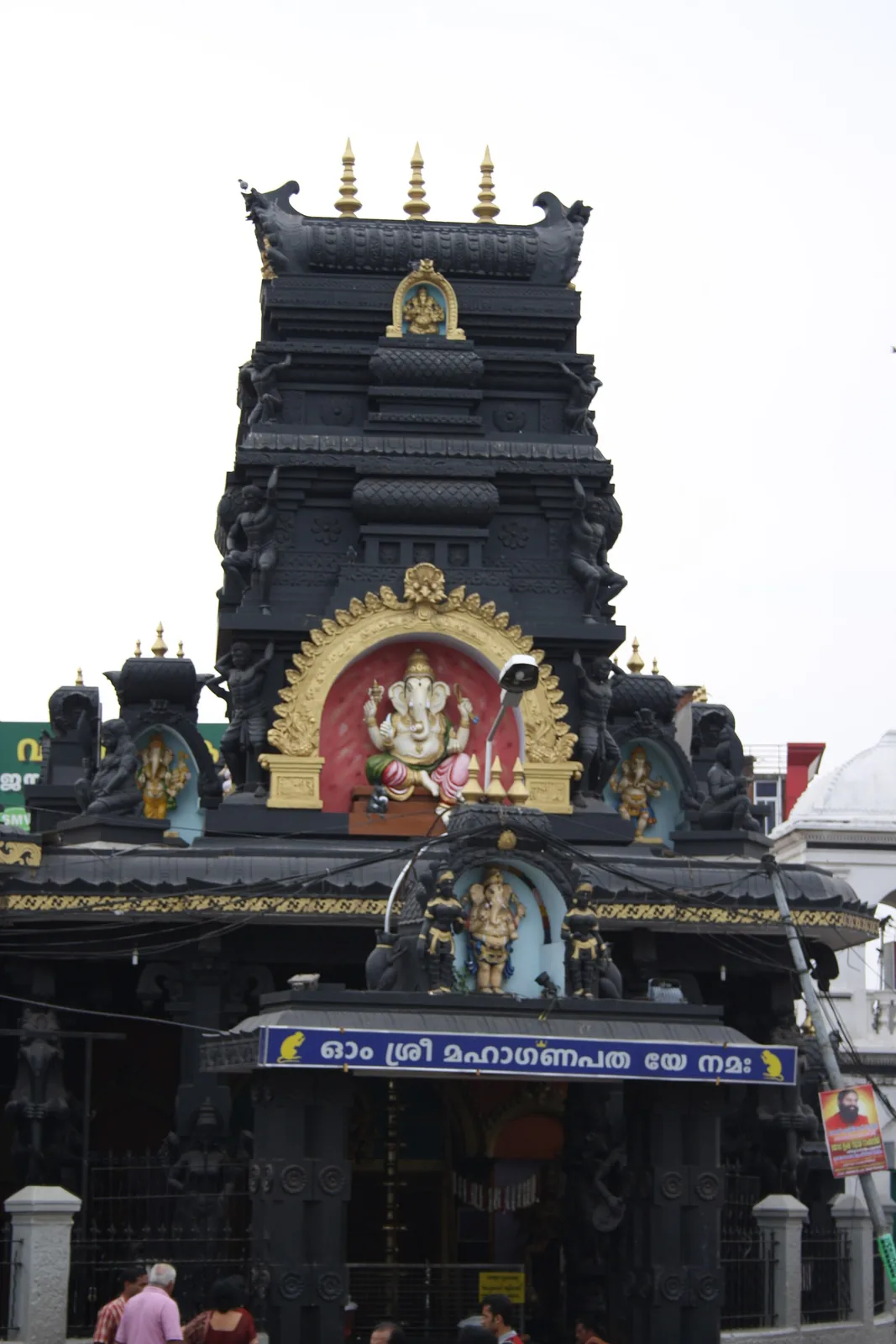
Ask how old the Pazhavangadi Ganapathy Temple is and you will be given a date. Ask twice and you will be given a different one. The figures in circulation — around 1750, around 1765, 1795, 1860 — are not rival guesses at a single event. They are four different events, each reasonably well attested, which almost every account of the temple flattens into one founding date that is then wrong about all four. Untangling them is worth doing, because the sequence is more interesting than any single year.
c.1750 — a soldier and a river
The temple’s own account has a soldier finding a small Ganapathy idol in the Valliyoor river around 1750, at a time when the Travancore capital was still at Padmanabhapuram. The idol was worshipped by soldiers at the Padmanabhapuram barracks. Nothing at East Fort exists yet. This is the earliest date anyone attaches to the temple, and what it actually dates is the object, not the institution or the site.
c.1765 — a shrine at East Fort
The idol was brought to Thiruvananthapuram during the reign of Dharma Raja, who ruled from 1758 to 1798, and a shrine was raised around 1765 with the Raja’s support. This is the founding of the temple as a place, and it is the date most defensibly called ‘when the temple was founded’. It is also the date that creates the problem, as the next paragraph shows.
1795 — the capital moves, and the story breaks
The transfer of the Travancore capital from Padmanabhapuram to Thiruvananthapuram is conventionally dated 1795, and the most commonly told version of the temple’s origin has the soldiers bringing their idol north when the capital moved. Those two statements cannot both be right. If a shrine was already standing at East Fort by about 1765, the idol had been here for roughly thirty years before the capital followed it. The soldiers’ move was real, but it happened earlier and in stages, and the tidy image of a garrison marching north with its god in 1795 is a compression of something slower and less cinematic. This is the single most common error in accounts of the temple, and it survives because both halves of it are individually true.
1860 — the building you actually walk into
The present temple structure is generally credited to Maharaja Ayilyam Thirunal in 1860. So the fabric a visitor sees is roughly a century younger than the shrine and over a century younger than the idol. When a source says the temple ‘dates from 1860’, it is not wrong — it is answering a different question from the one usually being asked. The gopuram has been repainted more than once within living memory, too: older photographs show it in a reddish-brown that has since given way to the black finish it carries today, which is worth knowing if you are comparing images.
Why it matters beyond pedantry
It matters because the compressed version tells a worse story. The flattened account is a single dramatic relocation. The actual sequence is a slow institutional migration: an object picked up by one man, adopted by a garrison, carried to a new city ahead of the government it served, given a permanent home by a king, rebuilt by a later king, and inherited without a break by a modern army. Nothing about that needed to be tidied. The unbroken chain — a Nair battalion from 1809, the Nair Brigade from 1830, the Travancore State Forces from 1935, integration into the Indian Army in 1951, the Madras Regimental Centre today — is set out in The Regiment’s God.
What we are not claiming
None of these dates rests on an inscription we have seen, and we are not presenting them as settled. Around 1750 and around 1765 come from the temple’s own account and carry the hedge the temple gives them. The 1795 capital transfer is standard Travancore history. The 1860 attribution to Ayilyam Thirunal is widely and consistently repeated. What we are confident about is the ordering and the fact that the four are distinct — which is enough to show that any single-date answer to ‘when was Pazhavangadi founded’ is answering less than it appears to.
Frequently asked questions
When was Pazhavangadi temple founded?
There is no single answer. The idol was reportedly found around 1750, a shrine was raised at East Fort around 1765 during Dharma Raja’s reign, and the present building is generally credited to Maharaja Ayilyam Thirunal in 1860. The most defensible answer to ‘founded’ is around 1765.
Did the soldiers bring the idol when the capital moved in 1795?
That is the usual telling, but it does not fit. If a shrine already stood at East Fort by about 1765, the idol arrived roughly thirty years before the capital transfer. The soldiers moved earlier and in stages; the 1795 version is a compression.
What happened in 1860?
The present temple building is generally credited to Maharaja Ayilyam Thirunal in that year. It is about a century younger than the original shrine on the site.
Where was the idol found?
The temple’s account names the Valliyoor river, at a time when the Travancore capital was still at Padmanabhapuram and the idol was first worshipped by soldiers at the barracks there.