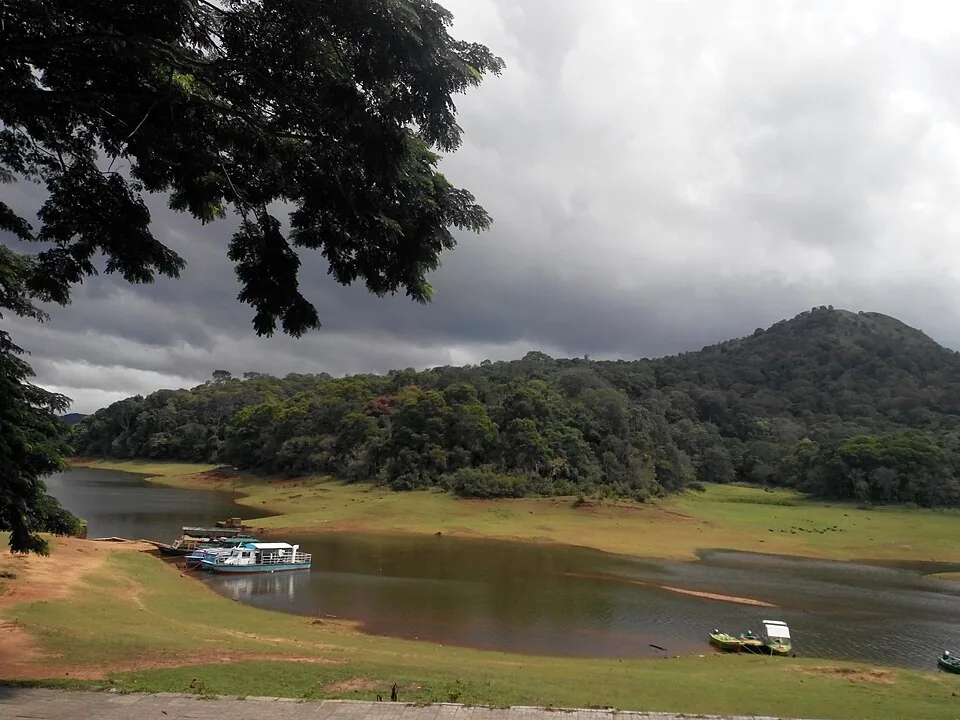
On a still morning at Thekkady, the dead tree trunks stand up out of the lake like grey posts, and gaur and sambar come down through the grass to drink at its edge. This water is the heart of the Periyar Tiger Reserve, and the trunks are a clue to how it was made. The lake is not natural. It was flooded into being in the 1890s, and everything that came after, from the hunting lodges to the tiger counts, grew up around it.
Long before the lake, the Periyar valley belonged to the Pandya kings who ruled from Madurai until the 12th century. Later it became the hunting ground of the Travancore kings in the 18th and 19th centuries. They kept a guest palace inside the forest, the Edapalayam Lake Palace, for visitors of the royal family. So for a long time the animals of Periyar were valued as game, and that is the past the reserve grew out of.
The change began with water. Work on the Mullaperiyar dam started in 1886, and the dam was finished in 1895 across the Periyar river. Its reservoir drowned the valley floor, which is why the old trees still stand in the water today, and it left a lake that now covers about 26 sq km. Then, in 1899, the forest around it was declared a forest reserve called the Periyar Lake Reserve. The story of how the lake was made follows the dam itself.
The first real step towards protection came from a game warden. On the advice of S. C. H. Robinson, the first game warden, the lake reserve became the Nellikkampatty Game Sanctuary in 1934, covering about 500 sq km. In 1950 more forest was added, and the whole area became the Periyar Wildlife Sanctuary. In less than a century the kings' hunting ground had turned into a place where hunting was the thing being stopped.
That shift became national in 1978, when the sanctuary joined Project Tiger, the central government's programme begun in 1972 to protect tigers in chosen reserves. Periyar was renamed the Periyar Tiger Reserve. More layers followed, because in 1992 it joined Project Elephant for wild Asian elephants, and in 1996 the India Eco-Development Project began here. In 2001 the reserve was split into two divisions, Periyar East and Periyar West, and visitors still enter at Thekkady in the East Division.
What makes Periyar unusual is how the land is shared out. Of its 925 sq km, the National Tiger Conservation Authority counts 881 sq km as core tiger habitat that is totally free of human settlements. Kerala chose to keep only a small buffer of 44 sq km. That buffer holds the lake, the trek paths and the Sabarimala shrine, and it is the only part where eco-tourism, eco-development and pilgrimage are allowed. In other words, the reserve fences its visitors into a thin edge so that the deep forest stays empty.
The deep forest is worth keeping empty. The reserve rises to 2,016 m and is drained by two rivers, the Periyar and the Pamba. Tropical evergreen forest is the main cover, about 38 percent of the land, with semi-evergreen forest and grassland each over a quarter. Out of 1,985 kinds of flowering plants recorded here, 519 grow only in the southern Western Ghats, and three are found nowhere but Periyar.
That forest feeds a long list of animals. The NTCA records 66 species of mammals, among them elephants, gaur, sambar, leopards, sloth bears, wild dogs, lion-tailed macaques, Nilgiri langurs and Nilgiri tahr. Over 342 species of birds, 262 butterflies and 45 fishes have been counted too, and seven of those fishes live only in Periyar. The tiger sits on top of it all, because gaur, sambar and wild boar are its main prey.
The tiger count tells how well the forest is doing. A 2010 assessment estimated 38 tigers in the Periyar region, and camera traps later identified 46 in the reserve alone. Periyar's staff keep this watch every day. Tiger monitoring is part of daily patrols, and field officers run the camera traps themselves. The NTCA also notes frequent sightings of tigers with cubs, even in dense evergreen forest, as a sign of a healthy population.
The people who once hunted here became part of that protection. The NTCA calls the turning of poachers into protectors a "well lauded achievement", and the "Periyar model" of community work is studied by other reserves. Periyar was also the first tiger reserve in India to register a Tiger Conservation Foundation. The story of the reserve that hired its poachers tells that change from the inside.
For a visitor, all of this is seen from the buffer, which is why the best way in is gentle. Kerala Tourism says a boat ride on the lake is the ideal way to see gaur and sambar, and in the hot months elephants and birds gather at the water to drink and cool off. The eco-tourism programmes, run with the same local communities, go further on foot or by raft, from bamboo rafting to the longer Periyar Tiger Trail.
The reserve still faces pressure from its edges. The NTCA lists a long border with Tamil Nadu that has many entry points, cattle from fringe villages, forest fires, weeds and a private estate inside the core. So the story of the old hunting ground is not finished. It goes on each day at the gate in Thekkady, where the reserve meets the busy town of Kumily and its spice shops. That trade is its own story, and it starts with the spice trade of Kumily.
Frequently asked questions
When did Periyar become a tiger reserve?
In 1978, when the Periyar Wildlife Sanctuary, formed in 1950, joined Project Tiger and was renamed.
How big is Periyar Tiger Reserve?
It covers 925 sq km: an 881 sq km core with no settlements and a 44 sq km buffer.
How many tigers live in Periyar?
Camera traps identified 46 tigers in the reserve, after a 2010 estimate of 38 for the Periyar region.
Where do visitors enter the reserve?
At Thekkady in the East Division, where the lake, boat rides and eco-tourism programmes are.