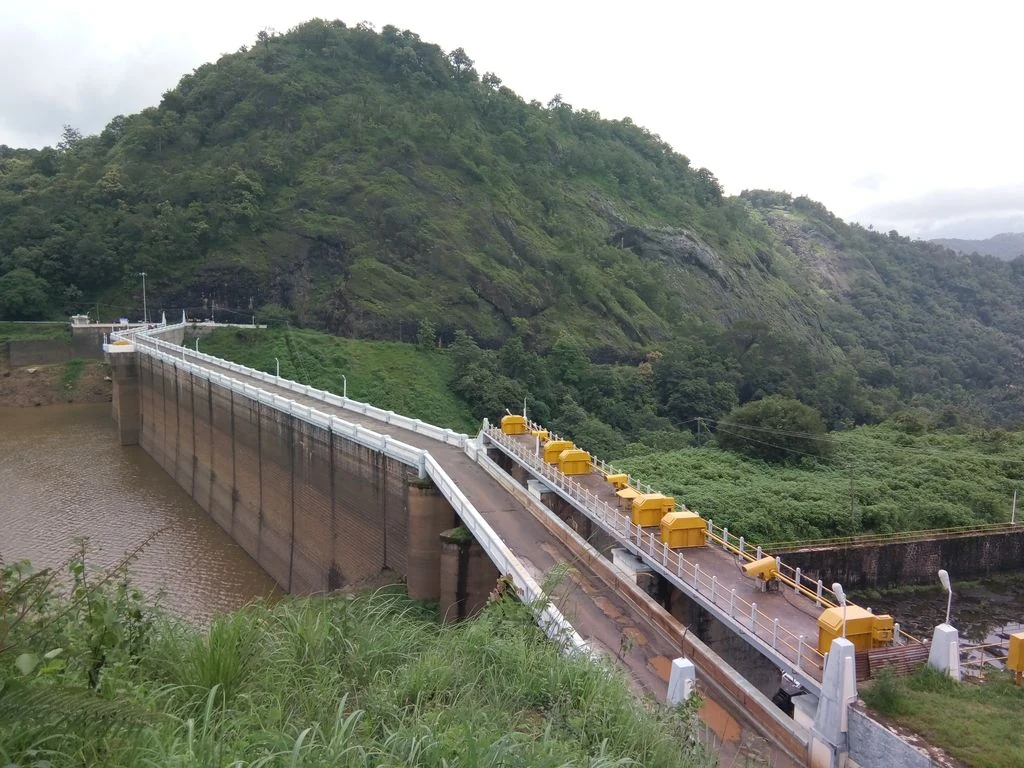
The yellow structures above Ponmudi’s spillway are easy to mistake for the centre of its power production. They belong to the gates. The dam stores and controls water, while the generating station stands elsewhere. That distinction makes a short visit more interesting: the visible structure is one part of a system that continues beyond the view.
A reservoir in the Panniyar basin
Ponmudi holds the Panniyar River at Konnathadi in Idukki. KSEB describes a water-conductor system carrying stored water towards Panniyar Power Station on the left bank of the Mudirapuzha. The river and project names therefore describe connected but different things: the river entering the reservoir, the dam retaining it, and the station using the delivered water.
Anayirankal is another storage site in this system. It is not the reservoir immediately beyond a different gate at Ponmudi. Likewise, the much larger Idukki reservoir has its own arrangement of dams and diversion works. A map showing several blue water bodies across the high ranges should not be read as one continuous visitor lake.
Look for the solid wall and the gated bays
Across much of the view, Ponmudi presents a long, regular barrier with a pale crest. At the spillway, piers divide the flow-control openings and support the equipment above. Looking at where the repeated bays begin is more revealing than trying to identify every piece of machinery. It shows how one structure combines water retention with a controlled outlet.
KSEB classifies the structure as masonry-gravity. In this kind of dam, the mass of the wall is central to resisting the reservoir’s pressure. The official height is measured from the deepest foundation, so it should not be read as the visible height above today’s water. A lower reservoir exposes more wall without making the dam itself taller.
The hill is part of the composition
At the abutment, the horizontal crest meets a steep rocky hill. Dark exposed surfaces, scattered trees and grass make the natural slope look irregular beside the repeated geometry of the parapet. Following the junction with your eye helps establish the scale: the dam spans the valley while the rock rises above the road along its edge.
On the lower side, service stairs and maintained ground reveal another part of the working site. These are useful details to observe from the visitor barrier, but they are not alternative sightseeing paths. A stair leading down towards equipment has an operational purpose even when it looks like the shortest route to a dramatic photograph.
Keep the visit tied to its actual entrance
The ordinary dam visit ends with the permitted route at Ponmudi. It does not include a power-station tour, an Anayirankal boat ride or access to the reservoir shore. Understanding the wider scheme adds context without requiring entry to every installation. From the accepted viewing area, the wall, spillway and rock abutment already explain a great deal.
Engineering reference: KSEB’s Ponmudi dam inventory. Visitor enquiries: KSEB hydel tourism.
Plan the visit: Ponmudi Dam.