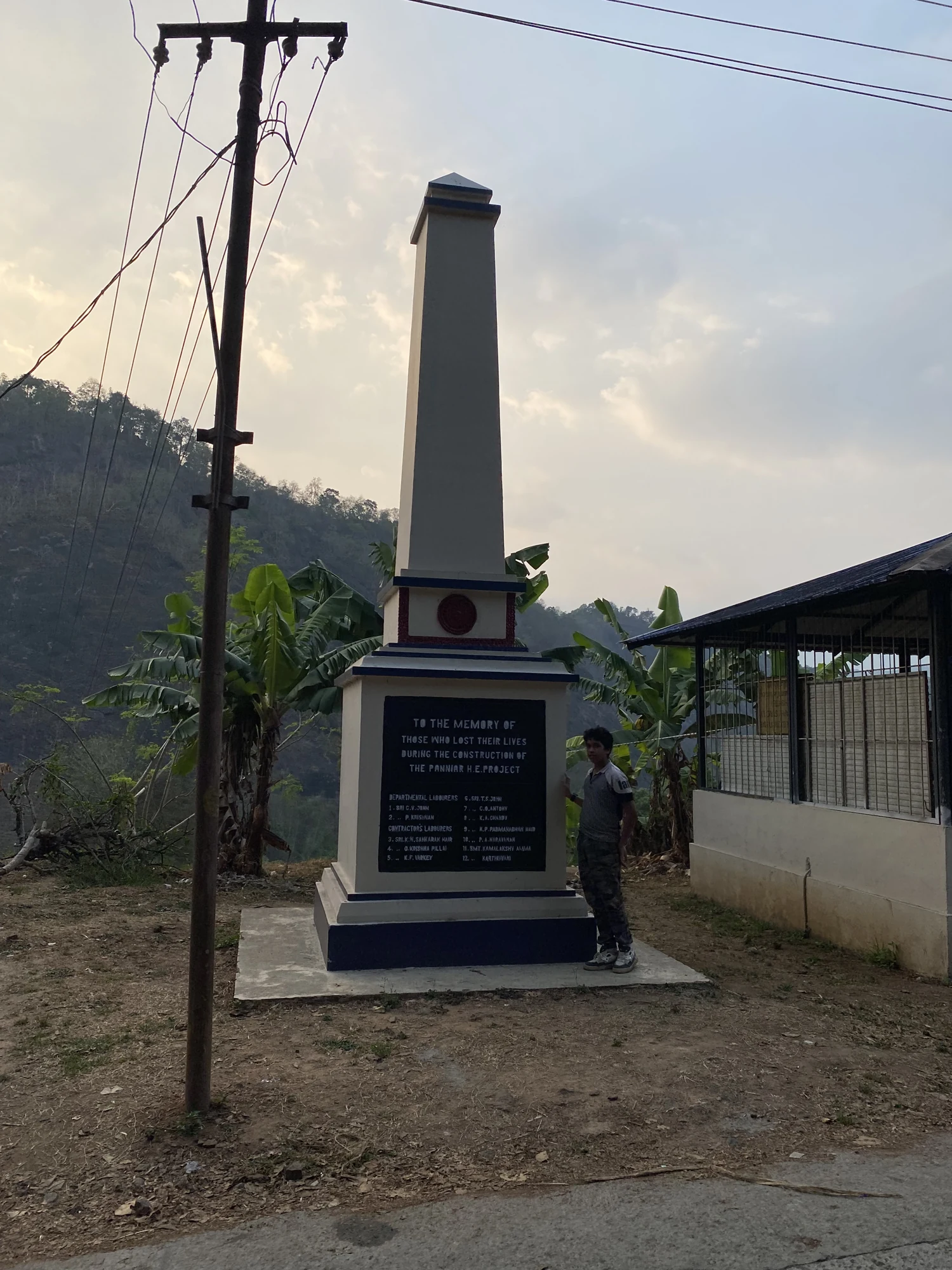
Before the dam becomes a long line across the water, a smaller vertical shape deserves attention. An obelisk stands beside the approach, close to the ordinary buildings and trees of the site. Its dark inscription panel remembers people who died during construction of the Panniyar hydroelectric project. It changes the scale of the story from a reservoir to individual workers.
A memorial within the working landscape
The monument is a tall, pale shaft with dark bands and a stepped base. It stands beside a roofed building, with the surrounding hill visible behind it. This is not a separate museum reached through an elaborate ceremonial entrance. It belongs to the approach to a working dam, where a visitor may otherwise be concentrating on the water and the route ahead.
The nearby tree, small structures and roadside setting make the memorial easy to pass without noticing. Pausing here is a different kind of observation from photographing the broad reservoir. The object is close enough to read as a constructed form: base, inscription, tapering shaft and cap, all arranged to draw attention upward before returning the eye to the names.
What the inscription actually records
The English dedication names the Panniyar hydroelectric project and remembers those who lost their lives during its construction. Beneath it, the list is divided between departmental labourers and contractors’ labourers. That distinction preserves two kinds of employment within the same public work, rather than reducing everyone involved to an anonymous construction workforce.
The memorial remembers the people who lost their lives while the Panniyar project was being built. Its significance lies in placing workers within the history of a structure usually described through dimensions, storage and electricity. Pause over the inscription before looking back towards the dam: the human record and the engineering record belong to the same undertaking, though they tell different parts of its story.
Alongside the official completion record
KSEB’s dam inventory records Ponmudi’s completion in 1965. That engineering date answers when the asset was completed; the memorial answers a different question about the human cost of the project’s construction. The two belong beside one another. Dimensions and operating purpose describe what was built, while the names prevent the work from becoming only a set of technical figures.
It is also useful to keep the dam and the wider Panniyar project distinct. The wording commemorates project construction, not a narrowly specified incident at one gate or wall. A visitor should not attach a precise location to each death simply because the monument now stands near the dam. Its presence gives the approach a commemorative role within the larger scheme.
Make room for a short pause
When the approach area is accessible, leave the vehicle and pedestrian route clear and take time to read the panel. The memorial is a reason to slow down before the wider view, not a separate excursion requiring another itinerary. A photograph should retain enough of its setting to show that this remembrance sits within the everyday landscape of the project.
The monument and inscription are visible in Vinayaraj’s photograph of the Ponmudi approach.jpg). The structure’s completion record is in KSEB’s dam inventory.
Plan the visit: Ponmudi Dam.