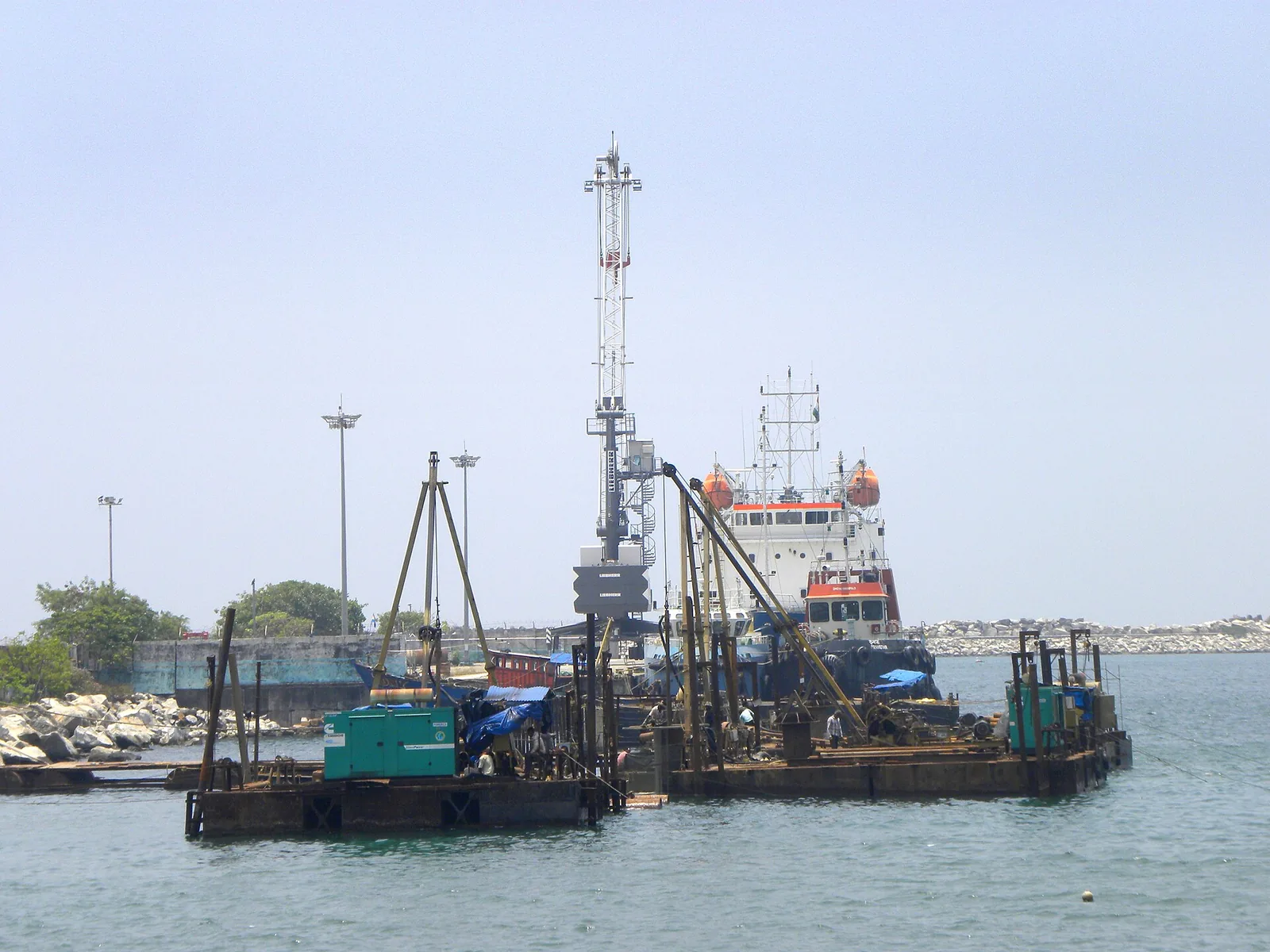
In January 2014, someone looking at the muddy slurry coming off a dredger at Kollam noticed that it had potsherds in it. And coins.

What followed is one of the better pieces of Indian maritime archaeology of the last two decades, and it is almost always reported in a way that makes it sound like something else.

The two numbers

You will read that thousands of Chinese coins were recovered at Kollam in 2014. That is what the dredging is reported to have brought up, and it is not a tabloid figure — the peer-reviewed paper on the material repeats it.

You will also read, in more careful accounts, that 44 coins were found. That is the assemblage that was actually collected, measured, weighed, photographed, classified and published, by the Department of Archaeology at the University of Kerala, from explorations at Thangassery across the 2013–14 and 2014–15 seasons.

Both are true and they describe different things. Quoting the thousands alone makes it sound as though a hoard was excavated under controlled conditions. Quoting the forty-four alone hides how much came out of the spoil. We print both, and we add the part that matters most: as far as we can establish, nobody has ever published a catalogue of the thousands. The 44 are what the record actually consists of.

What the forty-four are

Forty-three of the forty-four could be dated; one was too badly eroded to yield anything. They sort into three dynasties.

Thirty-six are Northern Song, the dynasty of 960 to 1127. Five are Tang, 618 to 907. Two are Southern Song, 1127 to 1279. By emperor, ten were issued under Shen Zong, nine under Ren Zong, five under Tai Zong. The latest legible reign-legend in the set is Chong Ning Zhong Bao, struck between 1102 and 1106.

They are small, light copper-alloy cash: twenty-three to thirty-five millimetres across, weighing between about one and eight grams, most of them round with a square hole. Twenty-one distinct obverse legends were identified across just forty-four objects, which is a lot of variety for a small set.

And one detail that stays with you. Of the forty-four, exactly one carries any mark at all on its reverse. Forty-three blank backs, and one that isn’t.

The sentence almost nobody repeats

Here is where the published paper does something that press coverage never does. Having established that Chinese coins spanning four centuries were lying off this coast, the authors decline to conclude the obvious thing.

There is, they write, no agreement among scholars about whether these coins had any circulation value locally at all.

The reasoning is specific to Chinese coinage. Unlike Western systems, where a coin’s commercial value tracked the intrinsic worth of its metal, Chinese cash was tariffed by form and general size; the metal in it was close to irrelevant. Carried to a port where Chinese merchants were themselves principals in the trade, such coins may have had no local monetary function whatever, with the actual exchange settled by other means entirely.

Which reframes the find. The coins may be evidence of who was standing on this shore rather than evidence of how anything was paid for. That is a smaller claim than the headlines want. It is also considerably more interesting, because it turns forty-four coins from a currency story into a presence story.

And they are not the oldest thing down there

The coins are routinely reported alongside Stone Age weapons, as though both came up in the same bucket in January 2014. They did not.

Lower Palaeolithic tools were recovered from the Thangassery seabed in August 2009, by a team led by P. Rajendran — five years before the coin find, and belonging to an entirely different order of time. They are not medieval trade goods. They are implements from a shoreline that was dry land when the sea stood lower, and they say something about the coast itself rather than about anybody’s commerce.

Merging the two events makes the palaeolithic material sound like a footnote to a spice-trade story. It is the other way round: the coins are a few centuries of one port’s life, and the stone tools are the landscape that port was eventually built on the edge of.

Why it matters that it came from the sea

Medieval Kollam has never wanted for testimony. Jia Dan describes trade with Kulam before 805. Tang records name it Mahlai. The copper plates of 849 are witnessed in three scripts. Ibn Battuta counted it among the five Indian ports he saw in twenty-four years of travelling.

But all of that is text. Until 2014, the case for Kollam as a great medieval entrepôt rested essentially on what people had written about it. Forty-four coins, forty-three of them datable, spanning Tang to Song, pulled out of the water off a working fishing harbour, are the first material proof from the site itself.

You can stand on the breakwater and look at the water they came out of. There is no museum, no marker and no interpretation board. There is a concrete walkway, some moored fishing boats, and a very long history that surfaced in a dredger’s spoil eleven years ago.

Frequently asked questions

How many Chinese coins were found at Kollam?

Two figures circulate and both are true. Thousands are reported to have come up in dredging off the coast in 2014. The assemblage actually collected, studied and published is 44 coins, of which 43 were datable. No catalogue of the larger figure appears to have been published.

What dynasties do the coins come from?

Of the 43 datable coins, 36 are Northern Song (960–1127), 5 are Tang (618–907) and 2 are Southern Song (1127–1279). By emperor: 10 under Shen Zong, 9 under Ren Zong, 5 under Tai Zong. The latest legible legend is Chong Ning Zhong Bao, 1102–06.

Did the coins circulate as money in Kollam?

The archaeologists who published them say there is no scholarly agreement on it, and lean against. Chinese cash was valued by form and size rather than metal content, so in a port where Chinese merchants were principals the coins may have had no local monetary value at all. They may be better evidence of presence than of payment.

Were Stone Age tools found with the coins?

No — that is a conflation of two separate events. Lower Palaeolithic tools were recovered from the Thangassery seabed in August 2009 by a team led by P. Rajendran; the coins and potsherds were noticed in dredging slurry in January 2014, five years later.

Can you see any of this at the port?

Not on site. There is no museum, marker or interpretation board at the port itself. The breakwater walk gives you the water the material came from, and the Thangassery lighthouse just above gives you the view of it.