If you read about the port of Kollam for more than about ten minutes, you will meet a sentence that says the harbour was founded in AD 825 as an alternative to reopening an inland seaport called Kore-ke-ni — and that Kore-ke-ni was the place the Romans and Greeks knew as Nelcynda or Tyndis, and the Tamils as Thondi.

It is a satisfying sentence. It hands you a thousand years of continuity in one line: classical antiquity, a silted harbour, a medieval replacement. It is also wrong in its second half, and we have already published the reason on our page for Ashtamudi Lake — no Phoenician or Roman source names Kollam, and no scholar we could trace places Nelcynda, Bacare or Tyndis here.

What we can now add is where the error comes from. That turns out to be more interesting than the error, because the name at the bottom of it is entirely real.

The name in the copper plates

The Tarisappalli copper plates of 849 CE — the grant made in the reign of Sthanu Ravi to the merchant recorded as Maruvan Sapir Iso, who built a church here — call this place Kurakkeni Kollam.

That is a genuine ninth-century name for a genuine place, and it appears in the primary document, in the reading carried through the Travancore Archaeological Series and quoted in the modern archaeological literature on the site. Kurakkeni Kollam is what the people who wrote the grant called the port they were granting land in.

Now say it a few times and watch what happens to it in transmission. Kurakkeni. Kurakkeni-Kollam. Kore-ke-ni. The consonants survive; the word stops looking Malayalam and starts looking like something a classical geographer might have written down.

And once it looks like that, somebody matches it to a classical port. Nelcynda and Tyndis are the ports of the Periplus of the Erythraean Sea, and every stretch of the Malabar coast has at some point been proposed as the site of one or the other. Attaching them to a half-familiar-looking name in a ninth-century document is an easy step to take, and once taken it gets copied.

Why the identification does not hold

Three problems, and any one of them is enough.

The first is chronological. Kurakkeni Kollam is attested in 849 CE. Nelcynda and Tyndis belong to the first century of the Common Era. Eight hundred years separate them, and a name appearing in a ninth-century grant is not evidence about a first-century port unless something independent links the two.

The second is that nothing independent does. The scholarly placements of Nelcynda and Tyndis are contested among themselves, but the candidate locations proposed are elsewhere on the coast, and we could not trace a scholar who places either at Kollam.

The third is the company the claim keeps. The same family of sources that gives you Kore-ke-ni also tells you that Kollam traded with the Phoenicians. Phoenicia as a maritime power was finished by the end of the fourth century BCE. When a claim arrives bundled with one that is straightforwardly impossible, that is information about the bundle.

What is lost, and what is not

It is worth being clear about what this correction takes away, which is less than it looks.

It takes away a Roman-era pedigree that Kollam never needed and cannot support. It does not touch the copper plates, the Tang itineraries, the Chinese place-name Mahlai, the merchant guilds, Ibn Battuta, or the forty-four Song and Tang coins pulled out of the seabed off Thangassery. The ninth-to-fourteenth-century case for this harbour is one of the strongest on the Indian coast and rests on documents and objects rather than on resemblance between words.

It also gives something back. Kurakkeni Kollam is a better fact than Kore-ke-ni ever was: it is the port’s own name for itself, in its own century, preserved on copper because a king was granting land to a Christian merchant whose neighbours signed in Arabic, Pahlavi and Hebrew.

A note on the pictures, for the same reason

The habit of reading a label as a fact is not confined to place-names, and this port is unusually exposed to it because its best early images circulate under filenames that look like dates.

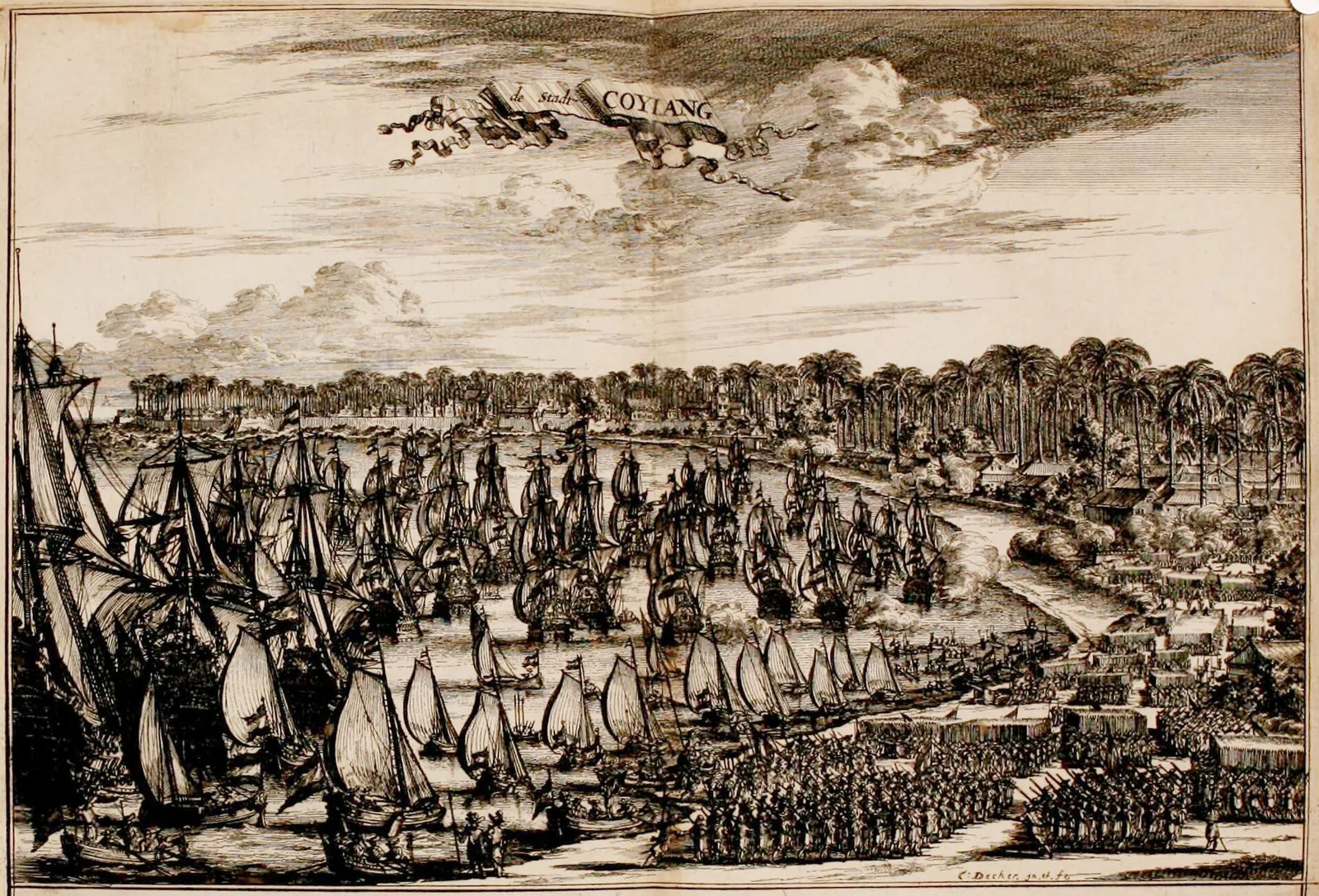
The image at the top of this story is filed as "Quilon 1670". It is Coenraet Decker’s engraving of the Dutch assault on Kollam of December 1661, published in Wouter Schouten’s account in 1676 — a military action, not a trade scene, with landed troops drawn up in ranks along the foreshore. Another famous plate is filed as "Quilon 1505"; it is a Portuguese manuscript town-plan of about 1600, and what belongs to 1505 is the founding of the fortress that its own caption records. Its stated latitude, 9°26′ north, is about sixty kilometres off.

None of that makes the images less valuable. It makes them documents with dates and authors rather than windows with captions. Which is, in the end, exactly what happened to Kurakkeni Kollam: a real thing, correctly recorded, that stopped being read carefully.

Frequently asked questions

Was Kollam the Roman port of Nelcynda?

No scholar we could trace places Nelcynda, Bacare or Tyndis at Kollam, and no Roman or Phoenician source names the place. The claim usually arrives bundled with an assertion that Kollam traded with the Phoenicians, who as a maritime power were gone by the end of the fourth century BCE.

What was Kore-ke-ni?

It appears to be a garbling of Kurakkeni Kollam, the name the Tarisappalli copper plates of 849 CE give to this port. The name is genuine and ninth-century; the identification of it with a first-century Greco-Roman port is not supported.

So how old is the port really?

The conventional founding date is AD 825 and the Malayalam calendar counts from it. Independent evidence of trade here is slightly earlier — Jia Dan’s itineraries of about 785–805 CE, and Tang coins from the seabed. What the record does not support is continuity back to the classical period.

Does the correction weaken Kollam’s history?

No. It removes a Roman-era pedigree the evidence never supported and leaves the ninth-to-fourteenth-century case untouched: the 849 copper plates witnessed in three scripts, Tang and Song coins from the seabed, Chinese records naming the place Mahlai, the Anchuvannam and Manigramam guilds, and Ibn Battuta counting Kollam among the five Indian ports he saw.

Is the 1670 engraving of Kollam a trade scene?

No. Coenraet Decker’s plate, published in 1676, shows the Dutch assault on Kollam of December 1661 — a fleet at anchor and troops drawn up on the shore. The "1670" is a filename, not the subject or the date.