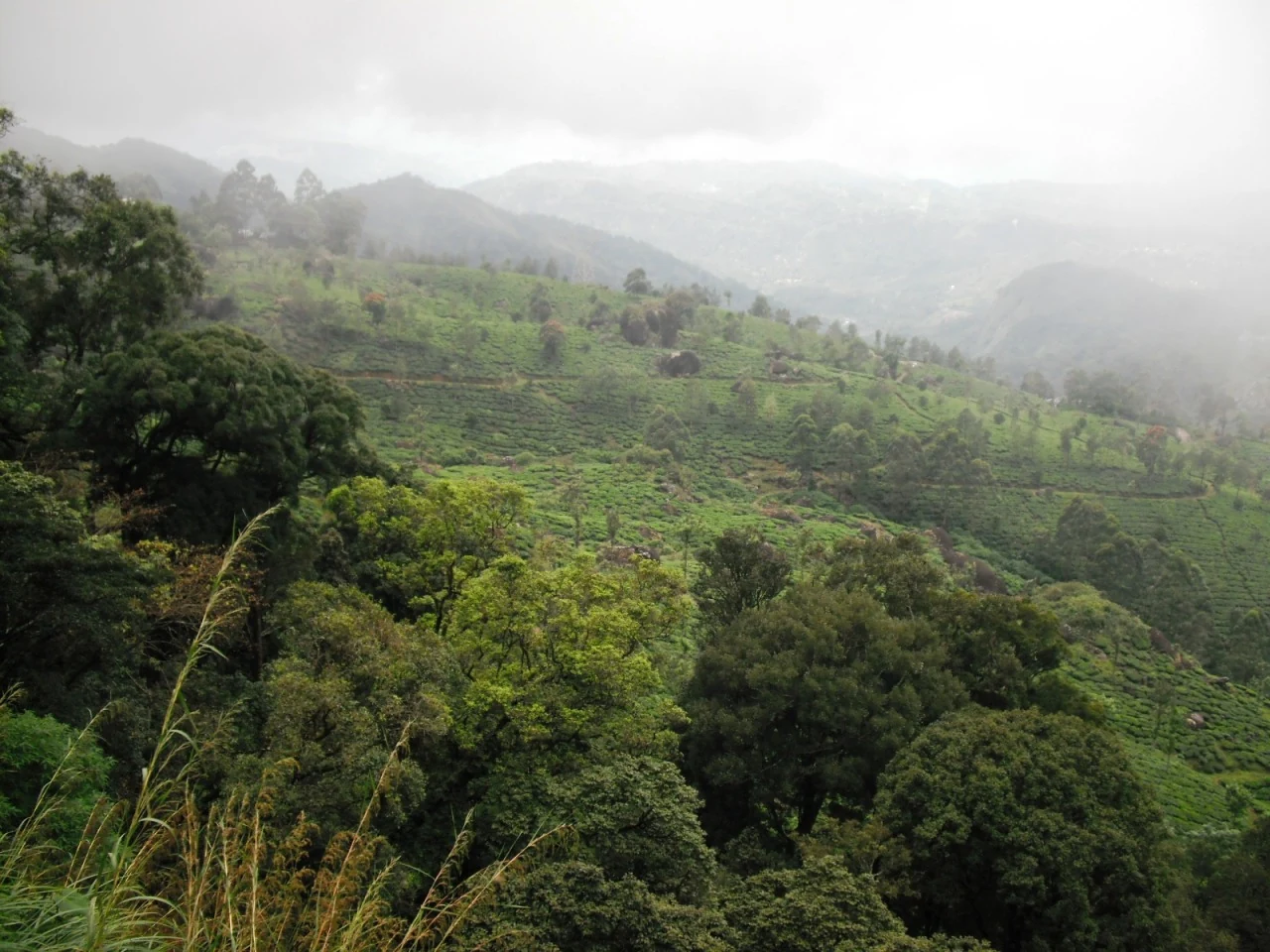
Pothamedu’s view is built from repeated small forms. Tea bushes follow the contours, taller trees interrupt the planted surface, and the valley opens beyond the nearest slope. From a distance the result looks like one green field; a longer look reveals how many separate layers create it.
Follow the contour
Tea planting gives the hill a visible texture. Rows curve as the ground changes direction, making the shape of the slope easier to read. Where the view is oblique, the same planting can look denser than on a surface facing the observer directly.
The tall trees add another scale. Their trunks and crowns rise above the lower crop, breaking up the fine pattern without hiding it completely. The contrast helps the eye move between a single tree and the broader hillside.
Pothamedu belongs to Munnar’s cultivated landscape, but a view across an estate is different from entering it. The photograph can be enjoyed from the permitted stopping area while the work and ownership of the land beyond remain respected. A path running through tea in the distance is not automatically a public walking route.
Let the weather change the subject
Mist can remove the most distant layer of a panorama. On such a day, the nearest tea and trees may become the subject rather than a disappointing substitute for a far horizon. The photograph heading this story shows how pale air can simplify the background while leaving the planted foreground readable.
Clearer conditions favour a wider view, with the valley and successive slopes becoming easier to distinguish. Neither state is permanent. Waiting briefly may change visibility, but a visit should not depend on a guaranteed sunrise, sunset or perfectly clear mountain outline.
The strongest observation is often specific: the direction in which the rows turn, a darker hollow between two slopes, or a tree standing above the crop. Those details remain useful even when the familiar wide photograph is unavailable.
Keep the viewpoint in proportion
Pothamedu is a road-accessed outlook within a larger locality. It can be a rewarding pause on a Munnar day without becoming a full-scale trek. The time spent looking and photographing should fit the actual stopping conditions, especially where vehicles need room to pass.
Avoid letting the search for an unobstructed frame draw the group onto a narrow verge or into plantation land. A safe view from slightly farther back can retain the same contour pattern, with a tree or roadside feature providing a useful foreground.
The appeal here lies in cultivated geometry meeting uneven ground. Reading that relationship gives Pothamedu its own visual character and makes the visit more memorable than collecting another photograph labelled simply Munnar tea gardens.
Plan the visit: Pothamedu Viewpoint.