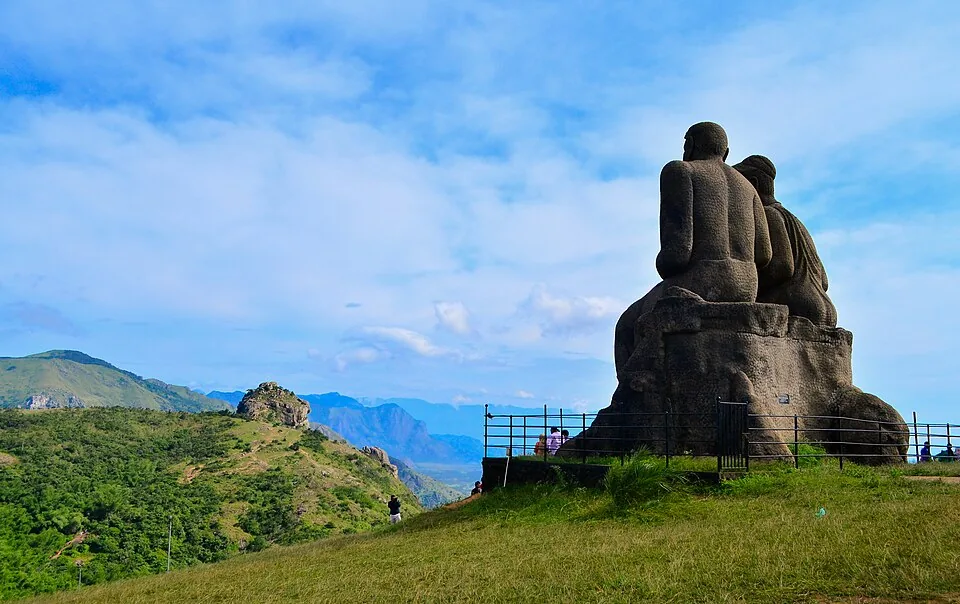
Stand on the edge of Ramakkalmedu and the first thing you notice is that you cannot stand still. The wind arrives from the plains below in a steady, shoving roar that tugs your shirt, snatches your voice and leans you back on your heels — and it does this every hour of every day, in every season. This high ridge on the very rim of the Western Ghats, where Kerala falls away into Tamil Nadu, is one of the windiest places in Asia. And watching over it all, arms and hen and child cast in concrete against the sky, stands a giant tribal couple with a legend older than the wind farm humming behind them.
The wind that never stops
Ramakkalmedu sits at around a thousand metres, and its geography does something unusual: it catches the moving air squeezed up over the Ghats from the flat Tamil Nadu lowlands. The result is a near-constant wind that averages roughly 35 kilometres an hour, year-round, regardless of season or time of day. Locals sometimes call the place the “cradle of wind,” and it earns the name honestly — this is counted among Asia’s largest wind-blown areas. The gusts are not a nuisance to be endured so much as the whole character of the hill; people come here specifically to feel weather that most hill stations spend their money trying to shelter you from.
A ridge that runs on air
That relentless wind is not only a spectacle — it is a power supply. Rows of turbines march along the ridgeline above the hamlets of the area, part of one of Kerala’s earliest wind-energy installations, a government undertaking that turns the ceaseless gusts into more than ten megawatts of electricity. Walking the ridge you hear them before you see them: the low whoosh of blades slicing the same air that is trying to push you over. There is a neat symmetry to it. The very thing that makes Ramakkalmedu difficult to build on, difficult to farm and difficult to stand in is also the thing that quietly lights homes across Idukki.
The view over two states
On a clear morning the reward for the climb is one of the great panoramas of the Western Ghats. From the grassy shoulder of the hill the land simply drops away, and the plains of Tamil Nadu open out a thousand metres below — the patchwork farms and townships of Cumbum, Theni and the valley beyond, brown and green squares crisscrossed by pale roads, hazing off toward a distant horizon. Sunrise is the moment locals will tell you to aim for, when light spills across the lowlands and the whole valley seems to switch on. It is the kind of view that makes the border between Kerala and Tamil Nadu feel less like a line on a map and more like the edge of a table you are peering over.
Rama’s stone
The name itself carries a story. Ramakkalmedu is usually read as “the land of Rama’s stone,” and according to legend the hill takes its name from the epic Ramayana. Tradition holds that Lord Rama set foot on the great rock here — some say he kept watch from this ridge, scanning the plains below during the long search for his abducted wife Sita. Whether you take the tale as scripture or scenery, the geography does the story a favour: from up here you really can see for enormous distances across the country below, exactly the vantage a searcher in the legend might have wanted.
The giant couple on the hill
The unmistakable landmark of Ramakkalmedu is the towering twin statue of Kuravan and Kurathi that crowns the summit. Sculpted by the artist C. B. Jinan and raised on the hilltop in 2005, the concrete figures stand roughly forty feet tall and are often described as the tallest statue of their kind in Kerala. They portray a couple from the region’s indigenous Kurava community — the man cradling a hen against his chest, his wife and a small child beside him — a deliberately ordinary, human tableau blown up to monumental scale. Set against the empty sky and the endless plains, the pair are visible long before you reach them, and they have become the signature image of the whole hill.
The legend behind the stone couple
Why a tribal couple, cast so large? The answer lies in a legend that links this ridge to the famous Idukki Arch Dam far to the north. The story goes that when Rama and Sita passed through these hills, the tribal pair Kuravan and Kurathi caught sight of Sita bathing in the Periyar river — and an angry Rama cursed them to turn to stone. As legend has it, the couple begged that they never be parted, and Rama promised that in a later age they would be reunited forever. They became two great hills, Kuravan Mala and Kurathi Mala, with the river running between them. When engineers later built Asia’s first arch dam across that very gap, joining the two hills at last, many local people took it as the ancient promise finally kept. The statue on Ramakkalmedu honours that couple and the folklore they carry.
A monument to tribal heritage
Beyond the myth, the Kuravan-Kurathi statue is meant as a tribute to Idukki’s indigenous communities, whose knowledge of these forests and gorges is woven through the district’s history — including, in the telling, the discovery of the narrow gap where the great dam would one day rise. In a district defined by hydro-electric engineering and plantation wealth, the monument deliberately puts a tribal family at the highest, most visible point on the ridge. It is a rare thing: a roadside photo-stop that is also a piece of public memory, insisting that the people who first read this landscape should not be forgotten in the story of what was built on it.
Flying on the gales
All that dependable wind has given Ramakkalmedu a second life as one of Kerala’s favourite spots for paragliding and adventure. The same steady updraughts that spin the turbines lift canopies off the ridge, and on good days you can watch — or join — paragliders soaring out over the drop toward the plains, the whole of Tamil Nadu spread beneath their feet. The flying season runs roughly from October to March, when the skies are clearest and the gusts are strong but stable. Add trekking, camping and simply leaning into the wind at the cliff edge, and the ridge has quietly become one of the most sought-after outdoor destinations in the district.
Visiting Ramakkalmedu
Ramakkalmedu lies in the highlands of Idukki, about 15 kilometres from Nedumkandam and roughly 25 kilometres from Kattappana, with Thekkady and Kumily around 40 kilometres away — an easy add-on to a Munnar-Thekkady trip. Aim for a clear morning to catch the sunrise view over the plains, carry a windproof layer even in warm months because the gusts are genuinely fierce, and give yourself time to walk up to the Ramakkalmedu statue and viewpoint on foot. The pleasant season stretches from about September to May. For more high-country escapes, dams and spice-hill drives nearby, browse the Idukki hub.
Frequently asked questions
Why is Ramakkalmedu so windy?
The ridge sits on the edge of the Western Ghats where air pushed up from the Tamil Nadu plains funnels over the hills, giving a near-constant wind of around 35 kilometres an hour year-round. It is considered one of the windiest places in Asia, and a government wind farm on the ridge uses those gusts to generate power.
What is the giant statue at Ramakkalmedu?
It is the twin statue of Kuravan and Kurathi, a tribal couple, sculpted by C. B. Jinan and raised on the summit in 2005. Standing roughly forty feet tall, it is often called the tallest statue of its kind in Kerala and honours the region’s indigenous Kurava heritage and the local Kuravan-Kurathi legend.
What does the name Ramakkalmedu mean?
The name is usually read as “the land of Rama’s stone.” According to legend, Lord Rama set foot on the rock here — some say he kept watch from this ridge during the search for Sita in the Ramayana. It is told as folklore rather than recorded history.