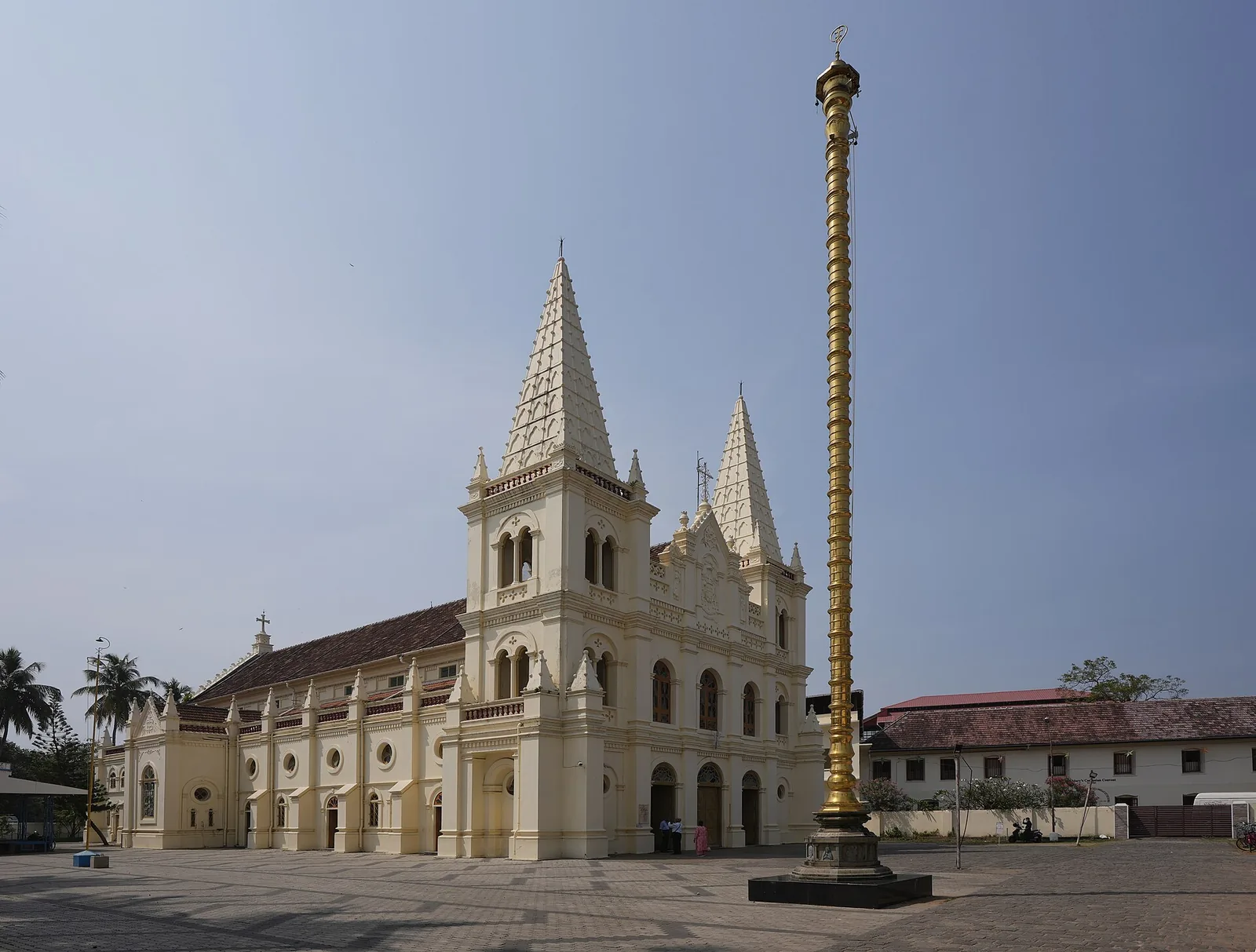
Walk down the lanes of Fort Kochi and two tall spires rise above the old houses, pale against the sky. They belong to the Santa Cruz Basilica, and once you step inside, the pastel nave and the ceiling painted from end to end make the building feel timeless. Yet the church you are standing in is only just over a century old, while the church on this ground is five centuries old. The story of Santa Cruz Basilica lives in the gap between those two numbers.
That story begins with a favour between rulers. The Portuguese reached Kochi in 1500, and according to Kerala Tourism the king of Kochi let them build a fort as thanks for their help against the Zamorin of Calicut. Once the fort stood, a church followed. In 1505 the first Portuguese viceroy, Dom Francisco de Almeida, received permission to build one, and the church took the name Santa Cruz, which means "Holy Cross".
The little church rose in rank far faster than anyone would expect of a building on a foreign shore. In 1558 Pope Paul IV raised it to a cathedral, so that barely fifty years after the first Portuguese ships arrived, Kochi had become the seat of a bishop. That rank has outlived everything that came after, and the GCatholic register still lists Santa Cruz as the cathedral of the Diocese of Cochin.
But a cathedral is only as safe as the power that protects it, and in 1663 that power changed hands. The Dutch took Kochi, and as Protestants they destroyed most of the Catholic monuments in the town. Santa Cruz escaped that fate, though not as a church, because the Dutch found a more practical use for its thick walls and turned the cathedral into an armoury. For years the place built for prayer held weapons instead. A few minutes away, the St Francis Church lived through the same takeover, and our St Francis Church story follows how that building changed hands too.
The armoury years kept the old walls standing, yet the next rulers did not spare them. When the British took Kochi from the Dutch, the old cathedral was pulled down. Kerala Tourism ties its destruction to the British invasion of 1795, while the GCatholic register gives the year as 1806. Whichever date you follow, the result was the same, and for most of the 19th century the ground where Santa Cruz had stood lay empty.
What brought it back was the arrival of one determined man. Bishop João Gomes Ferreira came to Kochi in 1887 and led the effort to rebuild the cathedral, work that stretched across close to two decades. The new church was consecrated on 19 November 1905 by Dom Sebastião José Pereira, Bishop of Damão. It looked nothing like a quiet Portuguese chapel, because its builders mixed Indo-European and Gothic styles and gave it the two spires that now mark the Fort Kochi skyline.
Inside, the new church was made to be looked at slowly. Bright blue pillars stand at the entrance, the carved pulpit shows fine craftsmanship, and stained glass windows throw coloured light across the floor. That is why people who sit for a while in the afternoon see the colours at their best. Above them all is the painted ceiling by the Italian Jesuit brother Antonio Moscheni and his disciple De Gama of Bangalore. Christ on the day of the crucifixion sits at its heart. Moscheni died four days before the consecration and never saw the church open, a story told in full in the painter who died before Santa Cruz opened.
The past has not vanished completely, though, because one piece of the first cathedral survived the armoury, the demolition and the empty century. Kerala Tourism says a decorative granite pillar from the original building is kept as a relic in the basilica. Visitors who seek it out are looking at the only part of the church that saw both 1505 and 1905.
The last honour came almost eighty years after the rebuilding. In 1984 Pope John Paul II raised the cathedral to a minor basilica, with a decree dated 23 August 1984. The title marks a church of special history, art or devotion. Old signs still call Santa Cruz one of only eight basilicas in India, but that count is long out of date. India now has more than thirty and Kerala alone more than ten, and Radio Veritas Asia reported a new one at Munnar in 2024. The title is not rare, and what sets Santa Cruz Basilica apart is the road it travelled to earn it.
Because that road ends in a working cathedral, the building still has a parish life of its own. Mass is held here regularly, so visitors dress modestly, keep their voices low and leave people at prayer out of their photographs, putting the camera away while Mass is on.
From the basilica steps, the rest of the old Portuguese and Dutch town is close enough to walk. The Chinese fishing nets swing on the shore nearby. The Indo-Portuguese Museum holds church art from the same era that built the first Santa Cruz, and the Dutch Cemetery tells the chapter that turned it into an armoury. Further east, Mattancherry Jew Town and the Dutch Palace are a short ride away. Our Kochi heritage walk links these stops on foot, and the Ernakulam guide opens up the wider district.
Frequently asked questions
When was Santa Cruz Basilica founded?
In 1505, when the Portuguese viceroy Dom Francisco de Almeida received permission to build a church in Kochi. Pope Paul IV made it a cathedral in 1558.
What happened to the old cathedral?
The Dutch spared it in 1663 and used it as an armoury. It was pulled down in the British era, in 1795 according to Kerala Tourism and 1806 according to the GCatholic register.
When was the present church built?
Rebuilding began under Bishop João Gomes Ferreira, who arrived in 1887, and the new church was consecrated on 19 November 1905.
When did Santa Cruz become a basilica?
Pope John Paul II made it a minor basilica by a decree dated 23 August 1984.