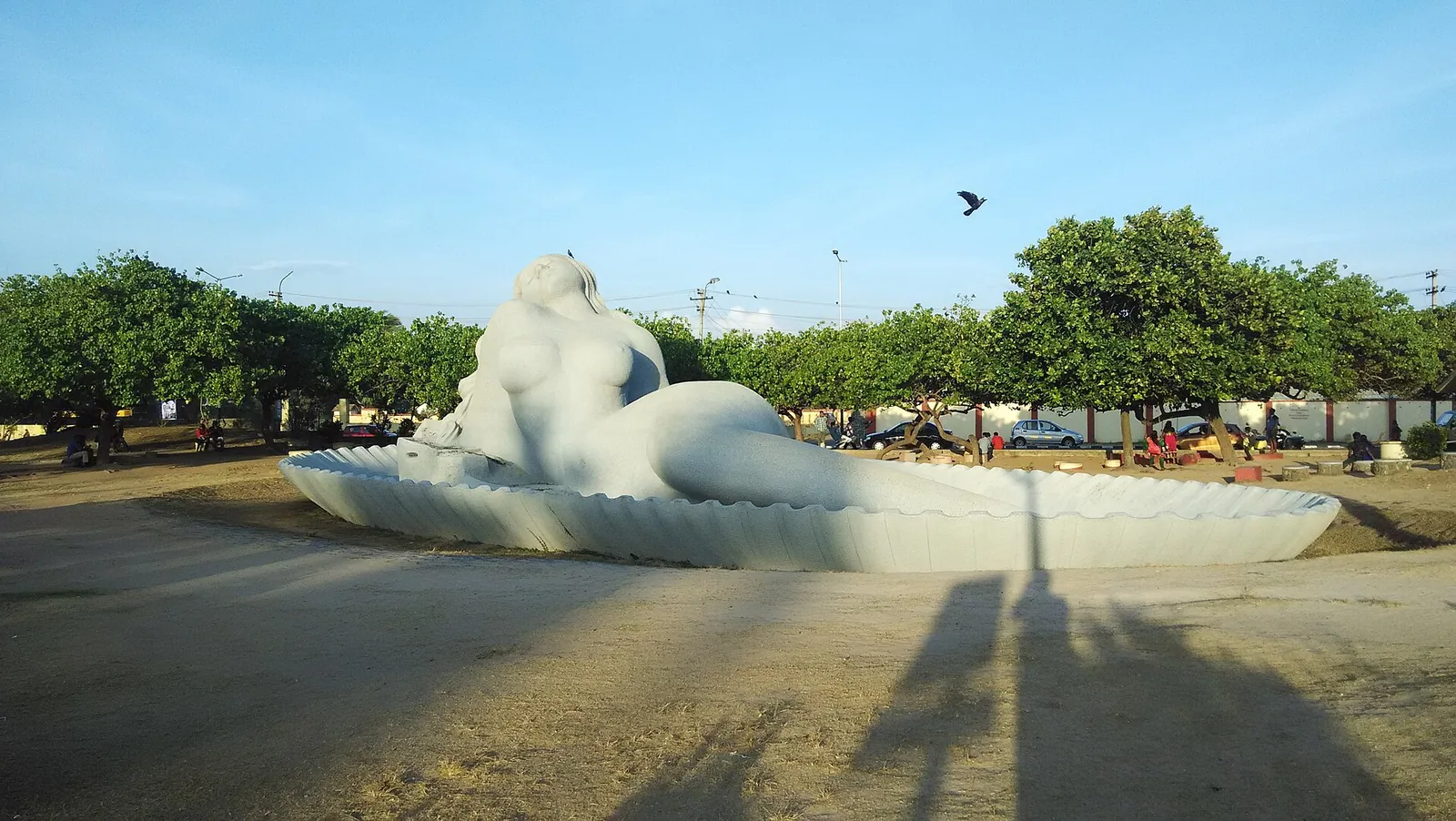
At Shanghumukham Beach, Kanayi Kunhiraman’s mermaid lies back in a shell-shaped form, her face turned upward. It is easy to make the story about scale: Guinness World Records lists Jalakanyaka, also called Sagarakanyaka or Matsyakanyaka, as the world’s largest merperson sculpture. The artist’s account points somewhere less comfortable. His mermaid left a polluted sea seeking refuge on land, only to find the land polluted too.
A refuge that fails twice
Guinness records Kunhiraman’s explanation of the concept: after finding contamination in both places, the mermaid looks to the sun to save the Earth. That changes the reclining figure from a seaside ornament into a question addressed to the people around her. The beach, the road and the sea all become part of the work’s setting. Kerala Tourism’s brochure calls the sculpture a tribute to the sea; the artist’s stated story gives that tribute an environmental edge.
What the record actually measures
Guinness gives the concrete figure as 26.5 metres long and 7.6 metres tall, with the surrounding shell about 32 metres long. Its record lists 1992, while the body text says it was made between 1990 and 1992. These are the clearest dated dimensions available here. Kerala Tourism’s beach page describes a 35-metre sculpture; that may refer to a different extent, but the pages do not explain how they measured it. The Guinness dimensions are the ones to use for the record claim.
The sculptor chose an open beach
Kunhiraman placed a monumental figure where people already came for the sea. The same artist made a conch sculpture at nearby Veli Tourist Village, which Kerala Tourism also documents. At Shanghumukham the work cannot be separated from the coast it addresses. To understand the form, walk around permitted public areas and see how the shell changes against the road and the water.
The title of a world record can make the work sound finished and fixed. Its own story refuses that ending: a mermaid searching for a safe place looks up because sea and land have both failed her. Once you know why, the scale becomes a way to make that question impossible to miss.
The beach changes the reading
Seen at Shanghumukham, Sagarakanyaka is never simply an object in a gallery. The sea is near enough to become part of its story, and visitors gather around the large shell as well as the figure. The artist’s account of contamination gives the mermaid an uneasy reason for being on land. Her scale attracts attention; her predicament keeps it.
A measured record can tell us the work’s size, but a length and height do not explain its meaning. The artist’s statement is the stronger source for that. Nor should the sculpture be used as a generic symbol for every coastal problem at this beach. It expresses one imagined figure’s loss of refuge; the shore erosion story follows a separate, measurable question.
Walk around the sculpture if public access permits and then face the water. The movement from carved shell to open coast is part of how the work is experienced. Sagarakanyaka asks a visitor to admire a beach while imagining a creature unable to live safely in either of her worlds.
Frequently asked questions
Who made the Shanghumukham mermaid?
Kerala sculptor Kanayi Kunhiraman created the concrete Jalakanyaka, also called Sagarakanyaka or Matsyakanyaka, between 1990 and 1992 according to Guinness World Records.
How large is the sculpture?
Guinness lists the figure as 26.5 metres long and 7.6 metres tall. The shell-shaped setting is about 32 metres long.
What does the sculpture mean?
Guinness records the artist’s concept: the mermaid flees a polluted sea, finds pollution on land too, and looks to the sun to save the Earth.
Is it the largest mermaid sculpture?
Guinness World Records lists it as the largest merperson sculpture. Record categories can change, so check the linked Guinness page for its latest status.