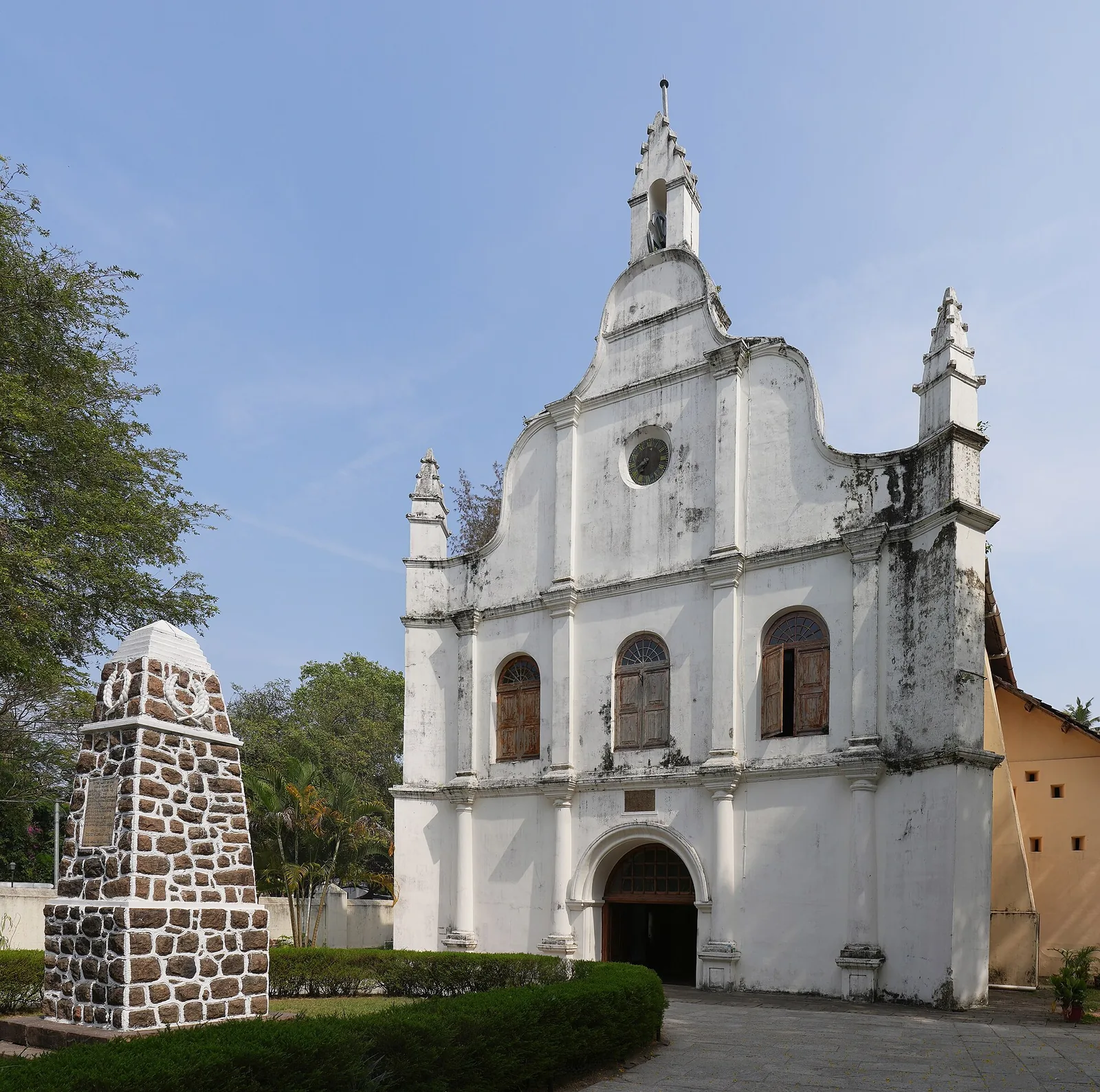
Walk into the cool, whitewashed calm of St Francis Church at Fort Kochi and, set into the floor to one side, you will find a plain slab with a railing around it and, usually, a knot of visitors leaning over it. There is nothing beneath it. This is the grave of Vasco da Gama — the man who first sailed from Europe around Africa to India and changed the history of the world — and it has been empty for nearly five hundred years.
The first European church in India
The church itself is a landmark before you ever reach the grave: built by Portuguese Franciscan friars in 1503, it is reckoned the oldest European church in India. The first version was a humble thing of timber and mud, raised inside the fort the Portuguese had built with the permission of the Raja of Kochi, and dedicated to St Bartholomew; a stone church replaced it and was reopened in 1516, dedicated to Santo António, patron of Portugal. To stand in it is to stand at the very beginning of European India — the seed from which five centuries of empire and encounter would grow.
The admiral who died in Kochi
Vasco da Gama had already made himself immortal in 1498, when his ships reached the Malabar coast and cracked open the ocean road between Europe and the spice lands of the East. He came back a third time in 1524, now as Portuguese viceroy of India — and this time the sea did not carry him home. He fell ill and died at Kochi in December 1524. They buried him here, in the church of St Francis, beneath the floor where you now stand.
The bones that sailed home
For fourteen years he lay in Kochi. Then, in 1539, his family had his remains exhumed and shipped back across the ocean he had conquered, to be reburied in Portugal; today they rest in the great Jerónimos Monastery in Lisbon. But the grave in Fort Kochi was never removed. The stone that marked it remains, railed off and honoured, an empty tomb that somehow moves visitors more than a full one would — the outline of a giant of history, with the giant himself long gone.
A church that changed hands with empires
The building outlived not just da Gama but the empire that raised it. The Franciscans held it until 1663, when the Protestant Dutch took Kochi from the Portuguese and, in a wave of church-demolitions, spared this one alone — reconditioning it as their own government church. When the British took over, it passed to the Anglicans. Each ruler left a trace, and inside you can still see the old cloth-fan punkahs that servants once pulled by rope to cool the European congregation, and centuries of tombstones and memorials worked into the walls. Few buildings in India have watched so much history pass through a single door.
Standing at the empty grave
There is something quietly extraordinary about this small church on a shaded Fort Kochi lane — that the whole story of Europe’s coming to India can be read from its floor and its walls, and that its most famous occupant is defined by his absence. Come for the history, stay for the stillness, and combine it with a slow wander through Fort Kochi’s Chinese nets, spice streets and old warehouses.
Visiting St Francis Church
The church stands in the heart of Fort Kochi, an easy walk from the Chinese fishing nets and the old harbour front. It is a working church, so dress and behave respectfully, especially during services. Details are on the St Francis Church place page; more of the district is on the Ernakulam hub.
Frequently asked questions
Is Vasco da Gama buried at St Francis Church?
He was buried there after his death at Kochi in December 1524, and lay in the church for fourteen years. In 1539 his remains were taken back to Portugal and now rest in the Jerónimos Monastery in Lisbon, but his original grave in Fort Kochi is still marked and can be seen — it is empty.
Why is St Francis Church important?
Built by Portuguese Franciscans in 1503, it is regarded as the oldest European church in India and a landmark of the beginning of European presence in the subcontinent. It also once held the grave of Vasco da Gama.
How did St Francis Church change hands?
It began as a Portuguese Roman Catholic church, was taken over by the Protestant Dutch in 1663 (who spared it while demolishing other churches), and later passed to the Anglicans under the British. Each left its mark on the building.
Where is St Francis Church?
It is in Fort Kochi, in Ernakulam district, within easy walking distance of the Chinese fishing nets and the old harbour area.