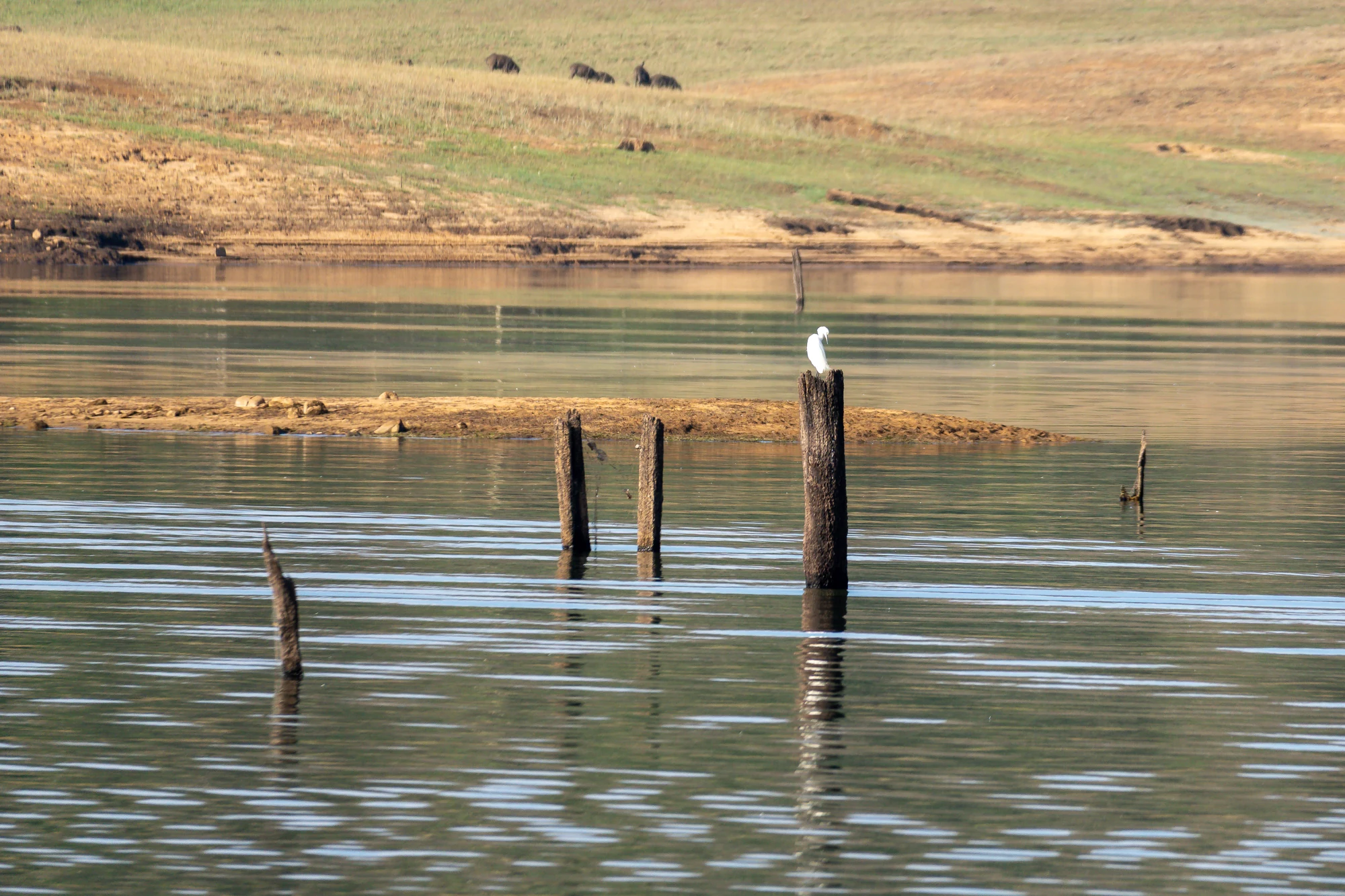
A white bird on a dark trunk can be the clearest wildlife sighting in a wide Periyar view. Behind it, the shore may hold movement too small to identify immediately. Looking through the scene in layers gives a lake outing more interest than watching only for the largest animal.
Start with the perches
Standing trunks break the reservoir surface into a series of small observation points. A bird resting on one has a clear outline against the water, often easier to see than a bird among leaves. The official boating account identifies darters, egrets and kingfishers among the birds associated with the lake.
Use shape and behaviour before committing to a name. A long neck, a pointed bill or the way a bird holds its wings can give a better clue than colour seen at a distance. Ask the guide or crew when identification is uncertain. A useful observation remains worthwhile even when it ends with a description rather than a species label.
Then read the water’s edge
The shore changes from open grass to denser forest. In the photograph accompanying this story, small wild pigs are visible beyond the perched egret, spread across the grassy margin. They occupy a different layer of the same view. The foreground bird makes a strong subject, while the farther movement rewards a second look.
This is the character of a lake outing: much of the scene is distant and sightings vary. Gaur, sambar and elephants are associated with Periyar, but no particular animal is guaranteed to stand at the waterline during a trip. Treat the boat as a way to observe habitat and chance encounters together.
The canopy offers another kind of movement
A guided forest walk brings attention upward as well as down to the path. Leaves and branches can hide animals until they move, and a call may be noticed before its source. A trained guide can connect those cues with the forest around the group.
Nilgiri langurs appear in identified photographs from the Thekkady forest, with dark bodies and paler hair around the head among high branches. Their position illustrates how different this view is from a grass-shore sighting. Looking only at eye level would miss much of the activity in a forest scene.
Keep observation separate from pursuit. On the boat, remain seated within the crew’s directions. On a walk, stay with the authorised group. A better angle is not a reason to move towards an animal, leave the path or block its route away. The programme’s pace and distance are part of watching responsibly.
A rewarding Thekkady wildlife day can be built from modest encounters: one clear perch, a movement along the grass, a call explained by a guide. Record those details rather than measuring the visit against a promotional photograph. The lake and forest offer different windows into the reserve, and patient attention makes both richer.
Programme context: Periyar’s official boating description and Nature Walk. Choose the activity for its way of observing, with wildlife sightings left open.
Plan the visit: Thekkady / Periyar.