Most visitors walk the Thenmala sculpture garden in about fifteen minutes and remember it as pleasant. It is worth slowing down for, because it is not decoration. It is an argument, and the park it stands in is on the other side of it.
The theme is stated, in capitals
The operator does not leave the intention to inference. The theme of the garden, it says in its own capital letters, is MAN AND NATURE: it endeavours to depict the relationship of MAN and his culture with NATURE, in the serene backdrop of a green forest.
How many works there are is oddly hard to settle. TEPS’s own FAQ says twenty-four sculptures; the most detailed local account says twenty-three. We have not been able to resolve it, and neither number is easy to check on the ground, where several pieces are half-swallowed by undergrowth and one has a living tree growing through it. Call it twenty-three or twenty-four and know why you cannot be certain.
The individual titles survive on the interpretive plaques, and they are not shy: Beauty of the Soul; Swimming in Space; Searching for Peace; Liberation is a Perpetual Process; People may Meet in Candle Light But to Unite, the Soul needs Inner Light; Can you Locate What the Child Points to?; The Cosmic Energy is One, But Men may See it in Many Forms; Jungle Bath; Nature — the Great Puppeteer. Teal TEPS plaque-stands are still visible beside the works in photographs from 2021, so the interpretation is standing.
The archer is not Parashurama
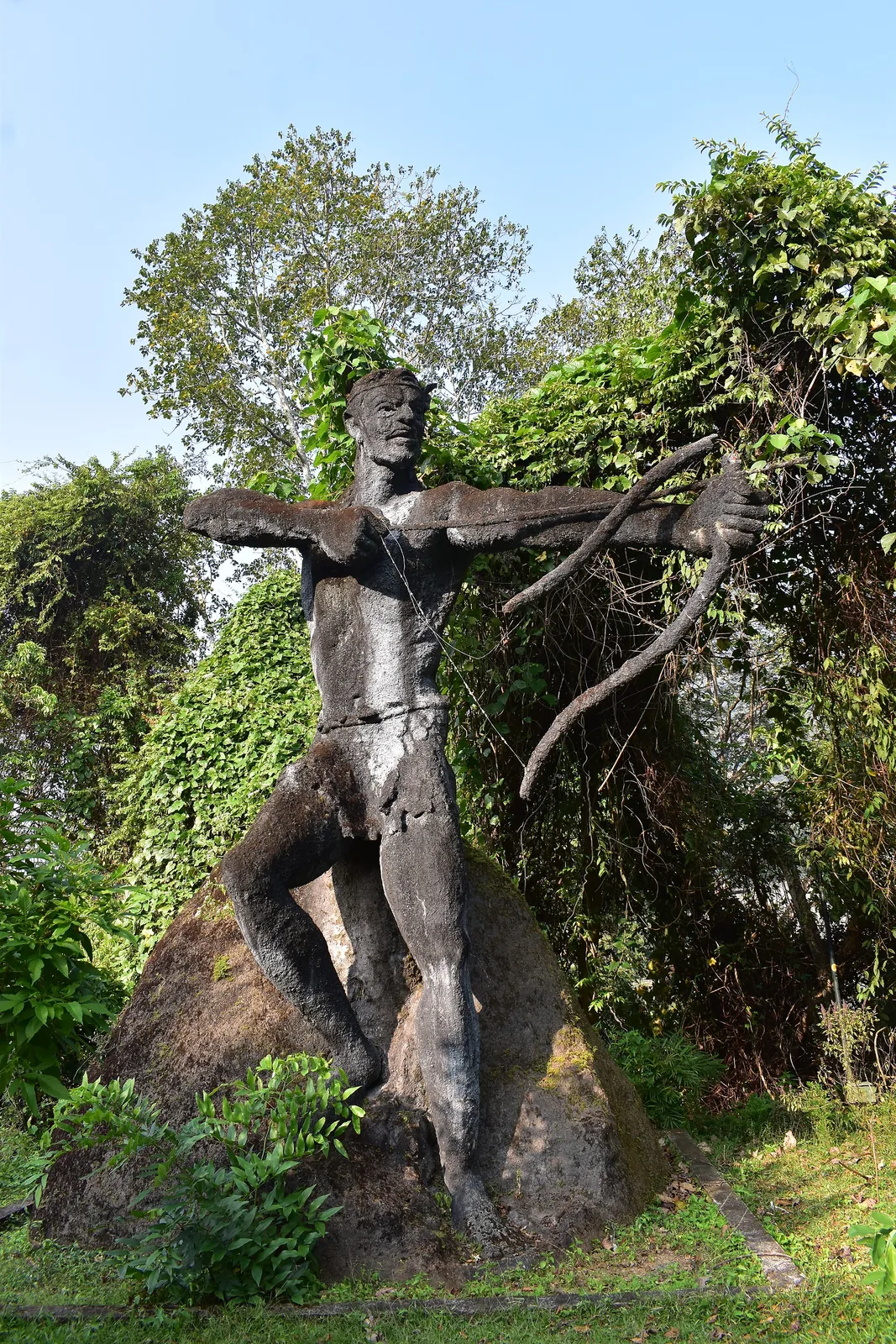
The largest piece is a lean, near-naked figure at full draw, standing astride a rock, with a thin wire doing the work of the bowstring. On Wikimedia Commons it is filed under a filename calling it Parashurama, and that name has propagated into captions elsewhere.
It is almost certainly wrong, and the file itself gives the game away: the uploader’s own description field says only "Statue at Thenmala Leisure Zone". Parashurama appears nowhere except the filename.
Parashurama’s attribute is the axe. It is in his name. In Kerala his entire story is an axe-throw — the one that raises the land out of the sea. He is not depicted with a drawn bow in Kerala iconography, and a life-size archer is not him.
What the local record says is that the garden’s biggest work is Ekalavya aiming at a dog, alongside a large Vikramaditya and Vetala group. And a second sculpture in the same garden is a flat-cut silhouette of a standing figure with three dogs. Put the archer and the dogs together and you have the two halves of one of the sharpest episodes in the Mahabharata: Ekalavya, the forest-dweller whom no teacher would take, silencing a barking dog with seven arrows without wounding it.
Why that choice is not neutral
In the story, Ekalavya learns archery by making a clay likeness of the teacher who refused him, practising before it, and surpassing the pupils who were admitted. When the teacher discovers this, he asks for the traditional fee, and asks for the boy’s right thumb.
So a park built to keep the public out of a protected forest has, as its largest sculpture, a forest-dweller who acquired an elite skill without permission and was made to pay for it with the thumb he drew with. The garden’s stated theme is man and his culture with nature. It is worth standing in front of the figure for a moment and asking who, in this arrangement, is being kept outside the fence.
We are not claiming the designers intended a critique of their own project. We are saying the sculpture is doing something more interesting than filling a lawn, and that reading it is free.
The other exhibit is the water, and it is not always there
Walk out of the garden and the view is the reservoir. Every photograph, every walkway, every viewpoint here is composed around that water.
On 26 April 2026 the Parappar reservoir stood at 98.46 metres against a full reservoir level of 115.82 metres — about thirty-four per cent — having dropped nearly two metres in a fortnight. Below 95 metres both the hydro generation and the Kallada Irrigation Project’s supply are disrupted. Water was being drawn at 12.47 cumecs for power with only one of the two generators running, the other under maintenance. The tourist boat and coracle rides at Pallamvetty kept going. The public washrooms on site were closed for want of water.
That is worth saying without drama, because the reason matters. The level of this lake is not a weather report. It is an irrigation decision taken for farmland up to eighty kilometres downstream, and the electricity is a by-product of that decision. What a visitor in April sees is a drawdown shoreline of bare red mud where the postcard had water.
In a park whose founding definition of ecotourism requires that education and interpretation be a major component, the most educational thing on site some years is the mud. It shows you, at scale and for free, what a working reservoir actually is.
One practical thing before you buy a boat ticket
There are two different boat trips here and they are not the same purchase. TEPS’s tariff line reads "Boating plus Sanctuary Entrance Fee" at ₹300 — that is boating inside Shenduruney. The coracle and pedal boating that a day visitor is likelier to end up doing, and that keeps running when the water is low, is at Pallamvetty below the dam. Ask at the counter which one your ticket is for; the words on the board do not make it obvious.
Frequently asked questions
How many sculptures are in the garden?
Twenty-three or twenty-four — the operator’s own FAQ says twenty-four, the most detailed local account says twenty-three, and the pieces are scattered enough that neither is easy to check on the ground.
Is the big archer statue Parashurama?
Almost certainly not, despite the filename it carries on Wikimedia Commons. Parashurama’s attribute is the axe — in Kerala his whole story is an axe-throw — and he is not shown with a drawn bow. The local record identifies the garden’s largest work as Ekalavya aiming at a dog, and a second sculpture in the same garden shows a figure with three dogs.
What is the garden’s theme?
The operator states it in capitals: MAN AND NATURE — the relationship of man and his culture with nature, set against the forest. Individual works carry their own titles on interpretive plaques, among them "Liberation is a Perpetual Process" and "Nature — the Great Puppeteer".
Which zone is the sculpture garden in?
TEPS puts it in the Leisure Zone, with the boardwalk and the suspension bridge. Kerala Tourism’s destination page puts it in the Culture Zone. Two Government of Kerala sources, two different maps of the same park — ask for it by name at the counter.
Why is the reservoir sometimes almost empty?
Because its level is an irrigation decision, not a weather story. On 26 April 2026 it was at 98.46 m against a full level of 115.82 m, about 34%, with generation and irrigation supply both at risk below 95 m and the site’s washrooms closed for want of water. Boating continued.
Is the boating included in the entry ticket?
No, and there are two different boat trips. The ₹300 tariff line is "boating plus sanctuary entrance fee", which is inside Shenduruney. The coracle and pedal boating below the dam at Pallamvetty is a separate thing. Ask which one you are buying.
