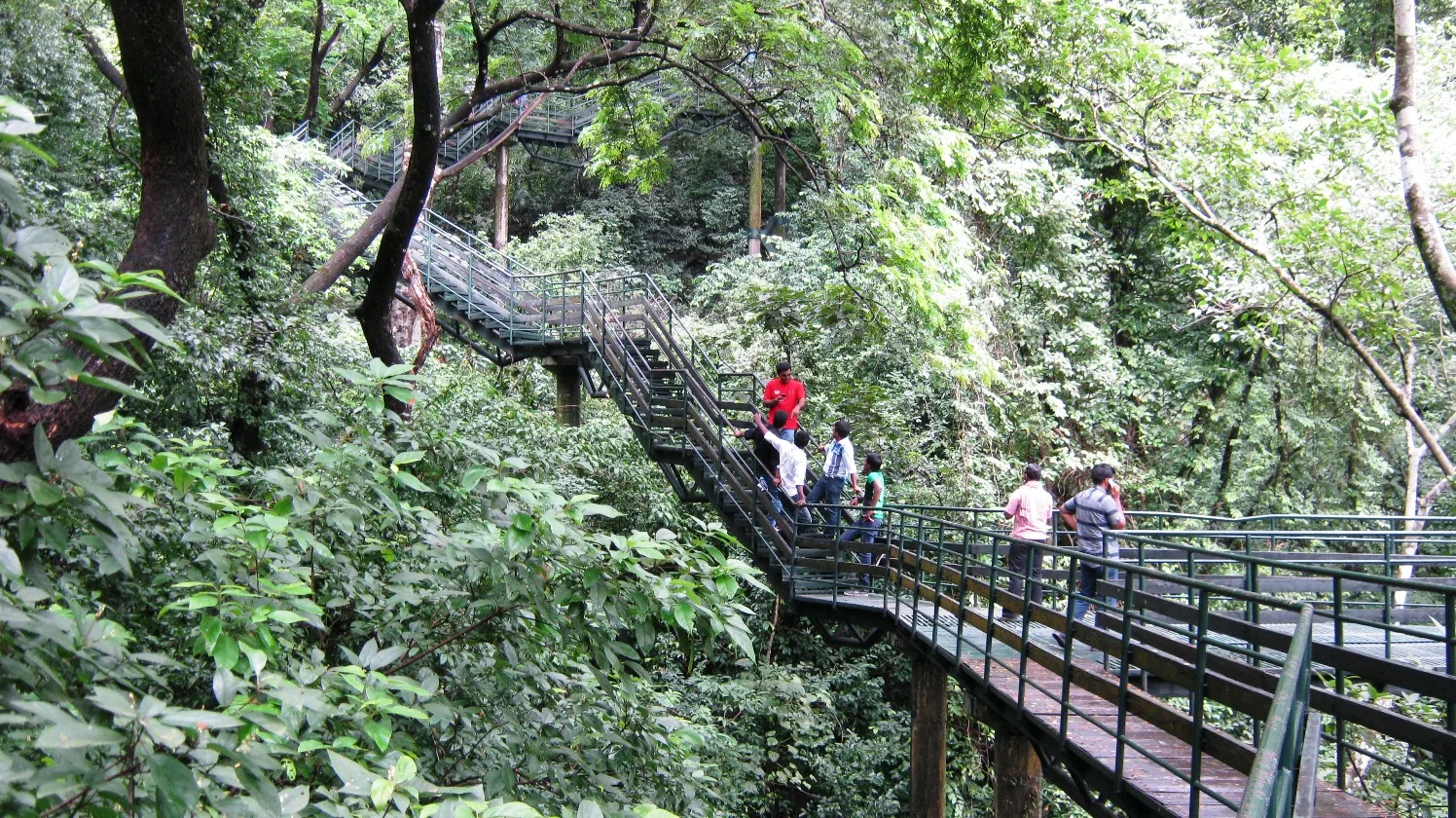
A common reaction to Thenmala, written into a lot of reviews, is mild disappointment. You come for India’s first planned ecotourism destination and you find a well-made municipal-feeling park: a canopy walkway, a sculpture garden, a deer enclosure, a musical fountain, a ticket counter with nine separate prices on it. Where, people ask, is the ecotourism?

It is behind you, and you are being kept out of it on purpose.

The operator’s own words

The Thenmala Ecotourism Promotion Society publishes its founding logic on its own website, and it is remarkably candid for a government page. When the idea was mooted seriously in 1996, it says, it was decided to develop the site as an ecotourism destination by keeping the degraded forest area, in the outskirts of the sanctuary, as a familiarization zone. The studies that followed, it goes on, helped to evolve a strategy to control the mass tourism within the outer limits of the sanctuary.

Then the sentence that explains the whole place: eco-friendly general tourism is planned in the periphery of the sanctuary so that pressure of tourism will not affect the sanctuary; the real ecotourism is to take place in the sanctuary, and only ecotourists are encouraged for that. Others can experience the eco-friendly products such as small nature trails, elevated walkway through canopies, mountain biking — which, it says, will give them a feeling of what awaits as ecotourism in the sanctuary area, for which they have to wait since it is supply driven.

You have to wait. The park is a waiting room with a very good view.

Two products, and you are almost certainly buying the second

This is not a rhetorical distinction; it is a formal one, with a menu attached. TEPS states that Thenmala offers two kinds of product: ecotourism, and eco-friendly general tourism. It then assigns to the second category the Leisure Zone, the Adventure Zone, the butterfly safari, the children’s park, the deer rehabilitation centre, the reservoir boating and the musical dancing fountain.

Read the tariff board against that list and the result is startling. Almost nothing a day visitor pays for at Thenmala is ecotourism by the operator’s own definition. The genuine article — trekking inside Shenduruney, with a permit and a guide — is priced separately, capped by design, and rationed.

TEPS is equally firm about what the word means. Its definition requires an activity to be nature based, ecologically sustainable, to have education and interpretation as a major component, and to benefit local people — and then adds an enforcement clause you will not find in most tourism prose: if it does not satisfy any one of these components then it cannot be called a real ecotourism venture. That is a standard written to exclude things, including some of its own.

The audit that shortened the menu

The part of this that impresses us most is easy to miss. TEPS commissioned an environmental impact assessment of the destination and its satellite spots from the Kerala Forest Research Institute — and then, on KFRI’s recommendations, amended the activities to minimise the project’s negative impacts.

A tourism project that made its own offering smaller because a research institute told it to is rare enough to be worth stating plainly. Most impact assessments in this sector are procurement paperwork. This one changed the product.

The trails themselves are not run by the society at all. Trekking and bird-watching are operationalised through the local forest committees — eco-development and participatory forest management committees, known locally as Vana Samrakshana Samithi — so that the benefit lands in the villages on the boundary. The named routes at the time of writing were the Dharbakulam trail, the Kallar trail, and the Kattilppara–Choodal bird-watching trail.

Three departments, one dais

The other half of the story is administrative, and it is visible on the ground if you know to look. At Thenmala the land is Forest Department, the water is Irrigation Department, and the visitor is Tourism Department. Three separate arms of the Kerala government own three overlapping interests in the same few square kilometres.

TEPS exists as a registered society specifically to sit across all three — its own account is that it adopted a strategy to co-ordinate with the Forest, Irrigation and Tourism Departments and implement activities in association with each. You can see the seam in the 2001 inauguration: the Chief Minister, E. K. Nayanar, plus the Ministers for Tourism, for Forests and for Irrigation, all on one dais. And you can still see it in the buildings — the Assistant Wildlife Warden’s Shendurney office, the Divisional Forest Office and the TEPS ecotourism office stand as three separate establishments within about 900 metres of each other.

The failure mode is that it worked

Here is the ending, and it is not the triumphant one.

The buffer worked so well that it became the destination. Nobody talks about Shenduruney; everybody talks about Thenmala. The place built to absorb attention has absorbed it completely, to the point where the Kollam district administration’s own website now describes Thenmala — the decoy — as a UNESCO World Heritage Site, which it is not and never has been. The World Heritage designation belongs to the Western Ghats, and one of its thirty-nine component sites is the sanctuary next door: the forest the park was built to shield.

And the model is expanding. TEPS is now the nodal agency for ecotourism across Thiruvananthapuram, Kollam and Pathanamthitta, and at its annual general meeting in August 2025 it resolved to seek government approval to go statewide, amending its memorandum and renewing its registration to do so.

A society constituted to keep one forest quiet is proposing to run the method across Kerala. Whether that is the best possible news or a warning depends entirely on whether the next thirty parks remember what this one was for.

What to do with this on the day

Nothing, except enjoy it more accurately. Walk the canopy walkway knowing it is a substitute and a deliberate one. Read the interpretive plaques — education and interpretation is a clause in the operator’s own definition, and the plaques are it. And if you want the forest itself, book the sanctuary programme in advance and accept the rationing, because the rationing is the policy working rather than the policy failing.

Frequently asked questions

Why does Thenmala feel more like a park than a forest?

Because it is one, on purpose. TEPS built the destination on degraded forest outside Shenduruney Wildlife Sanctuary as a "familiarization zone", explicitly to control mass tourism within the outer limits of the sanctuary. The walkway and the fountain are what you get instead of the forest.

So is Thenmala actually ecotourism?

By its own operator’s taxonomy, mostly not. TEPS distinguishes ecotourism from "eco-friendly general tourism" and puts the Leisure Zone, Adventure Zone, butterfly safari, children’s park, deer centre, boating and the musical fountain in the second category. The ecotourism proper is the permit-and-guide programme inside the sanctuary.

Who actually runs the trails?

Local forest committees — Vana Samrakshana Samithi — rather than the society directly, so that the trekking and bird-watching income lands with the villages on the sanctuary boundary. The named routes include the Dharbakulam and Kallar trails and the Kattilppara–Choodal bird-watching trail.

Was there an environmental assessment?

Yes, by the Kerala Forest Research Institute, covering the destination and its satellite spots — and TEPS states that it amended the planned activities on KFRI’s recommendations in order to reduce the project’s negative impacts.

Why are there so many government offices here?

Because three departments have overlapping claims on the same ground: the land is Forest, the water is Irrigation, the visitor is Tourism. TEPS is a registered society constituted to work across all three, and the 2001 inauguration had the Chief Minister and all three ministers on the dais.