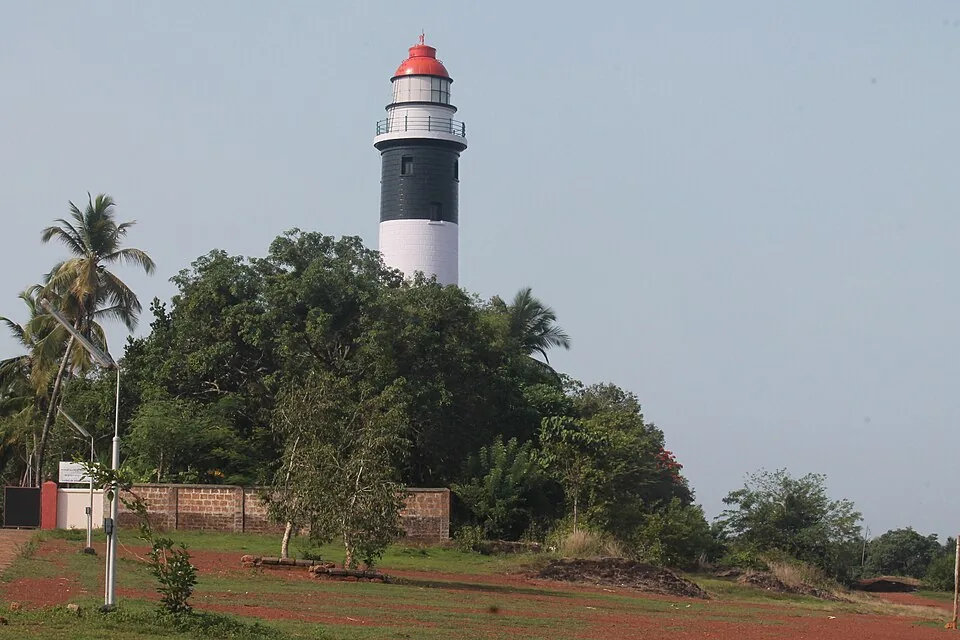
Stand at the gate of the Thikkoti lighthouse on a clear afternoon and look west-north-west, past the palms, past the surf line, out to where the horizon goes soft. If the air is good you will see a pale low shape sitting on the water about eight kilometres out. That is Velliyamkallu — Sacrifice Rock on the charts — and it is the reason this lighthouse exists. It is also where this lighthouse was supposed to be built.
A coast with no light at all
The story starts with an absence. Before 1909 there was no light anywhere on this stretch of the Malabar coast, and the Directorate’s own station note is blunt about it: no lighthouse in any earlier period, not even a flagstaff or a mast. Ships simply kept well out. That was tolerable while the coastal trade was modest and local pilots knew where the rock lay. It stopped being tolerable after 1792, when Malabar came under British administration and the ports of Calicut and Cannanore began to grow. Steamer traffic to Bombay ran north out of Calicut along a line that carried it close to a submerged reef nobody could see, and ships began to come to grief.
In 1895 the Presidency Port Officer at Madras, Commander W. J. Powell, decided to take up the long-deferred Cotta Point light, and asked an engineer named F. W. Ashpitel — a Public Works man on deputation to the Marine Department as Superintendent of Works, Lighthouse Division — to inspect and report. Ashpitel went, looked, and came back with an answer nobody had asked for. The light, he wrote, should not be on the coast at all. It should be on the rock.
The engineer who wanted a rock lighthouse
His 1896 report is worth quoting for its confidence. South of Mulki, he said, the next danger to navigation is Sacrifice Rock: forty feet high, deep water all around, four and a half miles from Cotta Point, and lying on the direct track of the Bombay steamers. An eighteen-mile flashing light on the rock itself would both guard the danger and serve as a landfall light for Tellicherry and Calicut, whose existing lights could then be demoted to port lights. It was a good argument on its merits. It was also, quite transparently, an argument about reputation — Ashpitel cited the Bishop Rock lighthouse in the Isles of Scilly as proof that a tower could hold against an ocean, and behind that citation stands the whole nineteenth-century cult of the rock lighthouse, Robert Stevenson and the Bell Rock among them. Ashpitel wanted his rock.
Powell said no, and his reasons were entirely practical. No communication with the rock for at least four months of the year. Great expense in construction. Keepers who would have to be provisioned from shore. Inspection costs that would mean hiring a steamer or maintaining a boat on the mainland. The danger, he wrote, could be guarded effectively by a light on the coast. Ashpitel resubmitted without changing a word, insisting that only a light on the rock gave mariners complete security. Government backed Powell. In 1896 the order was made: build on Cotta Point.
And then the file vanished
It was either lost or simply never shown to Powell’s successors, and the 1896 decision quietly stopped existing as far as the department was concerned. Five years later Ashpitel came back with a detailed estimate — Rs 94,400 — for a lighthouse on Sacrifice Rock, submitted on 30 August 1901. Commander H. A. Street, who had replaced Powell and had no idea a contrary order existed, countersigned it five days later and sent it up. Government sat on it. Street’s successor, Commander T. G. R. Finny, wrote again in July 1902 pressing the case. In 1904 the Coast Light Dues Bill passed, a proposal was floated to borrow from provincial funds at four per cent and repay from light dues, and that was refused on technical grounds. Finally, on 14 November 1906, the sanction for the Sacrifice Rock lighthouse was signed.
What Ashpitel had designed by then was extraordinary. The tower followed the Scottish rock-lighthouse pattern, with an inbuilt masonry cistern in the basement holding 2,500 gallons of fresh water and three iron tanks of 1,100 gallons each on the ground floor. The first floor was an oil store. The spiral stair was to be granite slabs embedded in the wall. The keepers would live inside the tower: bedrooms with folding cots, cabinets, armchairs, shelves and hat pegs; a kitchen; a bathroom with a tub and a towel rack. A boat basin costing Rs 10,000 was planned on the east side of the rock where the water was expected to stay smooth. Fresh water would come three ways — collected from the galleries, ferried out in summer, or condensed from seawater in shallow glazed reservoirs — and sea water for washing would be pumped up by a wave-powered system installed on a neighbouring rock. The kitchen inventory ran to a curry stone, a rice pounder, a meat safe, a nutmeg grater, a cork screw and three dozen towels.
Work actually began out at sea
Captain Smith, a Public Works executive engineer with previous lighthouse experience, took charge on 1 February 1907, his retirement deferred so he could see it through. He wasted no time. He picked his workforce from local men, chosen for natural skill and the physical stamina to work long hours in bad conditions, and he sent them out to Velliyamkallu in country craft borrowed from the fishermen to begin dressing and levelling the rock for the tower’s foundation. Ashore, he started casting the concrete blocks. Work on the Sacrifice Rock lighthouse had genuinely begun.
It fell apart over a boat
When the blocks were ready and needed moving, Smith realised that Ashpitel’s estimate — the estimate that specified how many tea spoons the keepers would have — contained no provision whatever for a steam launch to carry construction material and workers out to the rock, or to service the station afterwards. Smith reported it. The revised figure added Rs 54,000 for the launch and Rs 16,000 for its maintenance and crew, and the Chief Engineer, seeing the total climb from about Rs 94,000 towards Rs 171,400, wrote that he was in favour of building at Cotta Point after all. The file travelled. Somewhere along it, the Chief Secretary found the 1896 decision, noted that it appeared to have been overlooked, and submitted that Government should adhere to it. The Governor agreed, observing that there would be serious trouble feeding light-keepers through the south-west monsoon if the light stood on the rock. The final order is dated 21 May 1907.
So the tower came ashore. Twenty-seven acres were bought at Oottu Kunnu in Kadalur, a further two for an approach road, and the design changed with the site: wire-cut bricks from the Basel Mission tile works at Mangalore instead of interlocking concrete blocks, and three separate family quarters for the keepers instead of bedrooms in the shaft. Construction began at the end of 1907, the tower was finished by September 1908, and after a long argument in London about the burner the light was first exhibited on the evening of 20 October 1909.
The building that is not there
None of this is on the signage. What you climb at Kadalur Point is a perfectly good landfall light that has done its job for well over a century — by the Directorate’s own reckoning, no ship has been wrecked on Sacrifice Rock since it was lit. But it is also the shadow of a different building: a tower with a boat basin and a wave-driven pump and a nutmeg grater, out on a hectare of guano-whitened rock in the Arabian Sea, that a stubborn engineer nearly got built, and that was killed by a line item he forgot to write down. The rest of the district is on the Kozhikode hub.
Frequently asked questions
Was the Thikkoti lighthouse really going to be built offshore?
Yes, and construction had started. The engineer F. W. Ashpitel argued from 1896 that the light belonged on Sacrifice Rock itself; the scheme was sanctioned in 1906, and from February 1907 Captain Smith had local men out on the rock levelling it for a foundation. The site was moved ashore by order of 21 May 1907.
Why was the offshore scheme abandoned?
Cost, triggered by an omission. Ashpitel’s otherwise exhaustive estimate had no provision for a steam launch to carry material and keepers to the rock. Adding it pushed the total from about Rs 94,000 towards Rs 171,400, at which point the Chief Secretary rediscovered a 1896 Government order — which had been overlooked for a decade — directing that the light be built on the mainland.
When was the lighthouse actually commissioned?
The light was first exhibited on the evening of 20 October 1909. Construction of the tower began at the end of 1907 and the structure was complete by September 1908; the delay was caused by an argument over which illuminant to order from England. Sources giving 1907 are describing when building started, not when the light was lit.